Newsletter Subscribe
Subscribe for news, offers and a welcome 5% discount on us.
In many workplaces, waste sorting succeeds or fails in the everyday details: whether the right bin is nearby, whether the label is clear, and whether the waste is kept separate when it is collected. That makes recycling a practical part of cleaning and housekeeping work, not simply a decision made when a waste contractor arrives.
England’s Simpler Recycling rules set out how many workplaces must separate waste before collection. The system needs suitable containers, clear instructions and an agreed routine. Cleaning teams are often closest to the bins and waste store, so their observations can help a site identify problems early. But they should not be expected to guess what goes where or correct a poorly designed system without the right information and equipment.
The workplace requirements came into force on 31 March 2025. They apply to businesses, charities and public sector organisations in England, including offices, hotels, restaurants, retail sites, schools and healthcare premises. In general, workplaces with 10 or more full time equivalent employees must separate recyclable materials and food waste from residual, or non recyclable, waste.
The core materials are food waste, paper and card, other dry recyclables such as plastic, metal and glass, and residual waste. Paper and card should be separated from other dry recyclables unless the waste collector has established that co collection is permitted under the rules. The site should confirm its arrangement with its collector rather than assume that every mixed recycling bin is suitable.
Micro businesses with fewer than 10 full time equivalent employees have until 31 March 2027 to comply. The employee count relates to the whole business, not just one site. The GOV.UK workplace recycling guidance explains the requirements, including which materials belong in each stream and how the micro business extension works.
These requirements make sorting a shared site responsibility. The business or organisation must arrange an appropriate waste service. A cleaning contractor may have responsibilities under its agreement, while the cleaning team follows the site procedure, separates waste as instructed and reports issues. Clear ownership matters: cleaners should not have to decide whether a collector will accept a particular material.
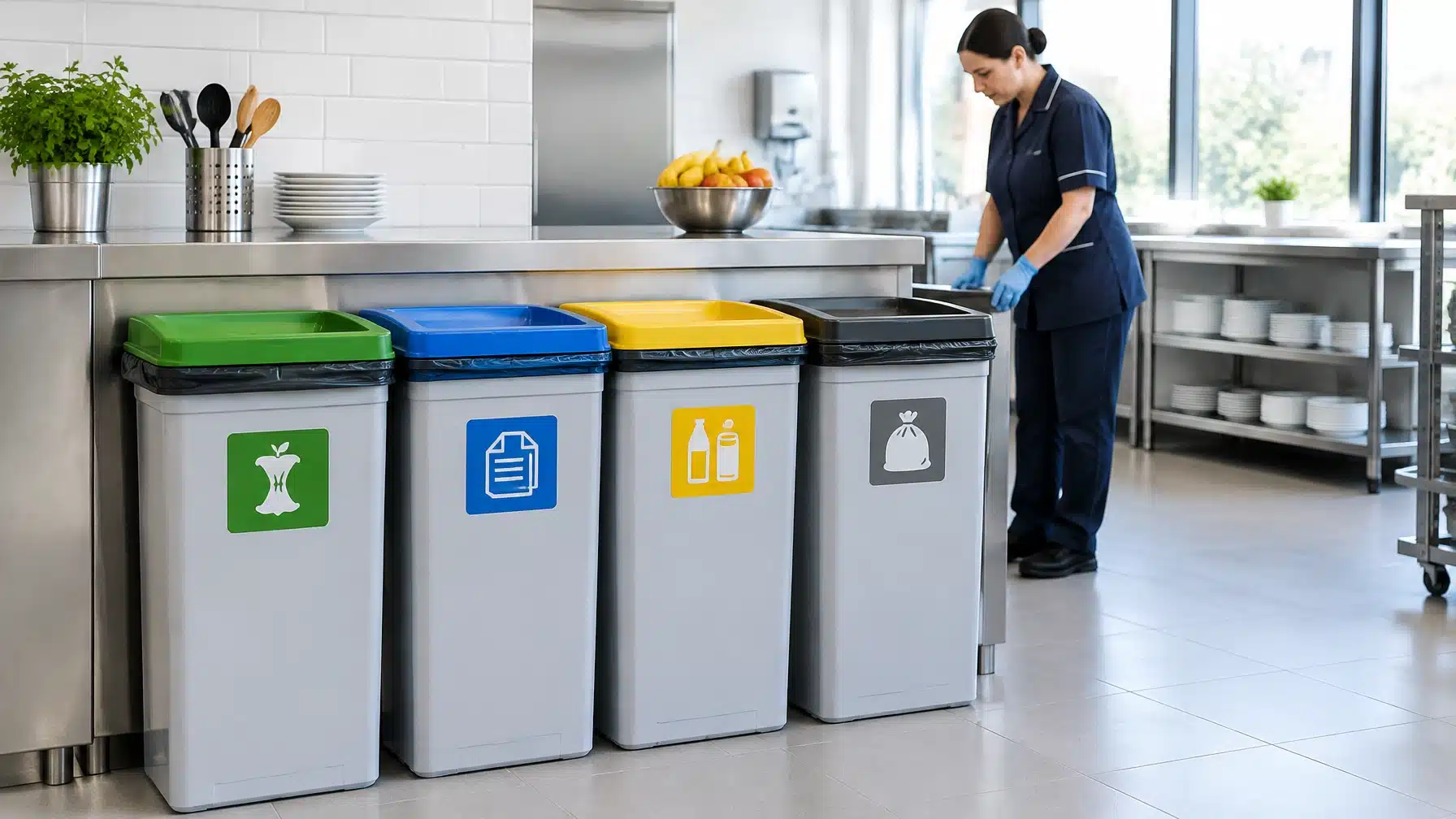
A recycling system should make the correct choice straightforward at the point where an item is thrown away. Start by checking where waste is generated. This might include staff kitchens, food preparation areas, meeting rooms, reception desks, customer spaces and offices. The right combination of containers will vary by location. A food waste bin is useful where people prepare or eat food, while a separate paper and card container may be most practical near desks or delivery unpacking areas.
Place the relevant bins together where possible. If a recycling bin is provided, residual waste should also be available nearby. Otherwise, people may put unsuitable items into recycling simply because there is nowhere convenient for them to go. Match container size and collection frequency to the amount of waste produced, and make sure bins are accessible without obstructing routes or creating manual handling difficulties.
The cleaning team can help assess whether the arrangement works in practice. A bin that is consistently full before collection, awkward to move or rarely used may need relocating, resizing or clearer labelling. These observations are more useful than asking staff to sort waste after it has already been mixed.

People should not need to interpret technical language while disposing of waste. Use plain labels with examples of what belongs in each bin. Simple pictures can help staff, visitors and customers make the right choice quickly. If colour coding is used, keep it consistent across the building and make sure the written label is still clear for anyone who may not distinguish colours easily.
The instructions should match the waste collector’s requirements. Some materials that look recyclable may not be accepted in the site’s collection. For example, compostable or biodegradable packaging should generally be treated as non recyclable waste unless the collector confirms that it is accepted through a separate service. A label that promises more than the contractor can deliver can lead to confusion and contamination.
Put signs where they can be read before someone disposes of an item, not only on a wall behind the bins. If a particular location has a recurring problem, review the placement and wording before simply asking cleaners to remove unwanted items from the container.
Contamination occurs when the wrong material is put in a recycling bin, or when recyclables are too dirty to be accepted. Food or liquid left in packaging can affect the quality of a recycling load. A single mistaken item does not necessarily make every collection unusable, but significant contamination may mean the collector cannot process the load as intended.
The consequences can include a rejected collection or additional charges under the waste service contract. The GOV.UK guidance advises workplaces to address recurring issues by monitoring behaviour and reviewing signs, bin locations or the number of containers. Where significant contamination is found before collection, the guidance says it may need to be handled as general waste. The appropriate response should be agreed with the collector and site manager.
Cleaning staff are well placed to notice patterns because they see what is actually being discarded and what is left behind. A practical routine is to check the state of bins during normal duties, note repeated problem items and report where and when the problem occurs. Do not assume the cleaner should hand sort mixed or unsafe waste. The site must provide a clear procedure, suitable equipment and any necessary risk controls.

Workplaces must collect food waste even if they produce only a small amount or do not have a canteen. This can include leftovers, food preparation scraps, tea bags and coffee grounds. Staff should not be asked to take workplace food waste home.
Provide a dedicated lidded food waste bin wherever food waste is likely to arise. A small caddy can be useful in a food preparation area, with a larger container at the collection point. Liners are optional. Where they are used, confirm with the collector which liners are accepted. Government guidance states that caddy liners, including compostable liners, can be collected with food waste, but compostable packaging itself should not be put in the food waste stream unless the collector has confirmed a suitable arrangement.
Good storage helps control smells and pests. Keep food waste containers closed, clean them as part of the site’s routine, and store them securely while awaiting collection. Defra guidance recommends weekly or fortnightly workplace food waste collections and advises against storing food waste for more than two weeks. The right frequency depends on the amount produced and the site’s collection arrangements.
The WRAP guidance on workplace recycling containers and storage offers practical advice on lidded containers, storage, access for collection and managing pests and odours. A clean, secure waste store makes the task easier for both cleaning staff and collection teams.
Paper and card can include office paper, envelopes, cardboard boxes and suitable cardboard food packaging. They should not automatically be put in the same bin as plastic, glass and metal. The waste collector may collect them separately or, where the rules allow and the required assessment has been made, collect them together with other dry recyclables.
This distinction is worth confirming in writing with the contractor and reflecting on site labels. A vague instruction such as “mixed recycling” can cause uncertainty if the site’s actual service treats paper and card separately. Staff should also know that items such as tissues, toilet paper and wet wipes are not part of the paper and card recycling stream.
For cleaners, the key is to follow the agreed local arrangement. If bins or contractor instructions do not match, report the inconsistency to the site contact rather than choosing a stream based on appearance.
A short induction can explain which bins are available, what each accepts, where waste goes after internal collection, and who to contact when a bin is contaminated or full. Include cleaning staff, supervisors, agency staff and any employees who regularly use the waste area. Refresher information is useful when signage, collections or contractor arrangements change.
Make the procedure practical. Explain whether containers should be emptied into separate external bins, where those bins are stored, and how to report damaged or missing labels. Include safe handling expectations, especially for heavy or awkward containers. If an item is sharp, leaking, hazardous or otherwise unsuitable for ordinary waste handling, staff should use the site’s relevant safety procedure rather than improvise.
The cleaning team’s role is important, but it depends on the site doing its part. Bins, labels, training, collection arrangements and a named point of contact must all be in place. Recycling works best when the system is designed around the routine, rather than added to cleaning duties without support.

Simpler Recycling also affects households in England. From 31 March 2026, local authorities are required by default to provide separate collections of core recyclable waste streams, including weekly food waste collections. Some councils have transitional arrangements that allow a later start for food waste service, so households should check their local council’s guidance. The GOV.UK household recycling guidance explains the collection streams and the transitional arrangements.
The same everyday principle applies at home as at work: make separation clear, use the containers provided and follow the instructions for your local service. People who already buy commercial grade cleaning supplies for demanding household tasks can apply the same care to keeping their waste areas clean and easy to use.
Waste sorting is now a defined part of workplace operations in England. For a cleaning team, it means knowing the site’s arrangements, keeping waste areas presentable, noticing recurring contamination and raising problems promptly. It does not mean guessing what a collector accepts or taking responsibility for gaps in the site’s provision.
For facilities teams and trade buyers, a reliable system starts with suitable bins, clear instructions, a confirmed collection service and training that reaches the people who use and empty the containers. Those practical foundations make recycling easier to maintain. If you are reviewing routine janitorial supplies alongside site operations, KleanPro Supplies provides professional cleaning products for commercial and everyday use. Cleaning supplies shop customers looking for trade cleaning supplies and professional cleaning supplies UK can also review options for their wider cleaning routine.