Newsletter Subscribe
Subscribe for news, offers and a welcome 5% discount on us.
Slips, trips and falls on the same level accounted for 30 per cent of employee non fatal injuries reported by employers under RIDDOR in 2024 to 2025. There were 59,219 employer reported non fatal injuries in total. That makes slips a major workplace safety concern, not a minor inconvenience to be dealt with after someone falls. The figures are from the Health and Safety Executive’s 2025 statistics.
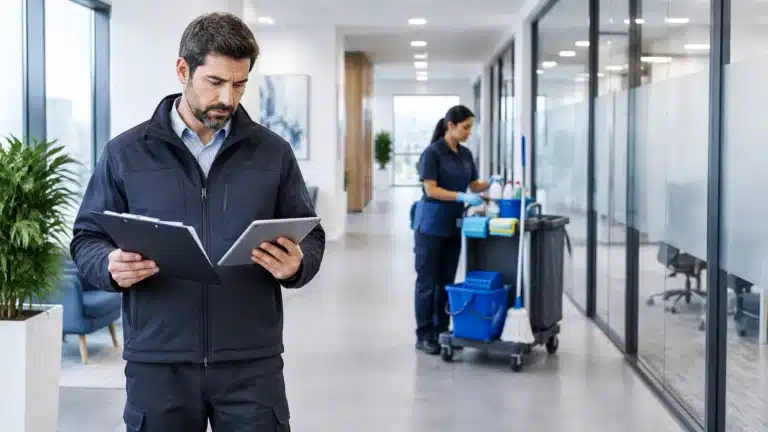
Cleaning work sits directly in the middle of this risk. It removes contamination that could cause a slip, but the process can also leave damp floors, equipment and obstacles in people’s paths. The HSE identifies cleaning activity as a source of slip and trip hazards, including damp floors, trailing leads and buckets. For cleaners, facilities teams, employers and homeowners, the practical aim is to prevent contamination where possible, remove it effectively when it occurs, and avoid introducing a new hazard in the process.
The HSE’s guidance provides a useful control chain: manage the floor and surrounding environment, control contamination, remove obstacles, choose a suitable cleaning method, restrict access while a floor is wet, and use footwear as an additional safeguard when other controls cannot eliminate the risk.
Most slips occur when a floor is contaminated with water, oil, grease, dirt or another substance. Even a small amount can make a smooth surface slippery. The HSE notes that contamination is involved in almost all slip accidents, and it can come from work activities, leaks, spillages, footwear or cleaning itself. Its guidance on contamination recommends identifying where the substance comes from before deciding how to control it.
Routine mopping illustrates the challenge. A well wrung mop can still leave a thin film of water. On a smooth floor, that film may be enough to create a slip risk. A squeegee or dry mop can reduce the amount of water left behind and shorten the drying period, but a damp floor is still a hazard until it is completely dry.
The risk is not limited to wet floors. Vacuum cleaners and floor machines may leave trailing leads across walkways. A bucket or cleaning trolley can narrow a route or obstruct a doorway. A worker carrying equipment may also have less opportunity to notice a spill or a change in floor level.
Timing matters too. Cleaning during busy periods can expose more people to wet floors and equipment. A poorly planned task can also encourage shortcuts, such as rushing the work, leaving equipment unattended or reopening a floor before it is dry. The HSE’s floor cleaning guidance emphasises planning, training and supervision alongside the cleaning method itself.
Slip prevention is not achieved by putting out a sign or issuing footwear alone. A reliable system combines several controls, starting with the floor and the conditions that make it hazardous.
Start by considering the way a space is used. Note where people enter, where liquids or food are handled, where machinery may leak and which routes are busy. Think about who uses the area, including visitors and people who may need more time or clearer routes to move safely.
The floor must be suitable for its purpose and kept in good condition. Damaged surfaces, loose mats, worn finishes and changes in level can add risk, particularly when visibility is poor. Good lighting helps people notice spills and obstacles. At entrances, well maintained matting can reduce water and dirt brought in on footwear. Where leaks or overflows are recurring, address the source rather than relying on repeated mopping.
Cleaners are well placed to spot recurring problems because they see floors across different shifts and operating conditions. Make it straightforward for them to report a leak, damaged tile, poor lighting, awkward route or repeated spill. Supervisors and premises managers can then review whether the environment needs repair or a change in work practice.
When contamination can be prevented from reaching the floor, there is less to clean up and less opportunity for someone to slip. Depending on the setting, controls may include drip trays, guards, lids, better storage, maintained equipment or revised work practices. Entrance matting can help limit contamination brought in from outside.
Where a spill does occur, make a prompt response part of the routine. The HSE encourages a “See it, sort it” approach: deal with a hazard or arrange for it to be dealt with, rather than leaving it for someone else. The right response depends on the substance. A small water spill may be absorbed and removed without wetting a much larger area. Grease or oil may need a suitable detergent and enough time for it to work.
Cleaning a spill in a way that spreads it can make the hazard harder to see and leave a larger slippery area. Consider what the substance is, which floor it is on, and what method will remove it without leaving residue or excess moisture. Follow the product instructions and the floor manufacturer’s advice.
Slips and trips are related risks, and cleaning equipment can contribute to both. Keep buckets, trolleys and supplies out of pedestrian routes. Use the nearest suitable electrical socket to limit the length of a lead. Where possible, battery operated equipment removes the need for trailing cables. If a cable must be used, keep it visible and away from walkways, and put it away promptly when work is complete.
Do not leave waste, bags or equipment unattended. Report damaged flooring and mats, and tell the responsible person about clutter that cannot be moved by the cleaner. This is especially important in shared spaces, where one team may create a hazard that another team encounters later.
A cleaning method should suit both the floor and the contaminant. Mopping may be appropriate for some surfaces and routine cleaning tasks, but it may leave a smooth floor damp. Spot cleaning can be a better choice for a small spill if it removes the substance without spreading it. For greasy contamination, water alone may not remove the grease effectively. The HSE advises using the right product in the right amount and allowing detergent enough time to work.
Equipment condition is part of the method. A scrubber drier may leave unwanted water behind if its recovery equipment is damaged, poorly adjusted or unsuitable for the floor. Regular checks and maintenance help ensure that equipment removes contamination and excess liquid as intended. Training helps staff use it correctly and recognise when the usual method is not working.
The method should also account for what happens immediately after cleaning. If the floor cannot be left dry, the cleaning plan needs to keep people away until it is safe to use. A dry mop or squeegee may reduce drying time, but should not be treated as proof that the floor is safe to reopen.

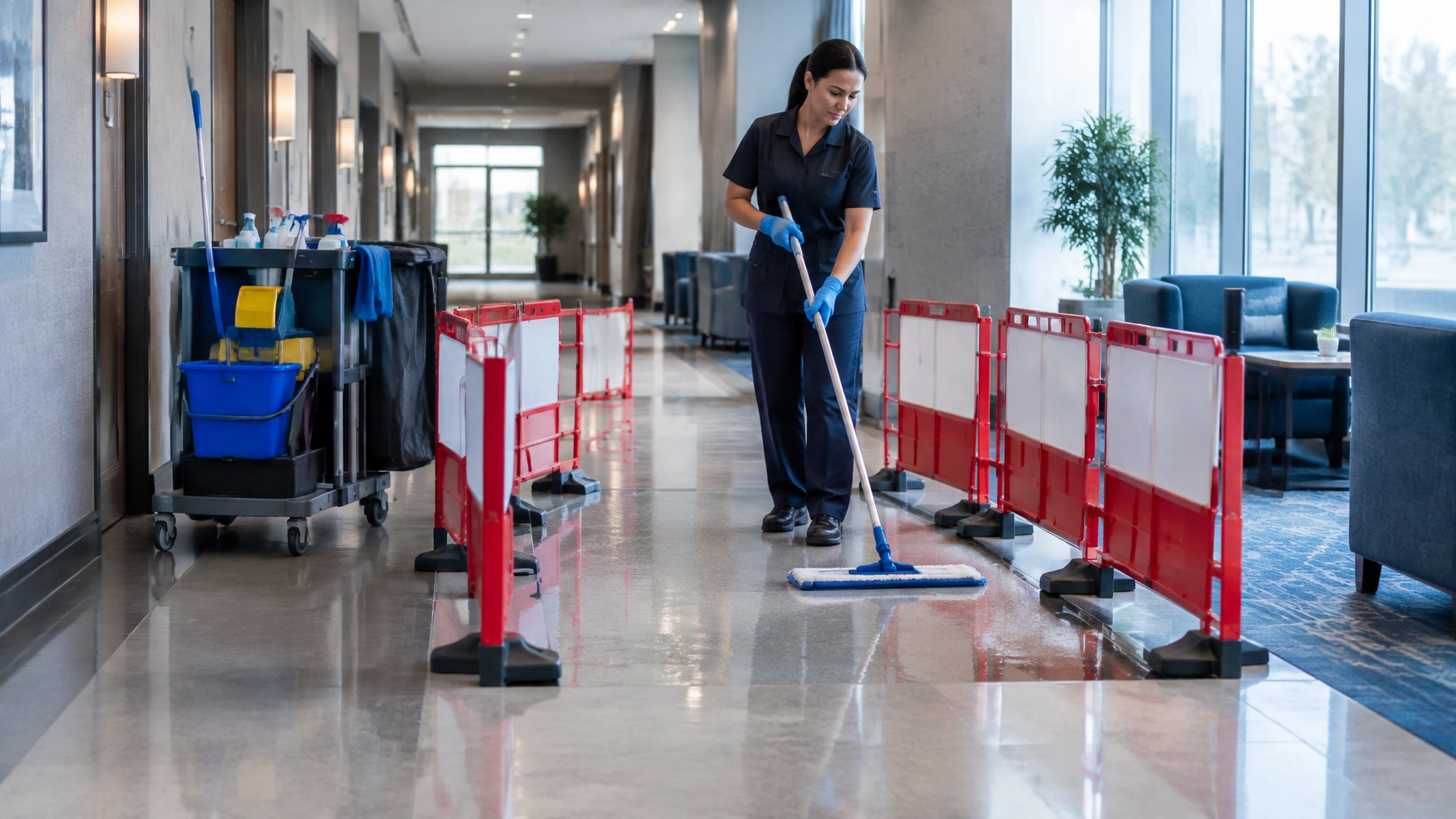
Where cleaning leaves a floor wet, the most dependable control is to prevent people entering the affected area until it is completely dry. The HSE recommends cleaning during quiet periods, locking doors where suitable, using physical barriers, or cleaning in sections so that a dry route remains available. Choose the control that works for the layout and the people using the premises, and provide a clear alternative route when needed.
Signs have a role, but they do not prevent access. A warning sign alerts people to a hazard; it does not stop someone walking onto the wet floor. A sign may also be ineffective if the spill is difficult to see, if the sign does not show the full area affected, or if signs are left out after the floor has dried. When that happens, people may stop noticing them.
Use signs to communicate a hazard, not as a substitute for restricting access. Remove them when the area is clean and dry. The HSE’s cleaning industry guidance describes barriers, locked doors and section cleaning as ways to prevent access, and makes clear that signs and cones only warn.
Floor material and finish influence how a surface behaves when wet or contaminated. If you are choosing flooring or investigating repeated slips, ask the flooring supplier for information about slip resistance under the conditions the floor will actually face. That means discussing the likely contamination, cleaning regime, footwear and how people use the area, rather than relying on a general description of the flooring.
One measure used to assess slip resistance is Pendulum Test Value, or PTV, obtained using a pendulum test. The HSE describes the pendulum as a method for assessing floor slipperiness in different conditions. Under the classifications referenced in HSE guidance, a PTV of 36 or above indicates low slip potential, 25 to 35 indicates moderate potential, and 0 to 24 indicates high potential. The test result should be considered alongside the actual site conditions. A test is not a guarantee that slips cannot occur.
Another measure is Rz, which describes the microscopic roughness of a surface. In simple terms, it measures the height difference between small peaks and valleys in the floor texture. HSE guidance gives the following ranges for water wet areas: below 10 micrometres indicates high slip potential, 10 to 20 indicates moderate potential, and 20 or above indicates low potential. Rz is supplementary information, not a replacement for the pendulum test. The pendulum result takes precedence.
If you are asking a flooring supplier about test results, ask which method was used, whether the testing reflects the likely conditions, and how the floor should be cleaned and maintained. HSE’s surface roughness guidance explains what Rz measures. Its Slips Assessment Tool information also explains that surface assessment requires the appropriate equipment. For a site concern, competent assessment and interpretation are important; a number on its own does not replace a suitable risk assessment.
Slip resistant footwear can help protect cleaners, especially where the risk cannot be eliminated through other controls. It should not be used to justify leaving floors contaminated, choosing an unsuitable cleaning method or allowing people onto wet floors.
Footwear needs to suit the workplace and the substances present. HSE guidance recommends trialling footwear for the actual environment and considering fit and comfort, as well as its performance. Employers must provide footwear free of charge when it is required as personal protective equipment. Staff should be told how to look after it and how to report damage or wear. See the HSE’s brief guide to preventing slips and trips for further information.

A short check at the start of a shift, during work and before reopening an area can help turn the control chain into routine practice.
Look for sources of contamination. Check for spills, leaks, overflow, wet entrances and residue from work activities.
Deal with hazards promptly. Clean a spill or arrange for a trained person to do so. Select a method suited to the substance and floor.
Plan the route and timing. Work during quieter periods where possible. Clean in sections if that allows a clear dry path to remain open.
Keep equipment out of walkways. Position buckets and trolleys safely. Limit or remove trailing leads, and put equipment away when it is not in use.
Use products and equipment as directed. Check dilution instructions where applicable, allow detergent time to work on grease, and make sure cleaning equipment is in effective condition.
Restrict access to wet floors. Use a physical barrier, a locked door or another suitable exclusion method until the floor is completely dry. Provide an alternative route if needed.
Use signs to support, not replace, controls. Place a warning where it can be seen, then remove it when the floor is safe.
Report problems and check results. Record recurring spills, damaged flooring, poor lighting, equipment faults and near misses. Review whether the chosen control has worked.
For homeowners using commercial grade products, the same principles apply on a smaller scale. Keep people away from wet floors, avoid trailing leads across a route, and follow the product and floor care instructions. The size of the premises may differ, but the need to prevent contamination and allow a wet floor to dry does not.

A safe floor is not achieved by one product, one sign or one piece of protective equipment. It depends on understanding where contamination comes from, preventing it where practical, removing it with a suitable method, keeping routes clear and controlling access while a floor dries. Footwear can provide additional protection, but it belongs near the end of the control chain rather than at the beginning.
Regular checks and clear communication help ensure the plan works in real conditions, not just on paper. If you are reviewing cleaning arrangements alongside your supplies, KleanPro’s professional cleaning information provides context on cleaning provision for workplace settings. For slip prevention itself, the HSE resources linked above offer practical guidance for assessing and improving cleaning controls.