Newsletter Subscribe
Subscribe for news, offers and a welcome 5% discount on us.
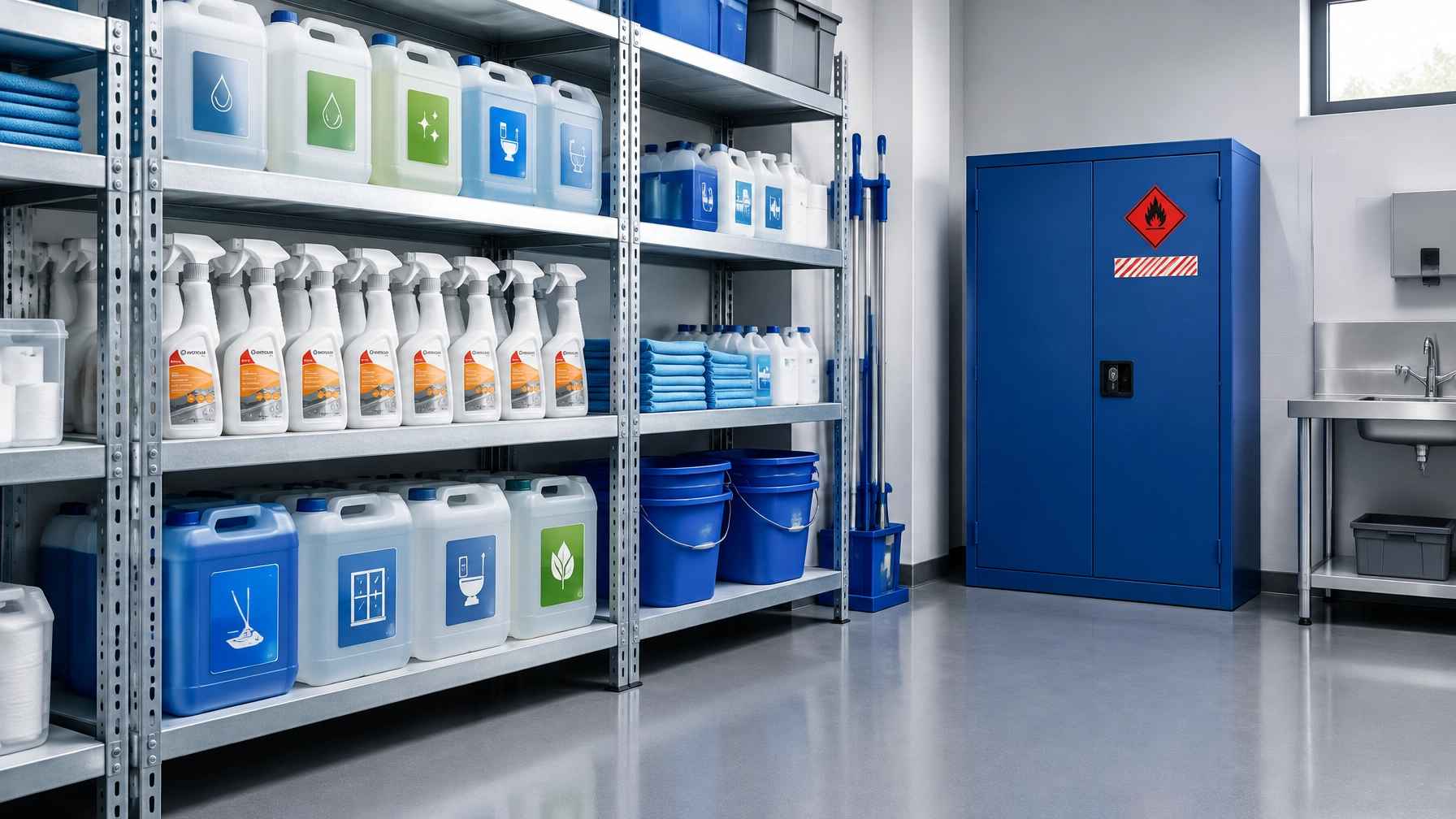
A cleaning cupboard may look like a small part of a building, but what is stored there, how it is used and what happens to waste can all affect fire safety. Cleaning teams move products around a site, work near equipment and create waste as part of ordinary routines. Those activities can influence whether a fire starts, how quickly it spreads and whether people can leave safely.
In England and Wales, the main workplace framework is the Regulatory Reform (Fire Safety) Order 2005. Its duties sit alongside requirements for dangerous substances, including the Dangerous Substances and Explosive Atmospheres Regulations 2002, known as DSEAR. Understanding how these rules connect helps responsible persons and contractors manage the practical details without treating fire safety as a separate issue from cleaning.
The Fire Safety Order applies to workplaces and to the common parts of buildings containing two or more domestic premises. Individual private homes are generally outside its scope, although shared areas such as communal corridors and stairways can be covered. The Order applies in England and Wales. Other parts of the UK have different fire safety legislation.
The person responsible for fire safety is usually the employer, owner, landlord or another person with control of the premises. Where responsibilities are shared, more than one person may have duties in relation to the same building or area. The Fire Safety Order sets out those duties, and the government guide to workplace fire safety provides an accessible overview.
A responsible person must complete a suitable and sufficient fire risk assessment under article 9. The assessment should identify the fire precautions needed to protect employees and others who may be on or near the premises. It must include dangerous substances where they are present or could reasonably be present. The assessment is not simply a document to file away. It should reflect how the premises are actually used, including the work done by cleaning staff.
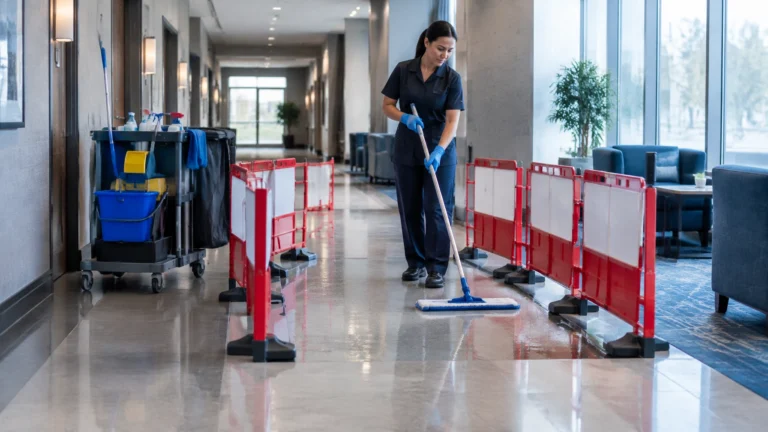
Article 14 requires emergency routes and exits to be kept clear at all times where necessary to protect people. In practical terms, cleaning trolleys, containers, waste bags and deliveries should not narrow escape routes or obstruct fire doors. Under article 23, employees must take reasonable care, cooperate with their employer and report serious dangers or shortcomings in safety arrangements. Self employed workers also need to cooperate with the site arrangements and take appropriate care while working.
Fire safety affects more than the person who controls the building. A responsible person must provide relevant information about risks and protective measures to employers from outside organisations whose staff are working on site. That includes cleaning contractors. Contractors need enough information to understand the building’s rules, evacuation arrangements and any local fire risks before work begins.
A contract can allocate tasks, but it cannot by itself remove a responsible person’s legal duties. The responsible person remains accountable for fire safety within their control. A cleaning contractor is responsible for managing its own work and staff, and may have duties in respect of premises or activities it controls. The practical requirement is to coordinate rather than assume that one party has taken care of everything.
Cleaning work can affect fire safety in several direct ways. Staff may bring flammable liquids or aerosols onto the site, store them between shifts, use them near heat producing equipment or move them through shared areas. They may also collect combustible waste, leave cleaning equipment near an electrical source or carry out work that exposes a hazard not covered by the current site arrangements.
DSEAR applies where an employer or self employed person carries out work and a dangerous substance is or may be present in a way that could create a risk to people. Its requirements include assessing the risks, eliminating or reducing them where reasonably practicable, minimising quantities, preventing or controlling releases, avoiding ignition sources and keeping incompatible substances apart. The HSE overview of DSEAR and its brief guide to controlling fire and explosion risks explain the principles.
For a contract cleaning operation, this means the product and the task both matter. A substance’s classification is important, but the way it is used, the amount present, the working temperature and the surrounding conditions should also be considered. A product used in a small quantity in a well ventilated area may present a different fire risk from the same product sprayed or heated in a confined space.
Start by checking which products are actually flammable. Most water based cleaning products are not classified as flammable under the classification, labelling and packaging rules. That is not a reason to guess. Check the product label and current safety data sheet. The flashpoint is reported in section 9 of a safety data sheet and can help identify relevant storage and use considerations. Some products may create a dangerous substance risk if heated to their flashpoint during use.
HSE guidance for flammable liquids stored in workrooms recommends keeping only the minimum quantity needed for frequently occurring activities, or enough for half a day or one shift. It gives recommended maximum quantities of 50 litres for highly flammable liquids or liquids with a flashpoint below the maximum ambient temperature, and 250 litres for other flammable liquids with a flashpoint up to 60 degrees Celsius.
These are recommended good practice maxima, not fixed statutory limits. If a site needs to keep more, the responsible employer or dutyholder should be able to justify the quantity through its risk assessment. The HSE guidance on storage of flammable liquids in work areas explains the factors to consider.
Where flammable liquids are stored in a workroom, containers should be closed when not in use and kept in a suitable fire resisting cabinet or bin designed to contain spills. HSE guidance specifies containment capacity of 110 per cent of the largest vessel normally stored. Keep the cabinet away from escape routes and, where possible, away from the immediate work area. Store materials that could increase fire risk or damage containers separately, including incompatible substances.
Aerosols need separate attention. The container is pressurised, so heat can cause it to rupture and propel the can. Store aerosols in a cool, dry and ventilated area away from direct sunlight and heat sources. Avoid damaging the valve. Bulk stocks may need to be separated in a fire resisting compartment or steel mesh cage, depending on the assessment and applicable guidance. If a can is damaged, move it to a safe, ventilated area in line with site procedures. The Fire Protection Association guidance RC19 covers the fire risks associated with aerosols.
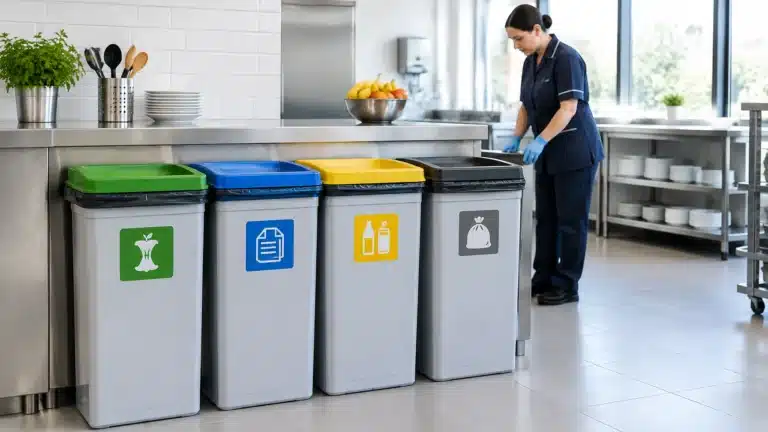
Housekeeping is part of fire prevention. The responsible person’s fire risk assessment should consider how combustible materials and waste are managed, including where they are left during a shift and how they are removed. Waste should not build up beside ignition sources or block access to exits, fire equipment or electrical controls.
External waste areas also need attention. Government fire safety guidance for factories and warehouses advises keeping skips at least six metres from buildings. External bins should be secured so they cannot be moved against a building or used to obstruct an exit. The government risk assessment guidance for factories and warehouses and the guide for small non domestic premises offer further practical advice.

Cleaning schedules can also reduce fuel in areas where combustible deposits accumulate. In commercial kitchens, grease can build up in extraction filters and ductwork. In laundry rooms, lint can collect around dryers and ventilation points. Plant rooms and areas around electrical equipment need routine housekeeping so that dust, packaging and other combustible materials do not accumulate close to heat or ignition sources.
Cleaning these deposits is a genuine overlap between hygiene and fire prevention. Removing grease, lint and dust reduces the material available to burn. Insurers may require kitchen extraction ductwork cleaning to follow the TR19 industry standard. The requirement will depend on the policy and site circumstances. Zurich’s commercial kitchen fire safety guidance discusses the risk associated with grease deposits in extraction systems.

The Fire Safety Act 2021 clarified that the Fire Safety Order applies to the structure, external walls and flat entrance doors of buildings containing two or more sets of domestic premises. The change matters to cleaning contractors working in residential blocks because shared areas and building features may be part of a wider fire safety plan.
The Fire Safety (England) Regulations 2022 added specific duties in England. For high rise residential buildings at least 18 metres tall or with at least seven storeys, requirements include a secure information box, floor plans and wayfinding signage. The regulations also include other requirements for certain residential buildings. Cleaning teams should follow the building’s instructions and avoid moving, covering or obstructing fire safety information and equipment. The government overview of the regulations sets out the requirements.
Section 156 of the Building Safety Act 2022 amended the Fire Safety Order. Since 1 October 2023, responsible persons must record their fire risk assessment in full and record their fire safety arrangements. Where a risk assessor is hired, the responsible person should record the assessor’s name and, where relevant, their organisation. Responsible persons must also take reasonably practicable steps to identify others who share duties in relation to the premises, cooperate with them and keep a record of relevant information.
In higher risk residential buildings, the responsible person must cooperate with accountable persons. The government definition covers buildings at least 18 metres tall or with at least seven storeys and containing at least two residential units. Relevant fire safety information must also be passed to an incoming responsible person when responsibilities change. Read the government guidance on section 156 responsibilities for details.
These recording duties make clear why informal assumptions are not enough. A contractor’s cleaning schedule, waste arrangements and product storage should fit the site’s fire safety arrangements. If a cleaning task changes, or a new product or storage location is introduced, the responsible person should consider whether the fire risk assessment needs review.
Fire and rescue authorities are the main enforcing authorities for the Fire Safety Order, subject to particular exceptions. They can inspect premises and may serve an enforcement notice where they consider that a duty has not been met. An enforcement notice sets out the failure and the steps required to remedy it. A prohibition notice may restrict or prevent use of premises where the risk to people is so serious that such action is necessary.
Under article 32, certain offences can be tried either way. For serious offences, the maximum penalty on conviction on indictment is an unlimited fine, imprisonment for up to two years, or both. The maximum fine available in the magistrates’ court was removed following commencement of section 85 of the Legal Aid, Sentencing and Punishment of Offenders Act 2012 on 12 March 2015. The exact offence and circumstances determine the applicable penalty. The Order’s offence provisions and government guidance on enforcement and sanctions provide further detail.
Use this checklist to review how cleaning work fits into a site’s fire safety arrangements:
Identify the products used on site, including aerosols and any solvents. Check labels and safety data sheets for flammability and flashpoint information.
Review quantities stored at the point of use. Keep them to the minimum needed for the activity or for half a day or one shift. Compare storage with the HSE recommended maxima of 50 or 250 litres, as relevant, and document the reasons if greater quantities are needed.
Check that flammable liquids are stored in suitable fire resisting, spill retaining cabinets where required. Keep storage away from escape routes, heat and ignition sources.
Check aerosol storage, including protection from heat, direct sunlight and damage. Confirm that staff know what to do with damaged cans.
Walk the waste route. Make sure waste does not accumulate in corridors or near ignition sources, and check external bin security and skip location.
Confirm that cleaning schedules cover kitchen extraction filters, laundry lint and routine housekeeping around plant and electrical equipment. Check any site or insurer requirements for extraction cleaning.
Agree in writing which party manages each relevant duty. Cover product approval, storage, waste, emergency arrangements, staff information, reporting and changes to the cleaning schedule.

Cleaning operations and fire safety law intersect more often than many teams expect. The practical response is to treat products, storage, waste and cleaning schedules as part of the fire risk assessment, rather than as separate housekeeping matters. Clear responsibilities and regular checks make it easier for the responsible person and contractor to keep arrangements consistent.
Chemical storage is explored in more depth in our earlier article on chemical storage safety beyond the locked cupboard. For equipment condition and filtration, see our guide to what HEPA means and the standards behind the vacuum label. Those topics support the same practical principle: understand what is present, how it is used and what controls the site needs.