

A cleaning schedule is only useful when it reflects the work taking place in the building. A hospital ward, a restaurant kitchen, a hotel bedroom and an office may all need clean surfaces and floors, but the risks, evidence and service expectations are different. Applying one generic specification across them can leave important tasks undefined and make performance difficult to check.
For facilities managers, contractors and in house teams, the practical starting point is to identify what the sector requires, then set out the tasks, responsibilities, products and checks that support it. This article compares those expectations and explains what they mean when selecting janitorial supplies and other professional cleaning products.
The scale of the sector makes the differences worth getting right. The British Cleaning Council's 2025 research estimates the UK cleaning industry at around 67 billion pounds a year, supporting roughly 1.49 million workers, and the largest part of that work takes place inside other people's premises, each with its own rules and expectations.
Hospitals: risk, responsibilities and evidence
Healthcare cleaning is closely tied to infection prevention and control. In England, the NHS England National Standards of Healthcare Cleanliness 2025 provide a framework for deciding what needs cleaning, how cleanliness is assessed and how organisations demonstrate that the work is being done. The standards apply across NHS settings and replace the 2021 edition.
The framework uses six Functional Risk categories. Each has an audit target and an audit frequency:
| Functional Risk category | Audit target | Audit frequency |
|---|---|---|
| FR1 | 98 percent | Weekly |
| FR2 | 95 percent | Monthly |
| FR3 | 90 percent | Every two months |
| FR4 | 85 percent | Every three months |
| FR5 | 80 percent | Every six months |
| FR6 | 75 percent | Every twelve months |
These figures are targets for cleanliness audits and the frequency of those audits. They should not be read as a universal cleaning schedule. The frequency of individual cleaning tasks is set through the local specification, taking account of the area, the elements that need cleaning and the associated risk. For example, an operating theatre and an administrative office do not require the same level of cleaning or monitoring.
Technical audits assess applicable elements in a functional area against expected cleanliness standards. The 2025 standard identifies 60 broad element categories that organisations can adapt to their premises. It also describes good practice of auditing at least half of the rooms in a functional area during a session. Efficacy audits add a different check: they examine whether the cleaning process is being carried out correctly, including the use of equipment, methods, colour coding and personal protective equipment.
A healthcare cleaning specification therefore needs more than a list of tasks. It should identify who is responsible for each item, the expected result, how often it is to be cleaned, how staff are trained, and how a failure is reported and corrected. NHS England’s local Commitment to Cleanliness charter helps make cleaning tasks, frequencies and responsibilities visible to patients, visitors and staff.
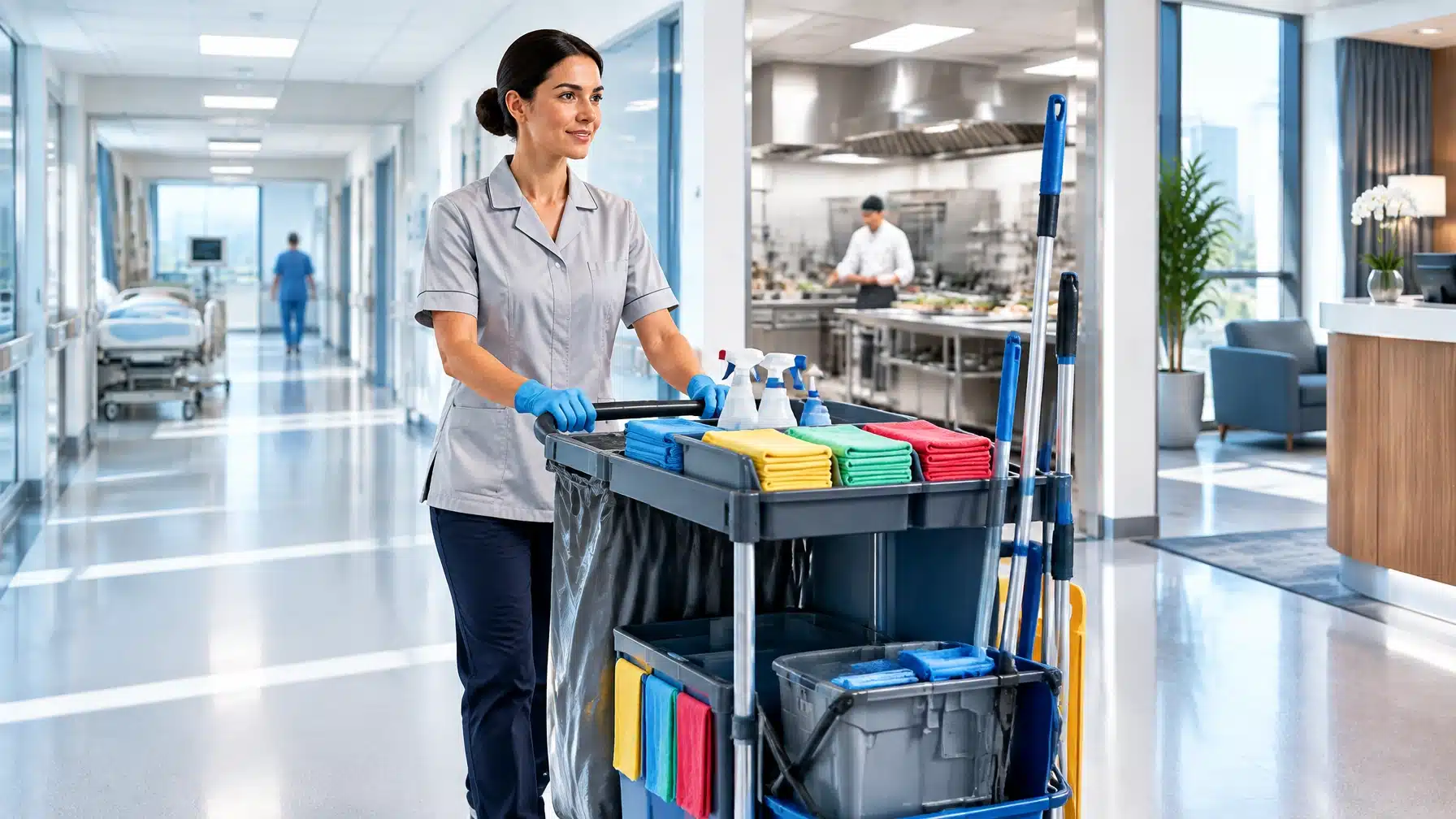
Equipment colour coding is a practical control against cross contamination. The NHS England scheme uses red for bathrooms and toilets, blue for general and public areas, green for catering areas and kitchens, and yellow for isolation areas. Staff need to know what the colours mean in their workplace and how to keep equipment separate.
The governance expectation is reinforced by the Health and Social Care Act 2008 code of practice, which covers clean premises and effective environmental cleaning. The Care Quality Commission’s infection prevention and control quality statement also considers how providers assess and manage infection risks, including whether premises and equipment are kept clean and hygienic.
For healthcare buyers, the requirement is not simply to source a suitable cleaner. The cleaning system must support local policy, staff training, appropriate equipment and documented assurance. A product’s label, directions and suitability for the surface and task all matter.
Food businesses: a schedule that protects food from contamination
In a commercial kitchen, cleaning is part of food safety. The GOV.UK guidance for food businesses says businesses must be able to show that cleaning is effective. A documented schedule should specify what is cleaned or disinfected, how often and which products are used. In practical terms, a useful schedule also makes clear who does each task and how it is checked.
The cleaning process needs to distinguish between removing soil and reducing harmful microorganisms. Visible food debris, grease and dirt should be removed with detergent and water, followed by a rinse where required. Disinfection comes after the surface is visibly clean, because dirt and grease can prevent a disinfectant from working as intended.
For a two stage method, the first stage is cleaning with detergent to remove visible dirt and grease. The second stage is disinfection using a suitable product. Food businesses should check product labels for relevant performance standards such as BS EN 1276 or BS EN 13697 and follow the stated dilution, contact time and use instructions. Where a sanitiser is intended to perform both functions, the required cleaning and disinfection applications should still be completed according to the product directions, including any requirement to apply it twice.
The schedule should cover more than worktops. Chopping boards, utensils, cooking equipment, sinks, handles, bins and cleaning cloths can all be part of the control plan. The Food Standards Agency’s E. coli cross contamination factsheet highlights the need to prevent transfer between raw and ready to eat food. Separate equipment should be used for these food types, with disinfection between uses where required by the method.
The Safer Food, Better Business guidance for caterers includes a cleaning schedule module to help food businesses document their approach. Staff need access to the schedule and should understand how to use the products and equipment safely.
A kitchen may need a heavy duty degreaser to tackle stubborn grease on suitable surfaces, but that does not replace detergent cleaning and disinfection of food contact areas. Product choice should follow the task and surface. A heavy duty cleaner used on a greasy floor, for example, is not automatically the correct choice for a food contact worktop.

Hotels: consistent presentation during busy room turnarounds
Hotels do not operate under one single UK cleaning standard that sets a universal cleaning frequency for every bedroom and public area. Expectations are generally set through the property’s service level agreements, operating procedures, brand standards and, where relevant, a rating scheme.
For hotel teams, a good specification turns the expected guest experience into repeatable housekeeping tasks. That may include room turnaround times, bedroom and bathroom checks, public area presentation, linen handling, waste removal and routines for dealing with spills or guest requests. It should also explain what is included in a routine clean and what is scheduled periodically.
The AA hotel rating scheme is one example of a quality framework that considers cleanliness alongside other aspects of a hotel’s service and facilities. It is a rating scheme rather than a universal legal cleaning schedule. Its relevance for operators is that guest facing quality needs to be consistent across rooms and shared spaces, not limited to the final moments before check in.
Bathrooms are a regular focus for housekeeping because visible marks, limescale and odours can quickly affect a guest’s impression. A professional bathroom cleaner can support routine cleaning, subject to surface compatibility and label directions. Mirrors, glass doors and display areas also need attention. A suitable glass cleaner can help leave those surfaces clear without visible streaks.
Laundry adds another operational requirement. Dependable detergent and fabric care help teams manage linen and towels through frequent use, while storage and handling routines help keep clean items separate from used ones. The precise process should reflect the hotel’s facilities and service standards.

There is a useful contrast with public sector healthcare. In Scotland, NHS facilities use the NHSScotland National Cleaning Services Specification, which is designed around healthcare risk assessment, cleaning tasks and assurance. It is not a hotel specification. The distinction illustrates why a hotel service level agreement should be built around its own operations and guest expectations rather than borrowed from a different sector.
Offices, education and retail: define the outcome and inspect it
Office cleaning is commonly specified by the result required and how that result will be checked. The British Institute of Cleaning Science, or BICSc, publishes standards and specifications used to support cleaning services. The European standard BS EN 13549 sets out basic requirements and recommendations for quality measurement systems in cleaning services. It can help a buyer develop a more objective inspection framework, but it does not prescribe one cleaning schedule for every workplace.
A clear office specification should identify the spaces, tasks, expected outcomes, frequencies and inspection arrangements. It may cover desks and shared touchpoints, floors, washrooms, kitchens, reception areas, meeting rooms and waste. High traffic and occupancy levels may call for more frequent attention than a low use room. The aim is to make the standard observable, so the cleaner and the person inspecting the work can understand what acceptable completion means.
Schools need similar clarity, with additional planning around term dates, access, periodic work and emergency cleaning. GOV.UK guidance on buying cleaning services for schools recommends defining the specification and considering daily cleaning, periodic or non routine tasks, performance monitoring, stock levels and who is responsible for reporting and resolving issues. It also reminds buyers to consider chemical labelling and storage in line with COSHH requirements.
Retail environments combine routine cleaning with presentation. Entrances, floors, washrooms and shared touchpoints need a dependable schedule, while windows, mirrors, display cases and other visible glass may require separate attention. A daily all purpose cleaner or All Purpose Cleaner Spray can suit some routine surface tasks when used according to its label. Floors may need an all purpose floor cleaner that is appropriate for the floor type and cleaning method.

Not every maintenance product belongs in the routine cleaning schedule. A drain cleaner unblocker, for instance, is for a particular drainage issue, not a substitute for a surface cleaner or a planned floor care method. Separating routine tasks from occasional maintenance helps buyers keep their cleaner supply list relevant and easier to manage.
What buyers and suppliers should take from the differences
A generic cleaning specification can be a starting point for discussion, but it is rarely enough in a regulated or service led environment. The shopping list and the operating controls should follow the sector’s actual requirements.
Healthcare prioritises risk classification, colour coded equipment, cleaning responsibilities, audit evidence and infection control. Food businesses need a documented cleaning schedule, correct sequencing of detergent cleaning and disinfection, and separation of equipment used for raw and ready to eat foods. Hospitality teams need efficient, repeatable housekeeping that supports room readiness and guest visible presentation. Offices and schools benefit from measurable outputs, defined inspection processes and schedules that reflect occupancy and use.
For procurement teams comparing trade cleaning supplies or professional cleaning supplies UK options, it is worth checking more than the product name. Confirm the task, the surface, the required standard, the label directions and the evidence needed to demonstrate completion. That approach also helps when buying through a cleaning supplies shop or planning broader janitorial supplies for multiple sites.
Homeowners choosing commercial grade products can use the same practical logic. Match the product to the task and surface rather than assuming one cleaner is suitable for every job. A bathroom product, a glass cleaner and an all purpose cleaner have different roles, and label directions remain central to safe, effective use.
Cleaning supplies should make the required routine achievable, but the sector specification is what sets the direction. Readers comparing products for specific tasks can review categories at the KleanPro Supplies shop; final selection should always follow the site’s procedures and the product label.
References
NHS England, National standards of healthcare cleanliness 2025
https://www.england.nhs.uk/publication/national-standards-of-healthcare-cleanliness/
NHS England, National standards of healthcare cleanliness 2025, long read
https://www.england.nhs.uk/long-read/national-standards-of-healthcare-cleanliness-2025/
GOV.UK, Health and Social Care Act 2008 code of practice on the prevention and control of infections
https://www.gov.uk/government/publications/the-health-and-social-care-act-2008-code-of-practice-on-the-prevention-and-control-of-infections-and-related-guidance/health-and-social-care-act-2008-code-of-practice-on-the-prevention-and-control-of-infections-and-related-guidance
Care Quality Commission, Infection prevention and control
https://www.cqc.org.uk/guidance-regulation/providers/assessment/single-assessment-framework/safe/infection-prevention-control
GOV.UK, Food hygiene for businesses: Cleaning
https://www.gov.uk/food-hygiene-businesses/cleaning
Food Standards Agency, E. coli cross contamination factsheet for caterers
https://www.food.gov.uk/sites/default/files/media/document/ecoli-cross-contamination-factsheet.pdf
GOV.UK, Safer Food, Better Business for caterers
https://www.gov.uk/government/publications/safer-food-better-business-for-caterers/safer-food-better-business-for-caterers
BSI, BS EN 13549 Cleaning services: Basic requirements and recommendations for quality measuring systems
https://knowledge.bsigroup.com/products/cleaning-services-basic-requirements-and-recommendations-for-quality-measuring-systems
GOV.UK, Buying for schools: Cleaning services
https://www.gov.uk/guidance/buying-for-schools-things-to-consider-before-you-start/cleaning-services
British Cleaning Council, Research and Reports 2025
https://www.bics.org.uk/wp-content/uploads/2025/04/RR2025.pdf
NHSScotland, National Cleaning Services Specification
https://www.nss.scot/publications/nhsscotland-national-cleaning-services-specification-shfn-01-02/