Newsletter Subscribe
Subscribe for news, offers and a welcome 5% discount on us.
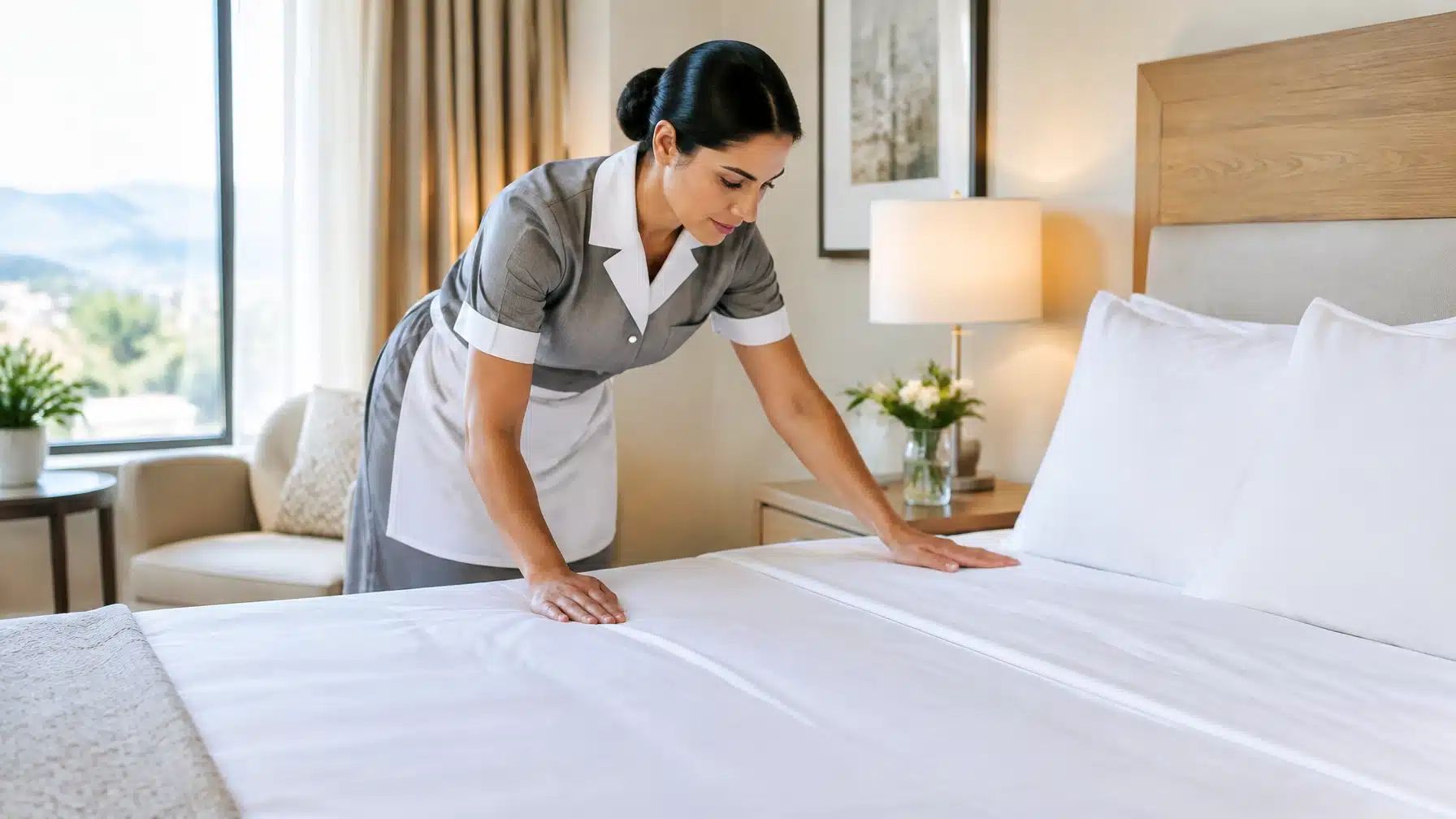
A hotel room is two products at once: a space that must look immaculate and a set of surfaces that must be hygienically clean. Guests may inspect the bathroom before they unpack. They judge what they can see, but they also touch handles, switches and taps that may look clean without having been cleaned effectively.
The housekeeper, meanwhile, works to a fixed allowance. That is where the room turn becomes a production process, and where standards can slip: the scope of a particular room does not always match the time assigned to it. A single guest leaving after a short stay and a family checking out after a wedding may receive the same room credit, despite leaving very different amounts of work.
The answer is not to rush the visible parts or to treat every room as identical. It is to define the work, sequence it, choose suitable products for each area and give each task enough time to be completed safely.
Cleanliness is not a soft measure that sits outside the guest experience. It is one of the categories guests score and compare.
In its 6 November 2025 hotel chain survey, Which? asked guests to rate stays out of five stars across eight categories, including cleanliness, customer service, breakfast quality, bed comfort and value. The large chain findings were based on 4,631 panel members surveyed in June and July 2025. Hotel Indigo received five stars for cleanliness, while Sofitel received five stars for cleanliness and bed comfort. Britannia received one star for the quality of its bedrooms and bathrooms and a customer score of 44 per cent, coming bottom of the large chain table for the twelfth consecutive time. Premier Inn scored 73 per cent and was rated highly for cleanliness, while Coaching Inn Group topped the large chain table with 81 per cent.
These results are a useful reminder that a room is experienced as a whole, yet its bathroom can strongly shape a guest’s view of its condition. They also show how an individual impression becomes a published, comparative measure. The current comparison is in the Which? UK hotel chain survey.
A departure clean, a stayover service and a periodic deep clean are different jobs. They should not be treated as interchangeable versions of the same room credit.
A departure clean prepares the room for a new guest. It normally includes removing used linen, cleaning and resetting the bathroom, cleaning bedroom surfaces and touch points, replenishing agreed supplies, making the bed and cleaning the floor. It also requires a careful final check for overlooked marks, hair, dust and items left behind.
A stayover service takes place while the guest remains in the room. Its scope may include refreshing the bathroom, removing waste, replenishing selected items and making the bed in line with the hotel’s policy and guest preference. It should not automatically be treated as a smaller departure clean: the guest’s belongings affect access, and the agreed service may differ.
A periodic deep clean addresses work that is not part of every daily turn, such as planned attention to furnishings, edges, ventilation grilles or other areas identified by the hotel’s schedule. If the schedule names only the departure clean, periodic work tends to be squeezed out during a busy week. A workable plan gives each type its own scope, frequency and allowance.
Room credits help a supervisor distribute planned work, but an average can disguise the outliers. A credit cannot tell whether a room had one occupant or a family of four, whether a guest left a kitchenette in use, or whether a suite needs more attention than a standard room.
Supervisors can make the planning more realistic without simply adding hours. Create room type bands that reflect meaningful differences in layout and work. Record room status, the number of beds to make, and any exceptional condition that changes the scope. Look at arrival and departure patterns alongside the stayover ratio, rather than planning only from a daily room total.
Pre arrival checks can identify rooms needing extra attention before they are assigned. Where practical, replenish linen and supplies from a suitable service area rather than making repeated journeys back to a store or overloading a room trolley. Review the difference between planned credits and observed work, then adjust the bands or schedule when the same mismatch keeps appearing.
A reliable room method matches the product to the surface and the soil. One product should not be expected to do every job.
Bathroom: A professional bathroom cleaner is for sanitary areas and deposits such as limescale or soap scum, when its label confirms suitability for the surface. It is not a general purpose room cleaner, and it should not be used on materials that are incompatible with its formula. Check the label and surface guidance before use. This guide to reading limescale and soap scum explains why identifying the deposit helps inform the choice.
Bedroom hard surfaces: An all purpose cleaner spray can be used on compatible hard surfaces such as a bedside shelf or wardrobe exterior. It is not intended for carpets or soft furnishings. For electronics and delicate finishes, follow the equipment or surface instructions and apply product to a cloth rather than spraying directly.
Soft furnishings and carpet: These need a method suited to the material, often routine vacuuming and planned professional cleaning where required. A glass cleaner or bathroom cleaner is not suitable for fabric. If contamination has occurred, follow the incident procedure rather than using a routine carpet method.
Floors: Choose a product and method suited to the floor type and the soil present, for example an all purpose floor cleaner diluted to the label ratio where the floor material is compatible. Correct measurement matters: excess product can leave residue rather than improve the result. Floors should be left dry or kept inaccessible until dry, as the Health and Safety Executive explains in its guidance on cleaning and slip risks.
In suites and serviced apartments, a heavy duty degreaser may be appropriate for greasy kitchenette surfaces if the product is suitable for the material. It is the wrong choice for routine bedroom cleaning. A glass cleaner belongs on suitable mirrors and windows, not as a substitute for a surface cleaner.
For every product, dwell time matters. Leave it on the surface for the period specified on its label before wiping or rinsing. Do not assume that immediate wiping gives the same result. Nor should staff invent a contact time: the product directions and the task method should state what is required.
For teams buying in volume, buying by task rather than by brand name keeps the order short and the trolley uncluttered: a professional bathroom cleaner, an all purpose cleaner, a glass cleaner for mirrors, a laundry detergent for on site linen, and a heavy duty degreaser only where a suite has cooking facilities. A housekeeping department that orders janitorial supplies on that basis carries fewer bottles and spends less time deciding which one to reach for. Concentrated professional cleaning products bought in bulk and diluted to the label ratio give the same result in every room, which is the practical reason trade cleaning supplies are usually concentrated rather than ready to use. Our range is arranged on that principle, so a housekeeping order can be built around the four zones of a room rather than around brands.

A polished room can still have missed contact points. Include door handles, light switches, the remote control, kettle and tray, hair dryer, telephone, taps, flush handle, toilet roll holder, towel rail, bedside shelf, wardrobe rail, iron and board, safety card and window handle in the written method.
A visible soil check asks whether dirt, marks or residue can be seen. A contamination test, such as a swab, checks for material that is not necessarily visible. A room can pass a visual inspection and still produce a positive swab because the two checks answer different questions. Neither should be presented as a substitute for a properly defined cleaning method.
The HSE’s CAIS22 information sheet covers cleaning substances used in hospitality, including toilet cleaners, bleach, disinfectants, descalers and sanitisers. Risks include contact with skin or eyes, breathing in a substance and accidental swallowing. Some products are corrosive; others can contribute to skin irritation, dermatitis or breathing problems when used without appropriate controls.
Never mix cleaning substances. Mixing bleach products with an acidic toilet cleaner or ammonia can release harmful gases. Do not spray products onto hot surfaces, such as a kettle or iron, and ensure suitable ventilation. Keep products out of guests’ reach. Never store them in drinks bottles or food containers.
Use labelled containers and follow the product’s dilution instructions. When diluting concentrate, add the concentrate to water, not water to concentrate. Gloves and eye protection should be selected in line with the product assessment and instructions. CAIS22 advises avoiding latex gloves because they are known to cause reactions. Where mains tap water is not readily available for eye irrigation, the guidance calls for at least a litre of sterile water or sterile saline in sealed disposable containers. Safe handling is part of the room method, not an optional extra.
Housekeeping involves repeated contact with water, cleaning products and gloves. Hands can remain wet or covered for much of a shift, which can weaken the skin’s protective barrier. Dryness, soreness or cracking should be reported early rather than treated as an unavoidable part of the job.
Choose gloves that suit the task and the substance, change them when damaged or contaminated, and dry hands properly before putting on a fresh pair. Provide hand care guidance and an accessible way to report symptoms. For more on prevention, see this practical guide to protecting cleaning staff from dermatitis and occupational asthma.
That same review found substantial evidence on musculoskeletal disorders, but no included study measured respiratory or skin conditions in this workforce. The review notes that workers have attributed symptoms to cleaning products, but that is not the same as a measured prevalence estimate. That research gap is a reason to manage exposure carefully, not a basis for overstating the evidence.
Bed making and bathroom cleaning are among the most demanding tasks in a room turn. Both require repeated bending, reaching and twisting, often in restricted spaces. A method that assumes staff can simply move faster does not resolve the physical work.
A 2026 systematic review of work related health conditions among hotel housekeepers included eight studies, all concerning musculoskeletal disorders. In five studies using the same questionnaire, pooled twelve month prevalence estimates included low back pain at 73.0 per cent, wrist and hand pain at 54.7 per cent, upper back pain at 49.2 per cent, shoulder pain at 48.2 per cent and neck pain at 40.1 per cent. These estimates need careful interpretation: heterogeneity was above 80 per cent in every body region, and the authors warn that the figures should be treated cautiously.
A study of 40 housekeepers found that all reported at least one musculoskeletal symptom in the previous twelve months. Its posture assessment identified medium, high and very high risk in bed making and bathroom cleaning. In a survey of 1,043 housekeepers in the Balearic Islands, 51 per cent reported chronic pain in at least one body region in the previous season, and 79.2 per cent reported pain in at least one region in the week before interview. Their average shift covered 18 occupied rooms and 5.4 checkout rooms. These findings describe particular study groups, not a universal room quota.
The review also reports that, in a study of 941 unionised room cleaners in Las Vegas, cleaning more than 14 rooms a day and more than 18 beds a day were associated with poorer health and severe pain. Working across three or more buildings and floors, time pressure and high psychological demands were also associated with poor health. These are observed associations, not safe limits or targets for other hotels.
The same review identifies practical protective factors reported in studies: frequent breaks, task rotation and sharing work with colleagues, occupational health and safety training, suitable risk prevention procedures and occupational health follow up. Adaptations included ergonomic trolleys, improved trolley wheels, mattress lift tools and changes to the bottom sheet type. Repetitive movements and excessive reaching or stretching were linked with pain in the neck, lower back and upper limbs; a higher number of beds made per shift was associated with low back pain.
This is where a room credit becomes a health and safety issue. Review the task, the load, the working environment and individual capability, as the HSE advises for manual handling in catering and hospitality. Ask housekeepers where the method forces awkward movements. Involve them in testing trolley layout, bed making aids and task rotation. Provide breaks that can actually be taken, and make early reporting of aches straightforward. A room standard that can only be met by working through pain is not a workable standard.
A sickness incident is not an occasion to improvise. Public Health England’s published 2019 procedure, Controlling Viral Gastroenteritis in hotels and other accommodation providers, sets out a specific sequence. A hotel should have a written plan and trained staff ready to follow it.
For contamination on hard surfaces, the procedure starts by removing gross contamination with paper towels and sealing the waste in a plastic bag. Wash the affected area with hot water and detergent, then disinfect using a freshly prepared 0.1 per cent hypochlorite solution, equivalent to 1,000 ppm. Prepare a fresh solution every 24 hours, recording when it was made, and never mix chemicals. The procedure calls for cleaning at least 3 metres in all directions from the incident.
Use separate cloths and disposable paper towels for each area. Clean the toilet bowl last, dry disinfected surfaces with disposable paper towels and leave windows open to air dry where possible. Do not use guest bathroom towels to dry cleaned surfaces, and do not dry vacuum affected carpets or soft furnishings. The document advises removing washable items to the laundry in soluble alginate bags and washing them above 60 degrees Celsius. Carpet and fixed seating should be treated with professional hot water and detergent extraction after gross contamination has been removed. Hypochlorite should not be used on soft furnishings because it can damage them.
Rooms occupied by ill guests should be cleaned before other rooms and, if possible, left unoccupied for 72 hours after cleaning. Disinfect equipment between rooms and flush away used hypochlorite after each room. During an outbreak, follow the action plan, involve the designated team and seek appropriate public health advice. Alcohol hand rub does not effectively inactivate norovirus, according to the PHE document. Staff with vomiting or diarrhoea should remain off work until at least 48 hours, preferably 72 hours, after symptoms cease.
A team without a documented procedure is left to decide the sequence under pressure. A prepared method, suitable products and recorded actions make the response more consistent.
An empty room is not necessarily a room ready to release. If it has stood unused for an extended period, dust, stale odours, deposits and maintenance issues may need attention before a guest arrives. The water system also needs to be managed by the person responsible for the building’s water safety controls.
The HSE advises that cold water should, where possible, be maintained below 20 degrees Celsius. Hot water should be stored at 60 degrees Celsius or above and distributed so that it reaches 50 degrees Celsius within one minute at outlets. Larger, more complex systems, including large hotels, should follow the relevant technical guidance. A manager’s water control plan should identify rarely used outlets and set out any flushing and recording requirements. Housekeepers should only flush outlets where the procedure assigns that task and explains how to do it safely.
Scald risk also matters. The HSE notes that water above 44 degrees Celsius can present a scalding risk, particularly for vulnerable people. Where vulnerable people can access baths or showers and the risk is significant, a Type 3 thermostatic mixing valve must be fitted. Cleaning routines should not bypass water safety controls.
Keep used linen separate from clean stock and handle it according to the hotel’s laundry procedure. Where sickness contamination is involved, the PHE protocol recommends soluble alginate bags and laundering above 60 degrees Celsius. For routine linen and towel care, follow textile and product instructions, using suitable laundry detergent and fabric softener where appropriate.
Guest towels should never be used to dry a surface that has just been cleaned. That can reintroduce soil and undermine the work. Microfibre cloths also need proper laundering and separation from lint producing items; see the guide to laundering cloths so microfibre keeps working.
Trolley discipline helps prevent cross contamination and wasted movement. Keep clean cloths separate by room zone, use one cloth for each designated zone and change it when the method requires. Carry dispensed, labelled chemistry rather than decanted drinks bottles or unmarked containers. Restock from a planned list, keep heavy supplies low and accessible, and check that wheels move freely. A neatly organised trolley is not just an appearance standard; it helps staff find the right kit without unnecessary trips or awkward handling.

A workable standard is written for each room type. It describes the scope of a departure clean, stayover service and periodic clean; the order of work; the products and cloths for each zone; the label based dwell times; and the final verification step.
The sequence should make contamination control and efficiency clear. For example, remove waste and used linen first, clean bedroom surfaces and touch points, then work through the bathroom from cleaner surfaces to dirtier ones, leaving the toilet bowl until last. Complete the floor after other cleaning so debris is not carried back across it. The exact sequence should reflect the hotel’s surfaces, room layout and incident procedures.
Verification should be more than a glance at the bed. Inspect visible surfaces, the bathroom, replenishment, touch points and the dry condition of floors. Record exceptions, such as a room that could not be accessed or a defect that needs maintenance. A written method makes the expected result clearer to the housekeeper and fairer to the person inspecting it. The principles in this guide to turning a cleaning specification into a method a team can deliver apply directly to room standards.
Week one: Observe room turns across different room types and stay statuses. Ask housekeepers which tasks regularly exceed the expected scope.
Week two: Write or revise the methods for departure, stayover and periodic work. Confirm product suitability, dilution, protective equipment and dwell times from the product instructions.
Week three: Test the room bands, trolley layout and work sequence with the team. Check whether breaks, task rotation and available aids fit the actual shift.
Week four: Review inspection findings, staff feedback and exceptions. Adjust the scope or allocation where the evidence shows a repeated mismatch, then record the revised method and train the team.
A hotel room is judged by a stranger, often with no opportunity to explain what was rushed or missed. That makes the room turn a demanding service, but it does not require heroics. It requires a clear scope, a realistic allowance, the right product for each zone and enough contact time for the product to work as directed.
When work is defined and sequenced well, inspection becomes a confirmation that the room is actually clean, rather than a test of how effectively someone hurried through the visible parts.