Newsletter Subscribe
Subscribe for news, offers and a welcome 5% discount on us.
A cleaning specification will happily state the chemical, the dilution and the dwell time, but often will not state the water. Yet a bucket, a rinse, a machine fill and a wash load all use water. They all appear on a meter, and in a drought year they all cost money.
The gap is not that water use is impossible to calculate. It is that cleaning teams and facilities managers rarely count it. Sustainability reporting often begins with the chemical and its packaging, while the water used to prepare, apply, rinse and launder is left outside the specification.
For a home, that water may be a bucket or a running tap. For a commercial site, it may be a repeated floor routine, a hotel laundry or a kitchen wash cycle. The method determines where water goes. Measuring those steps gives you a practical starting point for reducing use without reducing hygiene.
In England, water efficiency is both an operational issue and a national priority. The Environment Agency reported in November 2025 that average daily water use was 136.5 litres per person. More than 62 per cent of households were billed on a measured tariff, although only around 12 per cent had smart meters. Water companies still lost around 19 per cent of the water put into distribution through leakage. They abstracted 14,636 megalitres a day in 2024 to 2025, slightly below the previous year’s 14,664, but close to the 15,012 recorded in 2005. The Environment Agency’s water efficiency update sets out these figures.
Under the Environment Act 2021, the target is to reduce public water supply per head in England by 20 per cent by 31 March 2038. The measurement is against the 2019 to 2020 baseline of 140 litres per person per day. The target is 122 litres by March 2038, with a longer term aim of 110 litres by 2050. Reported data for 2024 to 2025 shows a 5.1 per cent reduction so far, about a quarter of the overall reduction required.
The pressure is not only about future targets. In June 2025, the Environment Agency warned that England could face a shortfall of 5 billion litres a day for public water supply by 2055 without action, equivalent to around a third of current daily use. It identified a further 1 billion litres a day of demand for energy, food and emerging technologies. Metering matters: the Agency reported that an average person on a meter uses 122 litres a day, compared with 171 litres without one. See its water supply shortfall announcement.
The latest drought report makes the issue immediate. For the week ending 5 November 2026, the Environment Agency recorded total reservoir storage in England at 60.1 per cent as of 3 November, 17 per cent below the average for that point in the year. Eight reservoirs or reservoir groups were exceptionally low. Severe drought remained in parts of Cornwall, Devon, Dorset, Somerset and East and West Sussex. Temporary use bans were in force across a number of water company areas. The Agency said at least 120 per cent of average rainfall over the following 6 months was needed for the whole country to be out of drought by next spring. The report recorded 425 confirmed drought and dry weather incidents in 2026, more than the whole of 2022 or 2025. The full England drought update provides the detail.
Business use deserves the same attention. Waterwise’s February 2025 report says Defra has set a goal to reduce business water consumption by 9 per cent by 2038 and 15 per cent by 2050. Ofwat has proposed that wholesalers reduce business demand by an average of 7.5 per cent by 2030. Waterwise notes that available market data suggests consumption is trending slightly upwards, away from Defra’s target, and that many non household customers have relatively low awareness of water scarcity.
The household target gets the headlines, while the business target is already moving in the wrong direction. Waterwise’s interviews with water using organisations found that every respondent identified data as the critical first step. Once they had data, many focused first on finding and fixing leaks. A facilities or cleaning manager who can show a measured reduction therefore has something real to report, rather than a general intention.
The Environment Agency’s regular water use figures give useful comparisons. They are not cleaning benchmarks, but they show how quickly water adds up when a method leaves a tap running or uses a hose.
A dual flush toilet uses 4 to 6 litres per flush, and an older model can use up to 13 litres. A standard shower runs at 10 to 15 litres a minute, against 6 litres a minute on a lower flow head, and a bath holds around 80 litres. A washing machine uses 50 litres for a normal load and 35 litres on an eco load, while a dishwasher uses 14 litres per cycle and 10 litres on an eco cycle. Washing up costs 9 litres a minute under a running tap and 8 litres with a washing up bowl. A car wash by hose uses 300 litres, and the same job with a bucket uses 30.
The comparison that matters for cleaning is the last one: hose and bucket, same job, a factor of ten difference. That is a method decision, not a product decision.
A tap left running while a cleaner fills a bucket or rinses a cloth has a measurable cost too. Waterwise’s Guide for Offices estimates a running tap wastes approximately 6 litres a minute. Ten minutes of unnecessary flow is 60 litres. A dripping tap can waste up to 5,500 litres a year.
A leaking toilet cistern is a useful example of hidden water loss. Waterwise estimates that 5 to 8 per cent of toilets are leaking at any one time, often silently from the cistern into the bowl. Each can waste 215 to 400 litres of clean drinking water a day.
The person paying the water bill may never see the leak. The person who cleans the washroom may hear it, see a continual flow, or notice that a bowl remains wet after a flush. In many buildings, the cleaning team is the only workforce that enters every washroom every day. That routine access makes its observations valuable.
A practical reporting route does not need to be complicated. Add one line to the cleaning schedule for a running toilet, dripping tap or unusual flow. Name the person responsible for forwarding the report, and record washroom checks consistently. This is a small control that costs nothing and runs every day. It may be more useful than an equipment purchase because it makes a leak visible early and gives someone a clear responsibility to act.
This fits Waterwise’s finding that leak identification was the saving businesses actually pursued once they had data. For offices, the guide recommends assigning someone to read the meter monthly, then comparing a reading taken when the building is empty with another a few hours later. Unexpected movement can point to a leak or an uncontrolled system such as urinals that flush continuously.

A concentrate is defined by the water added at the point of use. The label ratio is the specification, and the water is part of the product as it is used.
The EU Ecolabel criteria for hard surface cleaning products cover all purpose cleaners for routine indoor cleaning of hard surfaces, kitchen cleaners, window cleaners and sanitary cleaners, for private and professional use. Products may be sold ready to use or undiluted. The criteria define an undiluted product as one that should be diluted in water before use. See Commission Decision 2017/1217.
If a user estimates a dose rather than measuring it, both over dilution and under dilution can result. Over dilution wastes water and chemical. Under dilution may mean the clean is not achieved. Neither is a reliable way to reduce resource use.
The practical control is straightforward: use a graduated jug, display a wall chart with the correct ratio for each task, and name one person to check dosing equipment. A dispenser drawing the wrong ratio can remain unnoticed until someone tests it, so dispensers need periodic checks.
Safe handling is part of the same process. The HSE’s CAIS22 guidance advises buying diluted products in smaller containers where suitable, using syphons and pumps to avoid pouring from bulk, keeping products in their original labelled containers and decanting only into suitable, clearly marked containers. When diluting, add concentrate to water, not water to concentrate, and never mix products. These controls help make dosing consistent while reducing handling risks.
The same principle runs across janitorial supplies. A single site may hold a professional bathroom cleaner, an all purpose cleaner spray for desks and shared surfaces, an all purpose floor cleaner for hard floors, a heavy duty degreaser for kitchen extraction and a glass cleaner for glazing and mirrors. Each of them carries a different ratio to water. Anyone buying professional cleaning supplies in the UK can reasonably ask two questions of a concentrate: what ratio does the label give, and can the dispenser deliver it reliably. Trade cleaning supplies are usually concentrated for exactly this reason, because the water is added on site, and the environmental case for heavy duty cleaning products only holds when the dose is measured rather than guessed. A heavy duty cleaner poured by eye wastes chemical and water together.
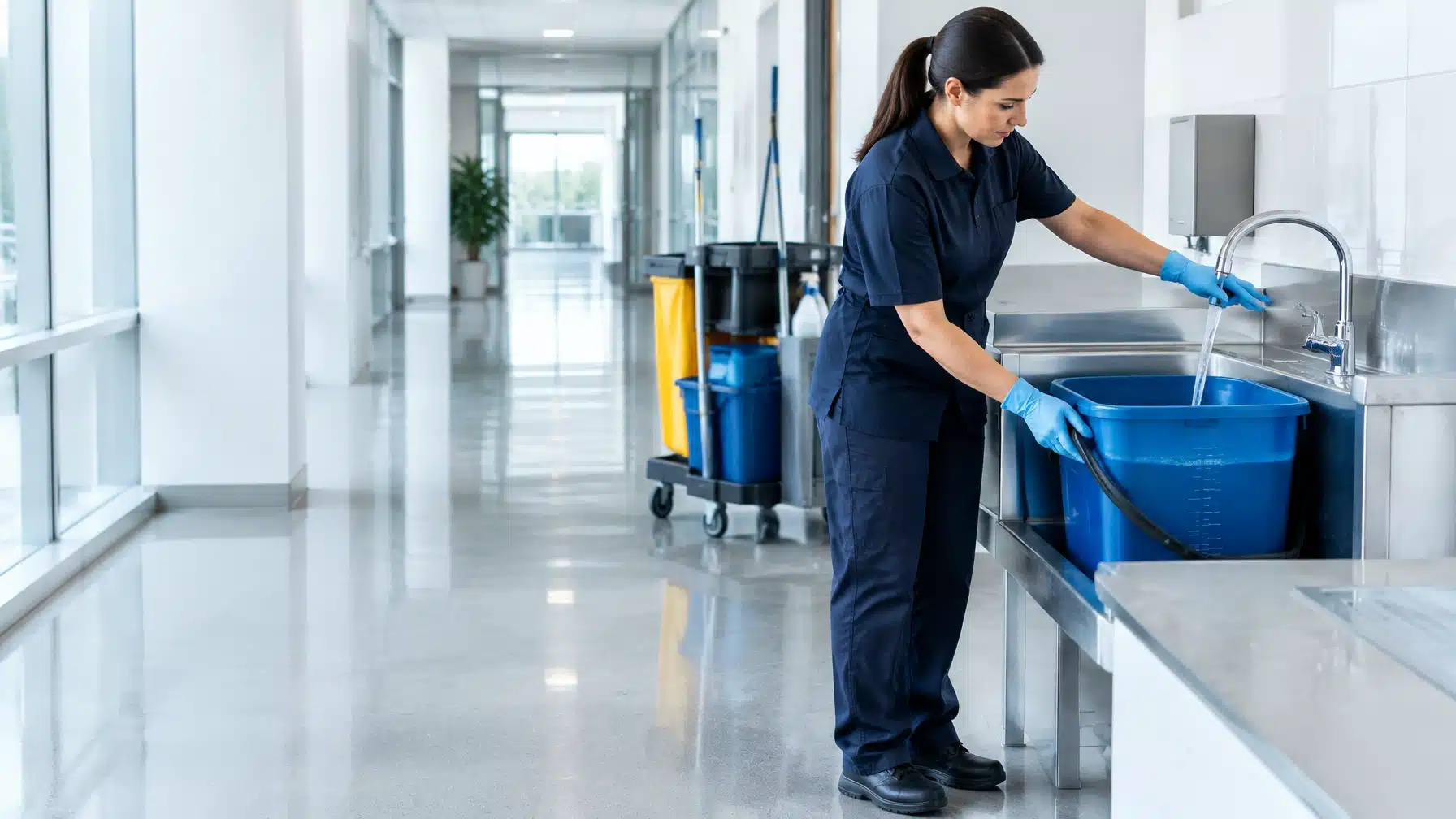
A floor cleaning routine has several measurable steps. A bucket is filled, a mop is wetted, the solution is used until it becomes dirty, and then it is emptied and refilled. A second bucket may be used for rinsing. Each fill can be counted.
Start with the bucket capacity shown on its label. Record how many fills are used per shift, the chemical dose for each fill, and any rinse water used in a second bucket. If no bucket label is available, mark a fill level and measure the volume once. This gives you a site specific record without relying on an invented industry average.
Double bucket work uses roughly twice the water of a single bucket for the same floor because one bucket holds the cleaning solution and the other the rinse water. The purpose is to keep the rinse cleaner. That makes the choice a hygiene decision with a water cost attached, not a free saving. The right method depends on the floor, the level of soil and the cleaning procedure.
Some methods reduce the amount of water carried into the cleaning process. A Department of Health report on microfibre and steam cleaning recorded that at St Richard’s Hospital in Chichester, cleaning took 26 per cent less time with microfibre cloths and mops than with conventional materials. The researchers noted significant time benefits from removing water from the overall cleaning process. They also identified the health and safety benefits of not carrying heavy buckets and reducing the risk of water spillage.
The same report makes clear that a lower water method is not suitable for every task. Microfibre is not suitable for cleaning body fluids. Those must be removed using hypochlorite solution and a disposable cloth in line with national guidance. The report also says overloading laundry machines reduces mechanical cleaning action, and prepared but unused cloths have a safety period of only 12 hours. Those are water and chemical decisions too: avoid washing more than needed, but do not reuse items beyond the safe process.

For reusable cloths and mop heads, cleaning the textile is part of the cleaning method. The Department of Health report notes that cloths and mop heads typically last 75 to 100 washes, so replacement and wash frequency are linked resource decisions. Washing unnecessarily shortens service life and uses water; delaying a required wash can compromise the process.
The report cites a Swedish study in which conventional cleaning costs were 7 per cent equipment, materials and liquids, compared with 70 to 85 per cent labour. It also identifies water consumption as the largest cost element in laundering microfibre, with energy becoming the largest cost when cloths have to be tumble dried. Avoid overloading machines, follow the laundry instructions for the textiles, and prepare only the number of cloths likely to be used within the safe period.
Kitchens offer a clear comparison between equipment and behaviour. The Environment Agency figures put a dishwasher at 14 litres per cycle, or 10 litres on eco. Washing up under a running tap uses 9 litres a minute, compared with 8 litres using a washing up bowl. How full a dishwasher is, whether it is run on an appropriate cycle and whether a tap is left flowing are all part of the water picture.
In hotels, interventions also have to work for the guest. Waterwise’s hospitality finding describes fully funded tap restrictors, showerheads and toilet valves in a water stressed coastal tourist area that produced a 20 per cent reduction in water use per sleeper. The same interviewee said guest experience often limits water saving: trials of water efficient showerheads in luxury hotels failed because guests complained about reduced pressure. Both points matter. Savings need to be measured, but changes also need to preserve the experience and service standard expected.

A lower flow is not automatically a safer or better choice. Waterwise’s business report describes one educational trust where flow restrictors and inserts were later removed by a health and safety assessor over legionella and bacterial risk concerns. A local authority declined tap aerators for the same reason. The examples show why plumbing changes require the right assessment.
The HSE’s guidance on legionella in hot and cold water systems says cold water should be kept below 20 degrees Celsius where possible. Hot water should be stored at 60 degrees Celsius or above, and distributed so it reaches 50 degrees within one minute at outlets, or 55 degrees in healthcare premises. Dead legs and blind ends can increase risk by allowing water to stagnate.
There is also a scalding risk when water comes out of taps above 44 degrees Celsius. Where vulnerable people can access baths or showers and the risk is significant, a Type 3 thermostatic mixing valve is required to control the outlet temperature. Reducing flow on a domestic tap is therefore a plumbing and water safety decision, not a cleaning decision. It belongs with the person responsible for the water safety plan.
Choose a small number of measures that relate to the work being done. Depending on the site, useful metrics include:
Record a monthly meter reading and take one overnight reading each quarter, when the building is not in normal use. The monthly figure shows the broader trend; the overnight check can help identify continuous flow or leaks. For a home, the meter provides a useful starting point even if you do not calculate a cleaning specific measure.
For each metric, define what is included. If litres per 100 square metres is the measure, decide whether it covers floor buckets only or also cloth preparation and rinsing. If litres per kilogram of linen is used, keep the laundry load and textile type consistent when comparing periods. Otherwise, the figures may move because the work changed, rather than because efficiency improved.
Waterwise’s report on non household saving found that accurate metering and monitoring was the first step identified by every organisation interviewed. Without a baseline, nobody can demonstrate a saving. That is one reason water projects can struggle for approval: a proposed change may sound sensible, but without a starting figure there is no clear way to show its effect.
A useful baseline need not be elaborate. Start with the readings already available, note cleaning activity and occupancy, and record the method used. Then compare like with like over time. If water use falls while cleaning output remains stable and hygiene checks are maintained, the improvement is credible.
Water reduction should not come at the expense of hygiene. Contact time and dilution are not negotiable. Body fluid spills require the hypochlorite method, regardless of water use. A floor cleaned with too little solution and no dwell time has been wetted, not properly cleaned.
The first savings to look for are usually what leaks and what runs unnecessarily. The next is whether the dose is being measured. Neither requires new professional cleaning products or new equipment. Both actions can reduce waste before anything is purchased, and both are straightforward to record.
For a wider view of how cleaning methods are documented, see our guide to building a cleaning specification. When assessing concentrates, a cleaning supplies shop such as KleanPro Supplies should make it straightforward to check whether the label gives a measurable dose, because the water added at point of use belongs in the specification too.
The water a building uses for cleaning is knowable, and almost nobody knows it. A specification that states litres as well as dilutions is a better document.