
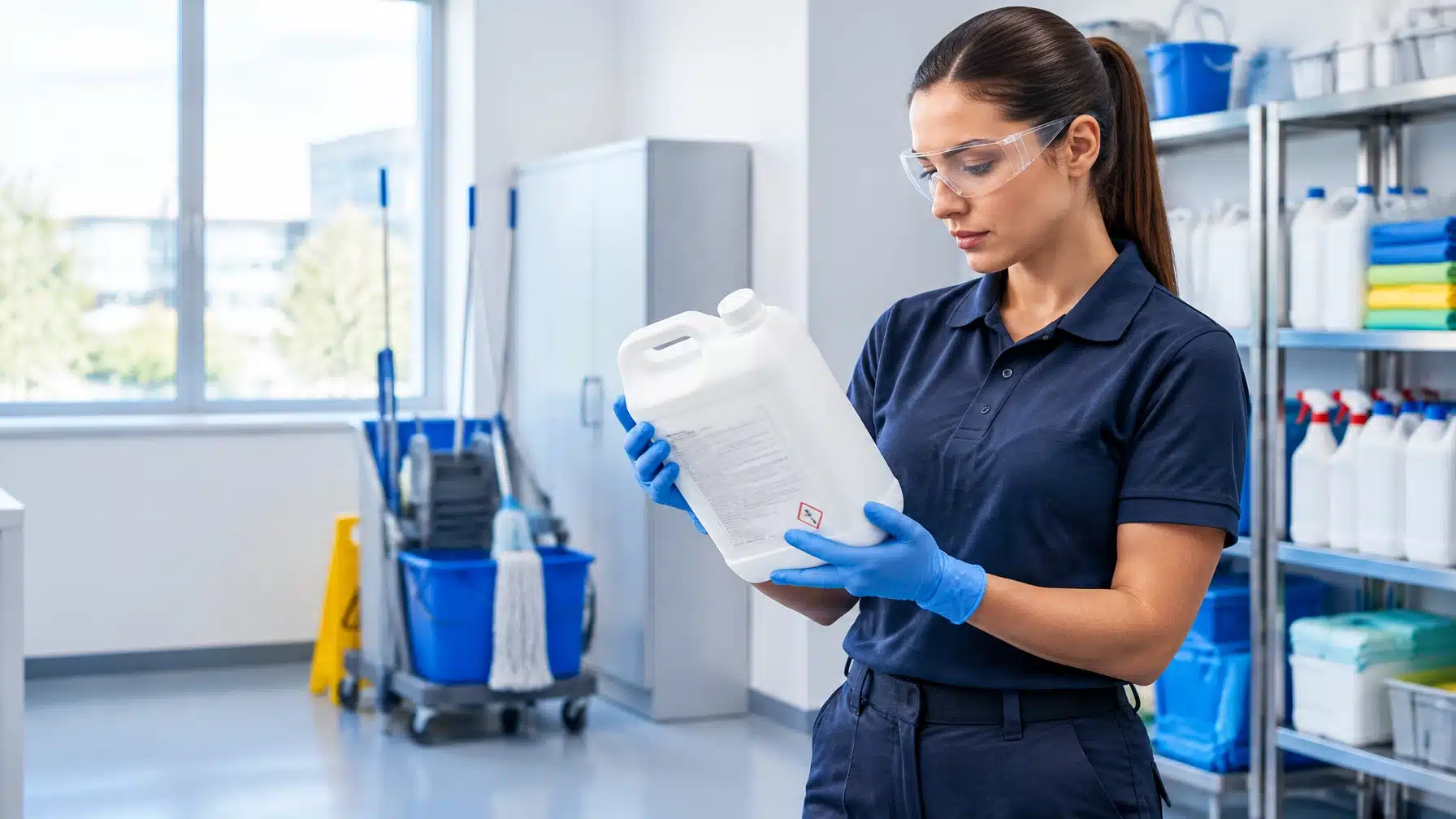

Cleaning chemicals help businesses maintain hygienic workplaces, but using them safely takes more than keeping product labels in a cupboard. Employers need to understand the risks created by the products and the way they are used, then put effective precautions into practice.
COSHH is the Control of Substances Hazardous to Health. For cleaning businesses, it provides the legal framework for assessing and controlling employees’ exposure to substances that could harm their health. This guide explains the practical measures to have in place, from product information and staff training to storage and emergency arrangements.
The focus here is on workplaces in Great Britain. Northern Ireland has separate, corresponding health and safety regulations, so businesses operating there should check guidance from the Health and Safety Executive for Northern Ireland.
What COSHH means for cleaning work
The Control of Substances Hazardous to Health Regulations 2002 require employers to assess health risks from hazardous substances used or created at work, and to prevent or adequately control exposure. Cleaning products can fall within COSHH when their ingredients or use may cause harm. The specific risks depend on the product, its concentration, how it is applied and the work environment.
Potential examples include products that can irritate or damage the skin or eyes, cause breathing problems, or produce harmful fumes if used incorrectly. A product does not need to be used in an industrial setting to require attention. A cleaner working for several hours with a product, or repeatedly handling a diluted solution, may face different risks from a person using it briefly at home.
COSHH is not simply a requirement to own a folder of forms. The precautions need to match the actual work and be followed by staff. A bathroom cleaner used in a small, poorly ventilated room, for example, presents a different work situation from a product used briefly in a spacious, ventilated area.
Homeowners do not have the same employer duties as a cleaning business. However, label directions, product safety information and careful storage remain important for household use.
Start with a product and task inventory
Make a current list of cleaning substances used at each workplace or client site. Include products used regularly and those kept for occasional jobs, such as stain removal, drain maintenance or deep cleaning. Record the product name, where it is used, who uses it and the task involved.
A product list alone is not enough. Think about the work that may expose someone to the substance. This includes measuring or diluting concentrates, transferring liquid into a smaller bottle, spraying, wiping surfaces, cleaning equipment and dealing with spills. Also consider where staff work and who else could be nearby, including clients, visitors, contractors and other employees.
A heavy duty degreaser, a professional bathroom cleaner, an all purpose floor cleaner and a drain cleaner unblocker illustrate how a cleaning supplies range can cover very different tasks. Their names do not tell you the full hazard or determine the precautions. Check the current label and safety information for the specific product, and assess the way it is actually used.

Carry out a suitable COSHH assessment
A COSHH assessment should identify the hazards, consider who could be harmed and decide how exposure will be prevented or controlled. The HSE guide to COSHH assessment recommends considering how often and for how long people use a substance, how they could be exposed, and what further action is needed.
For each relevant task, ask:
- Could the product get on skin or into eyes?
- Could the person breathe in mist, vapour or dust?
- Is there a risk of accidental swallowing, for example from poor hand hygiene?
- Is the product sprayed, diluted or used in a confined or poorly ventilated space?
- Could it be mixed accidentally with another product?
- Are there other people who may be exposed?
- Are the current controls practical and consistently followed?
An assessment should relate to the product and task, rather than relying on a generic statement that all cleaning chemicals are used safely. Two products in the same category may have different instructions and hazards. The same product may also need different controls if the method, frequency, ventilation or workplace changes.
Keep a record of the findings and actions. HSE guidance explains that employers with five or more employees must record their risk assessment findings. Keeping clear records is also useful for smaller businesses: it helps supervisors brief staff, review precautions and show how decisions were made.
Use safety data sheets as information, not as the assessment
A safety data sheet, often called an SDS, gives information about a chemical product. It can cover its hazards, handling, storage and emergency measures. Suppliers must provide an up to date SDS for chemicals that meet the relevant requirements. Staff who use the product should know how to access the information they need.
The HSE is clear that an SDS is not a COSHH assessment. It is a source of information to help an employer make an assessment for the workplace. A supplier cannot assess how long a cleaner will use a product, whether it will be sprayed in a small washroom, or whether it will be stored beside incompatible products at a particular site.
Check that the product in use matches the product information on file. Keep containers labelled and make sure that any information staff need is available where they work. If you transfer a product into another container, do not leave it unidentified. A bottle without a clear label can lead to misuse, accidental mixing or a delay in getting the right help after a spill.
Prevent exposure where possible and control what remains
The first question is whether you can avoid the exposure. Consider whether the task needs that product or whether a safer product or process can achieve the required result. If exposure cannot be avoided, choose controls that reduce it in a dependable way.
For example, a controlled application with a cloth may create less airborne mist than spraying, where the task and product instructions allow that method. A suitable dosing system or a prepared solution may also reduce manual handling of concentrated liquid. Use the manufacturer’s directions; changing a product’s dilution or application method without checking can reduce effectiveness or create new risks.
Ventilation matters when the assessment identifies a risk from vapour or mist. Plan work so that people are not exposed unnecessarily, and restrict access to the area where appropriate. Good work methods should also cover how staff open containers, measure product, clean equipment and dispose of used materials.

Personal protective equipment, or PPE, may be required as part of the controls. The correct gloves, eye protection, apron or other equipment depends on the task and product information. PPE must fit, be suitable for the work and be replaced when damaged or no longer effective. Employers are responsible for providing and paying for required PPE. It should not be treated as a substitute for safer work methods or other effective controls.
Keep chemicals secure, labelled and separate
Store cleaning chemicals in a suitable, secure place, with containers closed when not in use. Keep products in their original containers where possible. If another container must be used, it should be appropriate for the product and clearly labelled.
Separate products that could react dangerously if they leak or are mixed. Follow the product information and relevant storage guidance, and keep chemicals away from food and drink. Storage arrangements should account for the people who may access the area, including cleaners working outside normal hours.
Plan safe arrangements for moving products between storage and the work area. Staff should know how to deal with damaged packaging and how to report missing or unclear labels. A tidy cupboard makes it easier to identify products and spot leaks, but organisation alone does not replace a suitable assessment.
Give staff practical instruction and training
The HSE states that training and instruction should include cleaning and maintenance staff who work with hazardous substances. Employees should understand the findings of the assessment and what they need to do in practice. That means explaining product hazards, safe use, controls, hygiene measures and what to do if something goes wrong.
Training should cover the specific products and tasks staff carry out. It may include how to access product information, how to follow dilution instructions, which protective equipment to use, and how to store products after a shift. Explain that chemicals must not be mixed unless the product instructions specifically require it and provide a safe method. In particular, staff should know how to follow the label and avoid mixing products.
Keep basic training records and provide supervision suited to each person’s experience and responsibilities. Staff should have a way to raise concerns if the product, equipment or working conditions differ from the assessment. This is especially important for mobile teams who use trade cleaning supplies at multiple client sites.

Prepare for spills, splashes and other emergencies
The assessment should consider foreseeable accidents and emergencies. Staff need to know what to do after a spill, a splash to the skin or eyes, suspected inhalation, or accidental mixing. The right response depends on the substance, so make relevant product instructions accessible and ensure employees know where to find them.
Set out who to contact, how to keep other people away from the affected area, and what first aid or emergency action is required. Provide suitable arrangements for dealing with spills, including any equipment identified by the assessment. Do not ask an untrained employee to clean up a spill if doing so could expose them to harm.
Emergency procedures should be easy to understand and usable at the site. If cleaning teams work in client premises, agree how they will access local first aid, communicate an incident and report the products they bring onto the premises. The client and contractor should share relevant information about risks and controls.
Consider monitoring and health surveillance
Exposure monitoring and health surveillance are not automatic requirements for every cleaning business or every product. They may be needed when the assessment identifies a reason, such as checking whether exposure is adequately controlled or identifying early signs of a work related health effect.
Repeated skin contact can be a concern in some cleaning tasks, and respiratory risks may also need consideration depending on the substances and working conditions. Seek competent advice if you are unsure whether monitoring or health surveillance is appropriate. If a worker reports a health concern, review the task and controls rather than assuming the existing assessment remains sufficient.
Review when work changes
A COSHH assessment should be reviewed when it may no longer be valid. This can happen when the business changes product, equipment, dilution method, work frequency, premises or staffing. An accident, near miss or report from an employee can also show that a control needs attention.
A brief scheduled review helps confirm that the assessment still reflects day to day work. Check that products listed are still in use, staff can access the right information, containers remain labelled and controls are being followed. If a cleaning task has changed, update the assessment and brief the people affected before the new method becomes routine.
For businesses buying from a cleaner supply provider or a professional cleaning supplies uk retailer, product documentation is part of a sound selection process, but it does not transfer the employer’s COSHH duties. A cleaning supplies shop may supply product information; the business using the chemical still needs to assess its own tasks.
A practical COSHH checklist
Before a cleaning task begins, check that you have:
- A current list of cleaning products and the tasks in which they are used.
- A COSHH assessment that reflects the real working conditions.
- Current product labels and safety data sheets available to staff.
- Clear instructions for use, dilution, application, hygiene and required PPE.
- Suitable storage, with products labelled, closed and separated where necessary.
- Staff trained to use controls and respond to a spill or exposure.
- An emergency process that works at the premises where the task takes place.
- A plan to review controls after changes, incidents or concerns.
A reliable COSHH system is built into everyday work. When products are assessed in context, staff have clear instructions and controls are checked in practice, cleaning can be carried out with greater confidence and fewer avoidable risks.