

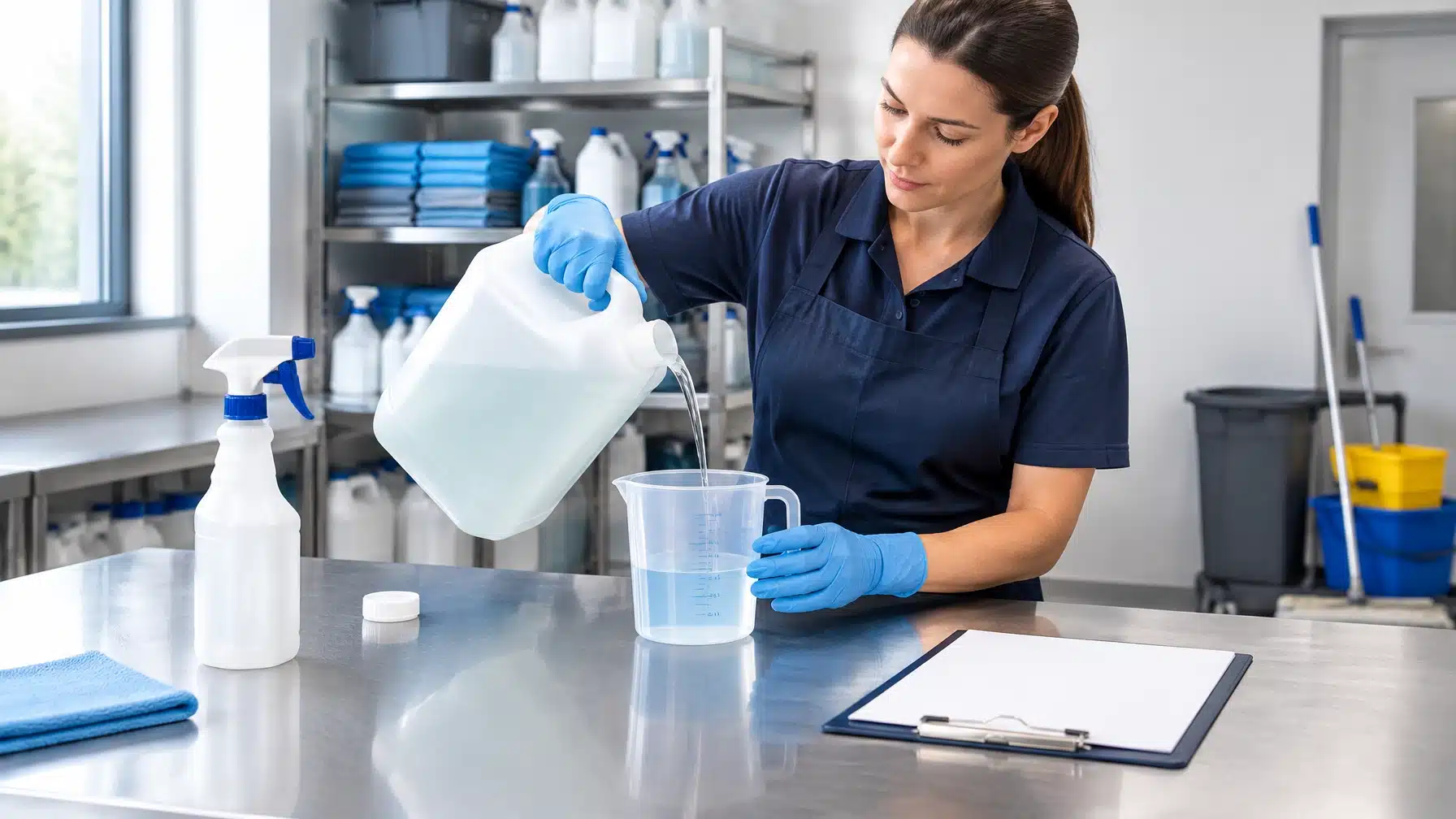

Category: Business & Operations
A low purchase price does not always mean a low cleaning cost. Concentrated cleaning products can make many litres of working solution from a smaller container, but the real cost depends on more than the price on the label. Dilution, delivery, dosing, staff time, storage and waste all affect what you pay for each usable litre and each completed cleaning task.
Ready to use products avoid the mixing step, which can be helpful where volumes are low or dosing facilities are not available. They may, however, cost more to transport and store per litre of usable solution. Neither format is automatically the better choice.
This guide explains how to compare them, with a worked example and a method you can apply to your own purchasing records.
What the terms mean
A concentrated product is supplied at a strength intended to be mixed with water before use. The manufacturer specifies the dilution for a particular task or surface. A ready to use product is supplied at its intended working strength and normally needs no further dilution.
The dilution ratio describes how much concentrate is needed for a given quantity of water or final solution. Read the label carefully because ratio notation can be interpreted in different ways. “One part product to 20 parts water” makes 21 parts of solution in total. “One part in 20” may mean one part product in 20 parts of final solution. The difference affects your calculation.
When comparing trade cleaning supplies, check the instructions for the actual cleaning task. A product may have different directions for different levels of soil or applications. Do not assume that one ratio applies to every job.
A comparison of the two formats
| Cost or operational factor | Concentrate | Ready to use |
|---|---|---|
| Purchase cost | Compare the price of the container and its volume | Compare the price per litre supplied |
| Working solution | Requires water and correct measuring or dosing | Usually ready for application |
| Staff time | Includes setup, dilution, checks and cleaning of dosing equipment | Usually has no dilution step |
| Storage | Often stores more usable solution in less space | More volume may need to be stored |
| Packaging and delivery | Fewer finished litres may need to be transported | More finished solution may increase volume moved |
| Dosing risk | Incorrect measuring can lead to weak or overly strong solution | No routine dilution calculation is needed |
| Best comparison | Cost per usable litre and cost per clean | Cost per usable litre and cost per clean |
The table is a starting point, not a purchasing decision by itself. If staff use more of one product to complete the same task, or if one format creates more waste, the apparent price difference may not reflect the real cost.

Calculate the cost per litre
Start with the amount you pay for the concentrate, including any delivery charge that should reasonably be allocated to it. Divide that total by the volume in the container to find the cost per litre of concentrate.
Next, calculate how much working solution the container can make at the manufacturer’s stated dilution. Divide the total container cost by the working solution volume. This gives the product cost per litre of working solution, before labour, water, equipment and waste are added.
For a ratio that means one part concentrate to 20 parts water:
- Total parts in the working solution: 1 + 20 = 21
- Working solution from a 5 litre container: 5 × 21 = 105 litres
- Product cost per litre of working solution: container price ÷ 105
This assumes the ratio is stated as one part product to 20 parts water. If the label instead specifies one part product in 20 parts of final solution, use 20 as the multiplier, not 21. When the wording is unclear, check with the manufacturer rather than guessing.
The water volume is not usually a major purchase cost, but it still needs to be included if your site tracks water use closely. For most comparisons, staff time, dosing and discarded solution are more likely to alter the result substantially.
Worked example: concentrate and ready to use
The figures below are assumptions for demonstrating the method. They are not a price survey or a claim about what any product should cost. Use the prices, dilution directions and timings that apply to your workplace.
Assume a 5 litre container of concentrate costs £36, with £2 allocated for delivery. Its label specifies one part concentrate to 20 parts water. A litre of ready to use product costs £1.40. For this example, preparing one litre of diluted solution takes 20 seconds of staff time, and the loaded labour rate is £15 per hour. The site also allocates 3 pence per litre for dosing equipment. It discards 5 per cent of the batch, for example because solution remains unused or is replaced before the next task.
The 5 litre container makes 105 litres of working solution before waste. At 5 per cent waste, about 99.75 litres are usable. The concentrate costs £36. Delivery adds £2. Preparing 105 litres takes 35 minutes, which costs £8.75 at the assumed labour rate. Equipment allocation adds about £3.15.
The total allocated cost is therefore £49.90 for about 99.75 usable litres. That works out at approximately 50 pence per usable litre.
At £1.40 per litre, 99.75 litres of ready to use product would cost £139.65 before any delivery cost. In this example, the concentrate has the lower calculated cost per litre, even after the assumed labour, equipment, delivery and waste are counted.
| Item | Concentrate example | Ready to use example |
|---|---|---|
| Product cost for about 100 usable litres | £36.00 | £139.65 |
| Allocated delivery | £2.00 | Not included |
| Dilution labour | £8.75 | No dilution time included |
| Dosing equipment allocation | £3.15 | Not included |
| Estimated usable volume | 99.75 litres | 99.75 litres |
| Estimated cost per usable litre | About £0.50 | £1.40 |
The comparison is not a universal result. Ready to use delivery charges, handling time and storage costs have not been added. The cost of applying the solution to a surface is also excluded because it may be similar for both formats. If the concentrate requires more preparation time, causes more waste, or does not perform as expected at the instructed dilution, the difference may narrow.
For a cost per clean, estimate how much solution is used for a defined task. If a task uses 250 millilitres, then the example concentrate costs about 12.5 pence in solution. The ready to use product costs 35 pence for the same volume. This is only a fair comparison if both products are suitable for the task and the same amount of solution achieves the required result.

Add the costs that are easy to miss
Staff time and dosing equipment
Mixing takes time. Include the time needed to collect the product, measure or pump the dose, add water, label the solution where required and clean the equipment. For a small amount of solution, that time may cost more than the product saved.
A calibrated dosing pump or dispensing system has a purchase and maintenance cost. Allocate this across the quantity of solution actually prepared, not the theoretical capacity of the equipment. Manual measuring may need less initial investment, but can take longer and make consistent dosing harder.
Delivery, packaging and storage
Compare prices on the same basis, such as delivered cost per usable litre. A concentrated container can reduce the amount of finished solution held in storage, but the site still needs an appropriate place for the concentrate. Consider secure access, containment, separation from incompatible materials and the space needed for delivery stock.
A larger pack can have a lower price per litre while creating more handling or stock management work. Check whether you can use the entire container within its stated shelf life and whether the supplier’s delivery terms suit your demand.
Waste, rework and surface damage
Count solution that is mixed but not used, spills, expired stock and product discarded after a task. Over dilution may leave soil behind and lead to repeat cleaning. Under dilution can waste chemical and may leave residues or damage surfaces. Both can increase the total cost, even if the container price appears low.
Measure actual use for a representative period. A simple record of the volume prepared, volume discarded and tasks completed can replace assumptions with site specific figures.
A step by step method for your own comparison
- Define the task. Identify the surface, type of soil and required outcome. Compare products intended for the same application, not simply products with similar names.
- Check the directions. Use the manufacturer’s label or technical information to confirm the correct dilution and any contact, rinsing or surface instructions.
- Calculate usable yield. Work out the total working solution from the container, then deduct measured or reasonably estimated waste.
- Find the delivered product cost. Include the relevant share of delivery and any other direct purchasing charges.
- Add preparation costs. Record staff time and an appropriate share of dosing equipment, cleaning and maintenance.
- Calculate cost per usable litre. Divide the total preparation cost by the usable solution volume.
- Calculate cost per clean. Measure how much solution is needed for a defined task, then multiply by the cost per usable litre.
- Check performance. Compare results on the actual surface and soil, following the product instructions. Record rework, residue, damage or changes in task time.
- Review the figures. Repeat the calculation when prices, instructions, water conditions or site practices change.
A cleaning supplies shop may list container prices and volumes, but those figures alone do not show the cost of a completed task. For example, KleanPro Supplies’ shop catalogue can be used to review listed pack sizes. Apply the same checks to any supplier: confirm the current instructions, calculate yield and include the costs relevant to your site.
Dilution, water quality and safe use
Correct dilution is both a cost and a safety issue. The Health and Safety Executive’s guidance on diluting chemical concentrates says working concentrations should follow the manufacturer’s specification. Using more concentrate than directed can waste product and increase exposure risk. Using too little may reduce cleaning performance.
Water quality can also affect results. Hardness varies between locations and may affect lather, rinsing or deposits, depending on the product and task. The Drinking Water Inspectorate guidance on water hardness explains how hardness is measured and why it varies. Do not change a dilution to compensate for hard water unless the product manufacturer advises it. If performance differs between sites, record local conditions and ask the manufacturer for suitable guidance.
Never mix cleaning products unless the manufacturer’s instructions specifically allow it. Check product compatibility and the safety information before using the chemical. Keep products in their original labelled containers where possible, and do not reuse food or drink containers for chemicals.

COSHH, storage and shelf life
Where workers may be exposed to hazardous substances, employers must assess and control the risks under the Control of Substances Hazardous to Health Regulations, known as COSHH. The HSE explains the process in its guidance on carrying out a COSHH risk assessment. A chemical safety data sheet provides information that can support the assessment, including hazards, handling, storage and emergency measures. It does not replace a workplace risk assessment or the product label.
Include the actual dilution task in your assessment. Consider splashes, spills, ventilation, manual handling, training and the protective equipment indicated by the assessment and product information. A dosing system may reduce direct handling, but staff still need training on its correct use and what to do if it leaks or blocks.
Follow the label and supplier guidance for storage conditions and shelf life. Keep stock organised so older containers are used appropriately, and do not use products beyond their stated expiry or recommended period after opening. The cost of an unused container that must be discarded belongs in the purchasing calculation.
Which format makes sense?
Concentrate is often worth evaluating where a site uses a regular volume, can dose it consistently and has suitable storage and controls. Ready to use products can be practical where demand is low, tasks are occasional or dilution equipment and trained staff are not available.
For buyers comparing professional cleaning supplies uk, the useful figure is not simply the price printed against a container. It is the cost of a suitable, correctly prepared amount of solution that completes a defined task safely and reliably. Keep the assumptions visible, use the manufacturer’s directions, and review actual use over time. That makes the comparison more useful than a price per container and helps ensure that any apparent saving holds up in daily operations.