

Sustainable cleaning is often described through a product label or a single feature. In day to day operations, however, its impact depends on more than what is printed on a bottle. The amount used, the task it is used for, the cleaning method, the textiles and equipment involved, and what happens to waste all matter.
For facilities managers, contract cleaners, hospitality teams and homeowners, a practical approach starts with avoiding unnecessary waste and getting routine work right. It also means treating environmental claims carefully. A claim that sounds reassuring is not useful unless its meaning is clear and its evidence can be checked.
This article looks at sustainable cleaning as an operational practice: how the waste hierarchy can guide decisions, why accurate dosing matters, what workplace recycling rules require in England, and how to assess environmental claims and ecolabels.
Start with prevention, not the recycling bin
The waste hierarchy sets out a preferred order for managing waste: prevent it where possible, prepare items for reuse, recycle, recover other value, and dispose of what remains. Defra’s waste prevention programme for England places prevention and keeping materials in use at the centre of a more resource efficient economy.
For a cleaning team, this means asking whether waste can be avoided before deciding how to recycle it. Is the task necessary at that frequency? Is the correct amount of solution being prepared? Can a durable tool or textile be used safely more than once? Are cleaning supplies being ordered in quantities that match actual use?
These questions do not mean compromising hygiene. Cleaning schedules and methods still need to meet the requirements of the site, its users and its risk controls. The point is to avoid product, packaging, water and labour being used without a corresponding cleaning benefit.
Defra’s latest available estimate for commercial and industrial waste in England reported 32 million tonnes in 2024. The department notes that these estimates have limitations and should be interpreted with care. Even so, the scale gives useful context: decisions made across workplaces add up. Prevention at the level of a cleaning store or contract can be a practical part of a wider resource management effort. See UK statistics on waste.
Make the cleaning method part of the decision
A product cannot be assessed separately from how it is used. A heavy duty degreaser may be required for stubborn grease in a commercial kitchen, while a lighter solution may be sufficient for routine surface maintenance. Using an unsuitable product can lead to extra applications, repeat work or surface damage. Using more than the recommended amount does not automatically improve the result.
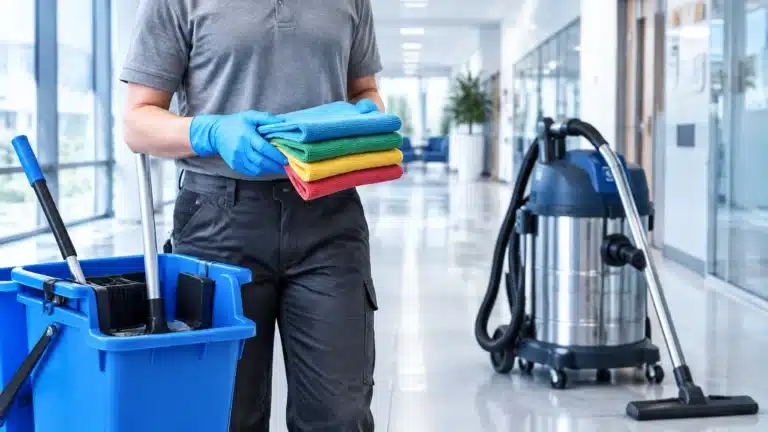
The same principle applies to cleaning textiles. Reusable micro fibre cloths can reduce reliance on disposable materials in suitable settings, but they need an effective system behind them. Teams should consider how cloths are separated between tasks, collected, laundered, dried, inspected and returned to service. Textile replacement, washing temperature, water and energy use all influence the overall picture.
There is no single answer that fits every workplace. In healthcare or other settings with specific infection control requirements, a disposable item may be the appropriate choice for a particular task. In other environments, well managed reusable cloths may be practical. The decision should reflect the hygiene requirement and the whole cleaning process, rather than a simple assumption that one type of cloth is always more sustainable.
UKCPI guidance on professional cleaning makes a similar point: the environmental comparison between reusable and disposable tools depends on how they are used and managed. A responsible decision considers the life cycle and the operational conditions.
Accurate dosing reduces waste and improves consistency
Correct dosing is one of the simplest operational controls to review. If a cleaning product is diluted for use, the stated instructions should be followed, and staff should have a reliable way to measure it. Depending on the site, this could mean a calibrated dispenser, a measuring vessel, or a suitable dilution system.
UKCPI gives a clear example of the impact of overuse: overdosing by 20 percent increases the product’s life cycle impact by 20 percent. The excess does not stop at the solution being poured down the drain. It also represents additional raw materials, packaging, manufacturing and transport for product that was not needed to achieve the specified cleaning task.
Overdosing can also affect practical results. Excess product may leave residue, require additional rinsing, or create extra work on a surface. It can make consumption less predictable and increase purchasing requirements. These are reasons to train staff in the correct method, not simply to ask them to use less.
Useful controls include keeping dilution instructions visible near the point of use, checking dispensing equipment, and making sure instructions are appropriate for the task and product. For a contract, consumption can be reviewed alongside areas cleaned and service requirements. A fall in product use is not meaningful on its own if it comes with missed tasks or poorer cleaning outcomes. Performance and dose need to be considered together.

Reuse textiles when the system supports it
Reusable cloths can reduce reliance on disposable wipes, but their effectiveness depends on suitable management. A written process can help staff understand how to use, separate and collect cloths, and how to ensure clean textiles are not confused with used ones.
Colour coding or another clear separation system may be used where appropriate to the site. Laundry arrangements should follow the relevant textile and product instructions. It is also useful to review how frequently textiles are replaced and whether they are being used for tasks for which they are suitable.
A comparison should include the full process: the material used to make the textile, its service life, laundering, detergent, energy and water consumption, drying, transport and disposal. It should also account for the specific hygiene needs of the work. A reusable option is not automatically the best choice in every setting, just as a disposable option is not automatically required for every task.
The same practical thinking applies to equipment and janitorial supplies more broadly. Maintained tools that stay in service, and purchasing decisions based on genuine demand, can help avoid premature replacement and excess stock.
Simpler Recycling is a compliance backdrop in England
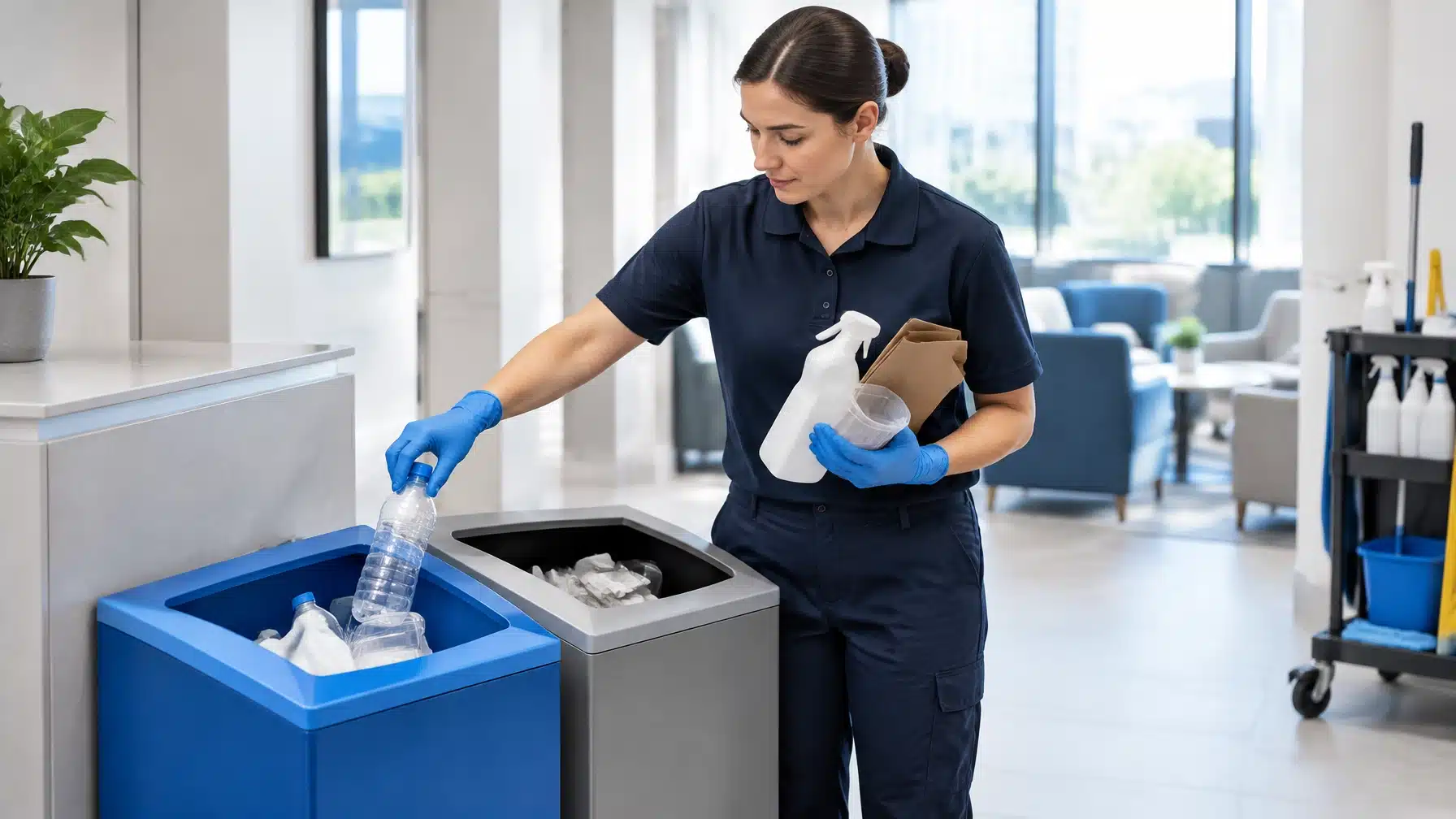
From 31 March 2025, most workplaces in England have been required to separate specified waste streams before collection under the Simpler Recycling rules. The required streams are dry recyclable materials, food waste and residual waste. Dry recyclables include plastic, metal, glass, paper and card. Micro firms, defined in the guidance as businesses with fewer than 10 full time equivalent employees, have until 31 March 2027 to comply.
The rules apply to many workplace types, including offices, hospitality, retail and healthcare settings. They also cover waste produced by employees, customers and visitors. The details of collection arrangements matter: for example, paper and card may be collected with other dry recyclables only where the collector’s service allows it.
Cleaning teams can support compliance by understanding which waste streams are generated in each area, ensuring bins are clearly identified, and checking how waste is presented to the collector. Cleaning product containers and other materials should only be placed in a recycling stream if they meet the collector’s requirements. Contaminated materials may need different handling.
These are England specific requirements, not a single set of rules for every part of the UK. Businesses operating across the devolved nations should check the relevant local requirements. The GOV.UK workplace recycling guidance sets out the rules and timing for workplaces in England.
Recycling is important, but the hierarchy still begins with prevention. A compliant waste collection process is one part of a responsible operation, not a substitute for avoiding unnecessary waste in the first place.
Read environmental claims with care
Terms such as “green”, “eco friendly” and “sustainable” can sound definitive while leaving important questions unanswered. Which part of the product or service does the claim describe? Is it about ingredients, packaging, manufacturing, use, disposal, or the overall life cycle? What is the comparison, and what evidence supports it?
The Competition and Markets Authority’s Green Claims Code says environmental claims should be truthful and accurate, clear and unambiguous, and should not omit or hide important relevant information. Comparisons should be fair and meaningful, claims should consider the full life cycle where relevant, and businesses should have evidence to substantiate what they say.
A specific claim is easier to assess than a broad one. For instance, a statement about a defined percentage of recycled packaging is more informative when it identifies which packaging it refers to and what evidence supports the percentage. A statement that a product is “sustainable” does not tell a buyer what has been measured or compared.
The CMA’s January 2026 guidance on green claims across the supply chain also makes clear that businesses should not assume responsibility rests only with the manufacturer. A retailer, supplier or other business that repeats or presents a claim should take appropriate steps to verify it. Supplier information can help, but it is sensible to retain the evidence, check that it supports the exact wording and update the claim if the facts change.
This matters legally as well as commercially. Under the Digital Markets, Competition and Consumers Act 2024, the CMA has direct powers to determine certain consumer law breaches and impose penalties. It is therefore prudent for any business making environmental statements to treat substantiation as part of the claims process, rather than a document to request only after a question is raised.
For a buyer, practical questions include: What exactly does this claim cover? Is there independent verification or a clear test method? Does the evidence relate to the product being purchased, rather than the company or a different product? Are important limits explained? If a claim relies on a comparison, is the basis for that comparison available?
What ecolabels and biodegradability rules tell you
An ecolabel can give buyers a useful set of criteria to check, but it is not a general guarantee that every product or cleaning operation is sustainable. The EU Ecolabel is voluntary and product specific. Criteria for hard surface cleaning products include requirements related to biodegradability, substances of concern, packaging, user information and cleaning performance. An all purpose cleaner would need to fall within the relevant product group and meet the applicable criteria to qualify.
These criteria are distinct from legal requirements. Regulation (EU) 2026/405 on detergents and surfactants replaces the earlier EU Detergents Regulation. It carries forward surfactant biodegradability requirements and introduces a digital product passport for detergents placed on the EU market. The regulation generally applies from 23 September 2029, with some additional biodegradability provisions phased in later. Businesses placing detergents on the EU market should refer to the text and transition provisions in the EU regulation on detergents and surfactants.
For UK buyers, it is important not to confuse a European regulatory timeline with an immediate change to every UK product requirement. The EU regulation is relevant to products placed on the EU market. Ecolabel criteria, biodegradability requirements and general rules against misleading environmental claims are related considerations, but each has its own scope.
A label or claim is a useful starting point for questions, not the end of them. Check what the scheme measures, which product it applies to, and whether it addresses the aspect that matters to your operation. A product may meet a particular biodegradability criterion without that fact alone proving that its packaging, use, transport or the overall cleaning service has a lower environmental impact.

A practical checklist for buyers
Whether you manage a large contract or clean at home, a few consistent checks can help turn sustainability into a routine part of purchasing and operations.
- Define the cleaning task and hygiene requirement before choosing a product.
- Check the product instructions and use the correct dose for the task.
- Review whether dispensing equipment is accurate and convenient for staff.
- Consider reusable textiles where they are suitable and can be managed safely.
- Include laundering, replacement and transport when assessing textile choices.
- Avoid buying more product or equipment than your storage and usage justify.
- Separate waste streams according to the applicable local rules and collection service.
- Ask what a supplier’s environmental claim specifically means and request evidence.
- Check whether an ecolabel applies to the product and the intended use.
- Keep records of the basis for any environmental claims made to customers or staff.
These steps are relevant whether you are selecting a heavy duty cleaner for a kitchen, a glass cleaner for public areas or an all purpose floor cleaner for routine maintenance. They are also useful when comparing professional cleaning products and trade cleaning supplies, because a product choice only tells part of the story. Training, dosing, storage, use and waste arrangements shape the result.
Sustainable cleaning is a repeatable process
In practice, sustainable cleaning is built through steady operational decisions. Preventing unnecessary product use, selecting methods that fit the task, maintaining equipment and reusable textiles, and separating waste correctly can all contribute. Accurate dosing is one measurable part of this approach. Clear, substantiated environmental claims are another.
For trade buyers, the strongest questions are not simply whether a product is described as sustainable, but what the claim means, how it has been verified, and how the product will be used within the real cleaning system. For homeowners, the same principle applies on a smaller scale: use the right cleaner for the job, follow the instructions and avoid excess.
To review cleaning supplies and product information, visit the KleanPro Supplies shop.
References
- Defra, Waste prevention programme for England: Maximising Resources, Minimising Waste
- Defra, UK statistics on waste
- GOV.UK, Simpler Recycling: workplace recycling in England
- UKCPI, Sustainable cleaning
- Competition and Markets Authority, Green Claims Code
- Competition and Markets Authority, Making green claims: Getting it right, across the supply chain
- Regulation (EU) 2026/405 on detergents and surfactants