

Professional cleaning chemicals help maintain kitchens, washrooms, floors and shared spaces. But safe results depend on more than choosing the right cleaner. Storage, handling and dilution all affect the risk of skin or eye injury, breathing problems and accidental chemical reactions.
For facilities managers, hospitality teams, healthcare sites, restaurants and cleaning contractors, clear procedures help protect staff and prevent avoidable incidents. The same principles matter at home, particularly when using concentrated or commercial grade products. Above all, cleaning products should not be mixed. Bleach must never meet acidic cleaners or ammonia.
Why chemical safety matters
Cleaning products can cause harm through splashes, skin contact, inhalation or accidental swallowing. The risks vary by product and task. A ready to use glass cleaner may present different hazards from a concentrated heavy duty degreaser or a drain cleaner unblocker. Frequent wet work and repeated contact with cleaning products can also irritate skin. Some ingredients can cause skin allergies or asthma, while corrosive products can cause burns and serious eye damage.
The Health and Safety Executive (HSE) advises that safe working depends on controls suited to the task. These may include safer work methods, reducing contact, preventing spills, suitable ventilation and appropriate protective equipment. Its guidance on COSHH and cleaners explains common health risks and practical ways to reduce exposure.
A safe routine also supports consistent cleaning. Staff who know which product to use, how much to apply and what must be kept separate are less likely to make dosing errors or damage surfaces. A documented process helps a business manage change when products, staff or cleaning tasks change.
What COSHH requires
The Control of Substances Hazardous to Health Regulations 2002, usually called COSHH, require employers to assess risks to health from hazardous substances at work and to prevent or adequately control exposure. Cleaning chemicals must be considered in the context of how they are used, not only as items on a stock list. A task may include moving containers, measuring concentrate, spraying, wiping, rinsing and disposing of waste.
HSE’s COSHH guidance for cleaning and advice on carrying out a COSHH risk assessment can help employers identify the hazards, consider who may be exposed and decide what controls are needed. The assessment should account for routine work as well as foreseeable problems such as leaks, splashes and accidental mixing.
For each product, keep the current label and Safety Data Sheet, or SDS, available to the people who use it. The SDS provides more detailed information, including storage conditions, incompatibilities, protective equipment, spill arrangements and first aid. Review the assessment if a product or process changes, or after an incident reveals that existing controls were not sufficient.
Read the label before use
Under the GB Classification, Labelling and Packaging Regulation, known as GB CLP, cleaning products may carry hazard pictograms, signal words and hazard and precautionary statements. The pictogram is an important prompt, but it is not a substitute for reading the whole label.
For example, the corrosive pictogram can indicate a risk of skin corrosion or serious eye damage. The exclamation mark pictogram is used for certain skin or eye irritants and other hazards. HSE explains the distinction in its guidance on cleaning products and GB CLP. The European Chemicals Agency guide to CLP pictograms also provides an overview of the symbols.
Before starting, check the product name, intended use, dilution instructions, required protective equipment, contact time and warnings about incompatible substances. Do not assume that products with similar uses have the same ingredients or precautions. A professional bathroom cleaner designed to tackle limescale, for instance, may be acidic. It must not be used with bleach or a chlorine releasing product.
If a label is damaged, missing or unreadable, do not guess what is in the container. Set the product aside and seek clear identification and safety information before it is used.
Store products securely and separately
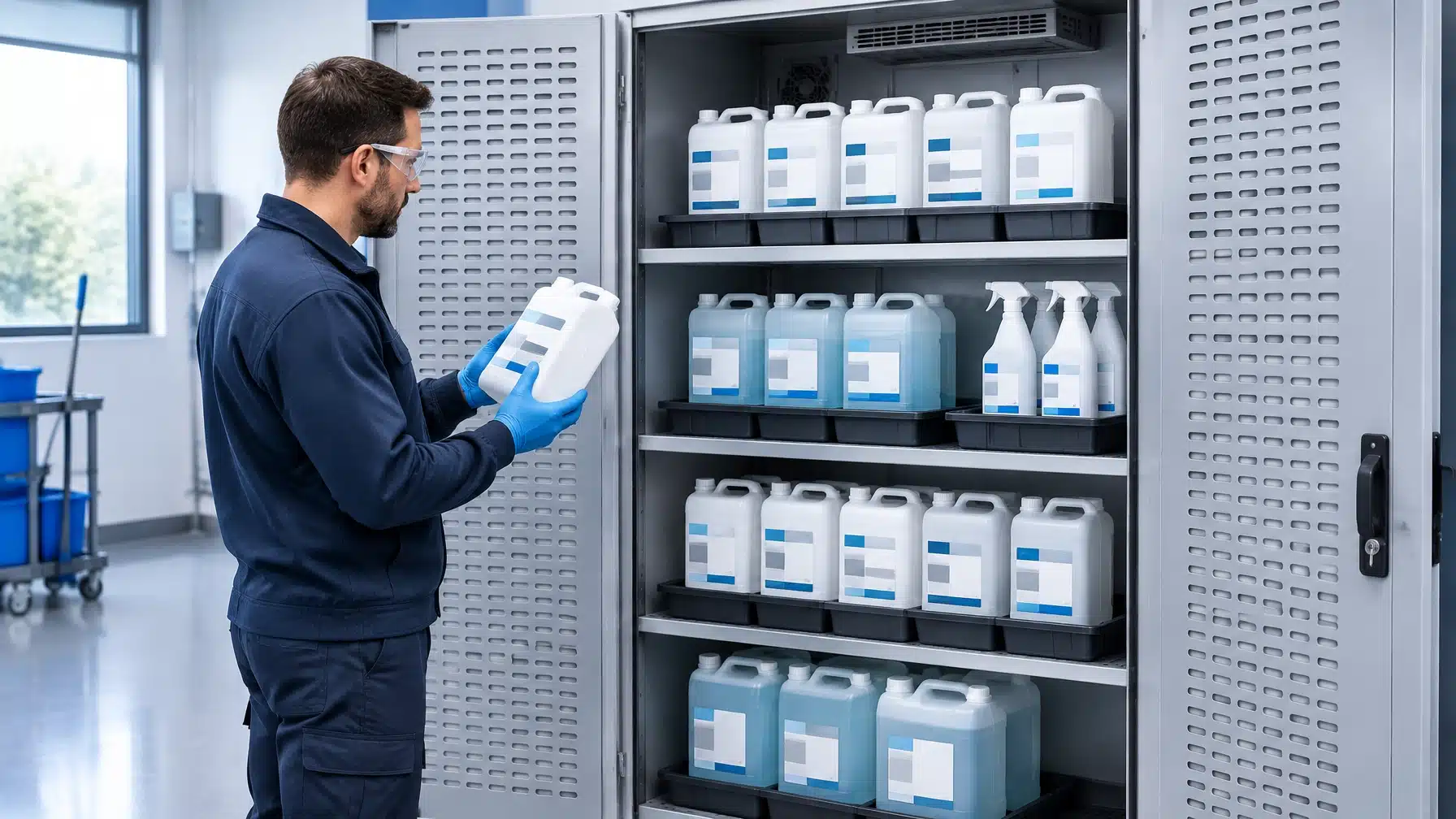
Storage should keep containers stable, labels visible and incompatible products apart. HSE guidance on cleaning accommodation and facilities and its advice for handling concentrates recommend secure storage in a cool, dry, ventilated and dark place, with a way to contain spills. Store only the quantity needed for the work and keep products away from food, heat and direct sunlight.
Keep chemicals in their original, closed containers wherever possible. The packaging is designed for the product and carries important safety information. Never transfer a chemical into a drinks bottle, food container or unlabelled vessel. If decanting is needed for a task, use a suitable container and label it clearly in line with the product instructions and workplace procedure. Close the original container promptly after use and wipe its outside if it has been contaminated.
Segregate products according to the label and SDS, not simply by product name or where they fit on a shelf. In particular, keep bleach and other chlorine releasing products physically separate from acidic cleaners, including descalers and some toilet cleaners. Store ammonia containing products away from bleach as well. Avoid shared trays or spill containment arrangements that could allow leaks from incompatible products to meet.
Keep containers upright and stable, with heavier packs lower down where practical. A secure store should restrict access by unauthorised people and be arranged so that stock can be checked without moving or handling containers unnecessarily. For homes, keep products in their original packaging, out of reach of children and away from food and drink.

Dilute carefully and control exposure
Concentrates require particular care because measuring and pouring can create splashes or expose users to stronger solutions. Follow the product label and SDS exactly. Do not estimate the amount by eye, mix different concentrates or make a stronger solution on the assumption that it will clean better.
Where the instructions require dilution, use the specified ratio and a suitable measure, pump or dosing system. HSE’s guidance on diluting chemical concentrates advises adding the concentrate to the diluting liquid, rather than the other way round, unless the product instructions say otherwise. This reduces the chance of splashing. Make up only the amount needed for immediate use, unless the manufacturer gives different storage instructions for diluted product.
A closed or measured dosing system can reduce handling and help staff prepare repeatable solutions. Use it only as intended, and check that the equipment is suitable for the chemical. Keep the work area ventilated and avoid creating unnecessary spray or mist. If a product is supplied ready to use, do not dilute it unless the label specifically permits this.
Wear the PPE identified by the risk assessment and product information. Depending on the task, this may include chemical compatible gloves, protective goggles or an apron. Ordinary household gloves or eyewear should not be assumed to provide the required protection. Remove contaminated gloves safely, wash splashes from the skin promptly and follow good hand care practices.
The Personal Protective Equipment at Work Regulations 1992 were amended in 2022. Where the risk assessment identifies a need for PPE, employers must provide suitable PPE free of charge, maintain and store it appropriately, and give workers information, instruction and training in its use. The amended regulations extended relevant duties to limb (b) workers. HSE sets out the changes in its guidance on the extended scope of the PPE at Work Regulations. PPE is one part of control, not a replacement for safe storage, suitable equipment and clear procedures.

Never mix cleaning products
Mixing cleaners can create a chemical reaction, release harmful gas or cause heat and splashing. The safest general rule is simple: use one product at a time and do not mix products unless the manufacturer explicitly instructs you to do so.
The most important example is bleach. Many bleach products contain sodium hypochlorite. When sodium hypochlorite is mixed with acidic products, it can release chlorine gas. Acidic products may include limescale removers, some toilet cleaners and some bathroom cleaners. The UK Health Security Agency’s information on sodium hypochlorite describes the risk and possible effects, including burning eyes or throat, coughing and breathing difficulties. The chlorine information page explains that more substantial exposure can cause serious respiratory harm.
Bleach must also never be mixed with ammonia containing products. This can produce chloramines, which are highly irritating to the respiratory tract. Do not try to improve a cleaning result by combining bleach with a bathroom cleaner, glass cleaner, all purpose cleaner spray, degreaser or any other product. The product name alone does not tell you whether it is compatible.
The same caution applies between cleaning tasks. Do not apply a new chemical over residue from a previous product. Follow the product instructions for rinsing or removing residues before changing products. In a kitchen, for example, a heavy duty degreaser and a disinfecting product have different purposes and should be used in sequence only as directed by the relevant labels and site procedure. A drain cleaner unblocker should never be combined with another drain product or poured into a drain where another chemical may remain.

Products such as a heavy duty degreaser and a bathroom cleaner have distinct uses and instructions. Their presence in the same cleaner supply range does not make them interchangeable or compatible. The label and SDS for the exact product should always guide use.
Spill response and first aid
Every workplace using hazardous cleaning products should have a spill procedure based on its COSHH assessment and the product SDS. Staff should know who is authorised to manage a spill, where the appropriate spill equipment is kept and when the area must be evacuated. Do not improvise a neutralising mixture or use another cleaner to treat a spill.
If products have mixed and fumes or gas are present, leave the area immediately, warn others and prevent entry. Do not attempt to clean up the mixture or return to ventilate the area if doing so would expose you. Contact the emergency services where there is a toxic gas risk or anyone is affected. Re entry should wait until the area has been assessed as safe by competent responders.
For skin or eye contact, follow the product label and SDS first aid instructions. The UKHSA advice for sodium hypochlorite is to remove contaminated clothing and wash affected skin with lukewarm water and soap for at least 10 to 15 minutes. For eye contact, it advises removing contact lenses and irrigating with lukewarm water for at least 10 to 15 minutes, then seeking medical advice. If someone has inhaled chlorine or another harmful gas, move away from the source and seek medical advice. Call emergency services for serious symptoms, breathing difficulty or significant exposure.
Make safe practice routine
Safe chemical management is a repeatable process: identify the product, read its instructions, store it in the right place, measure it correctly and keep it separate from incompatible products. Keep COSHH assessments, labels and SDS information accessible, and make sure workers receive training before handling unfamiliar products.
This applies across a professional cleaning supplies uk operation and at home. Whether choosing janitorial supplies for a site or products from a cleaning supplies shop for domestic use, use only the amount and method stated by the manufacturer. A glass cleaner, all purpose floor cleaner and heavy duty cleaning products each have their own instructions. Never assume one product can safely replace or be combined with another.
For managers, regular checks can confirm that containers are labelled and intact, storage remains organised and staff understand the spill and first aid arrangements. For homeowners, the same discipline is straightforward: keep products closed in their original containers, follow the label and never mix cleaners. These habits make daily cleaning more predictable and help protect everyone who uses the space.
References
- HSE, COSHH and cleaners
- HSE, Control of substances hazardous to health
- HSE, How to carry out a COSHH risk assessment
- HSE, Diluting chemical concentrates
- HSE, Cleaning accommodation and facilities
- HSE, Cleaning products and GB CLP
- HSE, The GB CLP Regulation
- ECHA, CLP pictograms
- HSE, Extended scope of the Personal Protective Equipment at Work Regulations
- GOV.UK, Sodium hypochlorite: general information
- GOV.UK, Chlorine: general information