


Laundry detergent and fabric softener are often used together, but they perform different jobs. Detergent is formulated to loosen soil and carry it away in the wash water. Fabric softener is usually added in the rinse, where conditioning ingredients settle onto fibres to change how the fabric feels.
Understanding this difference can help housekeeping teams, facilities managers, care laundry operators and homeowners choose appropriate products, set practical routines and avoid common problems such as detergent residue or towels that absorb water less readily. This guide explains the chemistry in plain terms, then considers what it means for everyday and professional laundry.
How detergent lifts soil from fabric
A laundry detergent is a blend of ingredients, each contributing to the cleaning process. A key group is surfactants. These molecules have one part that interacts well with water and another that is drawn to oils and grease.
During washing, the oil seeking parts associate with oily soil on the fabric. Water, movement and the action of the machine help loosen the soil. Surfactant molecules then gather around small droplets of oil and dirt, with their water compatible parts facing outwards. These groupings are called micelles. They help keep soil dispersed in the wash liquor so it can be carried away when the water is drained and the load is rinsed.
The Royal Society of Chemistry’s explanation of washing detergent describes this process and explains why surfactants are central to cleaning. It also notes that detergent formulas can contain several other types of ingredient, depending on their intended use.
This chemistry helps explain why washing is more than simply adding soap and water. Soil has to be released from fibres, held in the water rather than redeposited, and removed from the load during rinsing.
What the other detergent ingredients do
Builders and water hardness control
Water contains dissolved minerals, including calcium and magnesium. In hard water, these minerals can interfere with detergent performance and contribute to deposits. Builders and other water conditioning ingredients help manage these minerals, allowing surfactants to work more effectively.
Alkaline ingredients can also support cleaning. They adjust the wash water so some soils, including greasy material, are easier to remove. The right balance depends on the detergent formula, the fabric, the wash equipment and the process. Using more detergent than directed does not necessarily compensate for hard water or a poorly set wash programme. It may instead leave additional residue that needs to be rinsed away.
For trade operators, water quality is a process consideration rather than a minor detail. NHS England’s Health Technical Memorandum 01 04 identifies water hardness and alkalinity or pH among the factors that may need monitoring in laundry processes for healthcare linen.
Enzymes and specific stains
Some detergents contain enzymes. These are proteins that help break larger stain materials into smaller components that are easier to remove. Different enzymes act on different kinds of soil. Proteases work on protein based residues, such as some food stains. Amylases act on starch, while lipases act on certain fats.
An enzyme is not a general purpose stain remover for every substance. Its effectiveness depends on the stain, the formulation and the conditions of the wash. The Royal Society of Chemistry notes that enzymes are among the ingredients used in biological detergents and that formulas vary. Always check the product instructions and the garment care label, particularly for delicate or specialist fabrics.
Enzymes can also support cleaning at lower temperatures in suitable formulations. The UK Cleaning Products Industry Association explains that enzymes can be effective at lower temperatures and may contribute to energy savings when they are used as part of an appropriate cleaning process. That does not mean every load should be washed cold. The right temperature depends on the fabric, soil, detergent guidance and any required hygiene process.
Bleaching agents and appearance
Some detergents include bleaching ingredients to help address stains that are difficult to remove through surfactant action alone. These ingredients are not present in every product and may not be suitable for every colour or fibre. Always consider garment care instructions and product directions before using a detergent with bleaching action.
For operators handling uniforms, towels or guest linen, repeatable results depend on matching the detergent and programme to the textile. A product that works well on white cotton may not be appropriate for coloured items or fabrics with specialist finishes.
How fabric softener works differently
Fabric softener is not simply a second detergent. It is generally used in the final rinse, after the main wash liquor has been drained. Many conditioners use positively charged ingredients known as cationic surfactants. These can attach to the surface of many textile fibres, which tend to carry a negative charge after washing.
Once deposited, the conditioning ingredients form a thin layer on the fibres. This reduces friction between them, which can make fabric feel smoother and help reduce static cling. Fragrance may also be included, but fragrance does not indicate whether the wash has removed soil or achieved a particular hygiene outcome.
The UKCPI article on research into fabric softeners discusses how cationic ingredients interact with cellulose fibres. The underlying idea is useful operationally: detergent ingredients are intended to help remove soil, while conditioner is intended to remain on the textile after rinsing.

When softener may not be the right choice
A softer feel is not always the priority. Because conditioner leaves a layer on fibres, it can affect some textile properties. Towels may become less absorbent when softener is used too heavily or too frequently. Certain technical textiles, flame resistant garments and other specialist fabrics may have care requirements that limit or prohibit conditioner use.
For care and healthcare laundry, the relevant process and textile guidance should take precedence over a general preference for softness or fragrance. NHS England HTM 01 04 concerns decontamination of linen for health and social care. It describes process control, equipment validation and monitoring, including variables such as programme, time, temperature, chemical dosing, load weight, alkalinity and water hardness. It should not be read as a general product selection guide for every domestic wash.
The key distinction is that detergent performance and fabric softening do not establish that linen has been hygienically decontaminated. The HTM describes thermal disinfection conditions of at least 65°C for 10 minutes or 71°C for 3 minutes, where the specified process is followed and the conditions are achieved across the items requiring disinfection. Chemical disinfection has its own requirements, including the disinfectant supplier’s specified concentration, temperature and contact time. Healthcare laundry operators should follow their validated process and local policy, rather than assuming that an ordinary detergent or fabric softener provides disinfection.
Dose, load and rinse all matter
Good cleaning depends on the whole wash process. Detergent dose, water hardness, soil level, load size, time, temperature, mechanical action and rinsing all influence the result. If a machine is overloaded, water and detergent may not circulate evenly through the textiles. If the dose is too high, residue may remain. If it is too low for the load and conditions, cleaning may be insufficient.
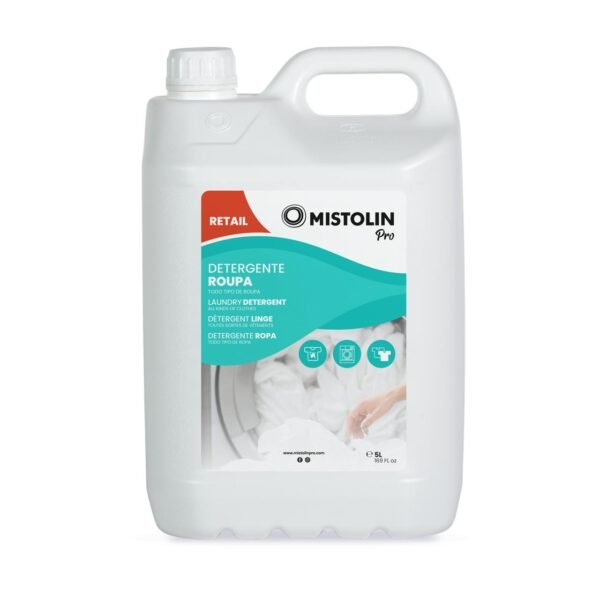
Use the detergent maker’s instructions for the relevant machine and load. For example, the product guidance for Mistolin Pro Laundry Liquid Detergent gives a dose range of 8 to 20 millilitres per kilogram of dry clothing, depending on how soiled the laundry is. The manufacturer’s current label and instructions should always be checked before use, as product directions take priority over general advice.
Fabric softener should be dispensed in the correct compartment or added at the appropriate point in the process. The product instructions for Mistolin Pro Fabric Softener specify use during the final rinse and give a dose range of 5 to 10 millilitres per kilogram of dry laundry. These are product specific directions, not universal dosing rules for all conditioners.

Practical guidance for trade laundry teams
In hotels, care settings, hospitality venues and commercial laundries, a consistent process can make results easier to assess and stock easier to manage. Start by identifying the textiles being processed and the type of soil commonly encountered. Separate items according to care instructions and any infection prevention or hygiene requirements.
Then check the washing equipment and detergent instructions. A measured dose is generally more reliable than an estimate, especially where laundry is processed repeatedly. Staff should know which product goes in each dispenser and which cycle is intended for different fabric types. Where automatic dosing is used, the system should be maintained and monitored according to its instructions.
For healthcare linen, follow the applicable validated decontamination process. HTM 01 04 highlights the importance of monitoring the disinfection process and checking that equipment and controls perform as intended. A clean appearance alone is not proof that a process has met its required conditions. Fabric softener should only be used where it is compatible with the textile and permitted by the relevant laundry policy.
For everyday household laundry, the same principles apply on a smaller scale. Avoid packing the drum too tightly, measure detergent according to the load and water conditions, and use conditioner only when its effect is wanted and suitable for the items being washed. If towels are not absorbing well, consider reducing or stopping softener use and check that the detergent dose and rinse settings are appropriate.
Lower temperature washing and sensible use
Reducing wash temperature can reduce energy use, but temperature is only one part of the cleaning system. The UKCPI notes that some detergent ingredients, including enzymes, can support effective cleaning at lower temperatures. The benefit depends on the formula and the wash conditions. For commercial sites, changing a programme should be considered in relation to the textiles, the soil load, equipment and any hygiene specification.
Using only the amount of product required is also a practical way to avoid unnecessary chemical use and reduce the likelihood of residue. The UKCPI’s guidance on cleaning product ingredients discusses how formulation and correct use contribute to cleaning with fewer resources. Where a process is tightly specified, however, efficiency changes should be checked against that process rather than introduced informally.
Choosing products for the job
The most suitable laundry detergent is one that fits the fabric, soil, water conditions, equipment and required wash process. A fabric softener is an optional finishing product, not a replacement for detergent and not a disinfection treatment. Keeping their roles separate makes it easier to set expectations and troubleshoot poor results.
For facilities managers and housekeeping teams, product instructions, dosing controls and staff training support repeatable laundry outcomes. For homeowners, careful dosing and attention to care labels can help prevent residue and protect fabrics. In all settings, follow the product label, machine guidance and any applicable workplace or healthcare laundry procedure.