Newsletter Subscribe
Subscribe for news, offers and a welcome 5% discount on us.
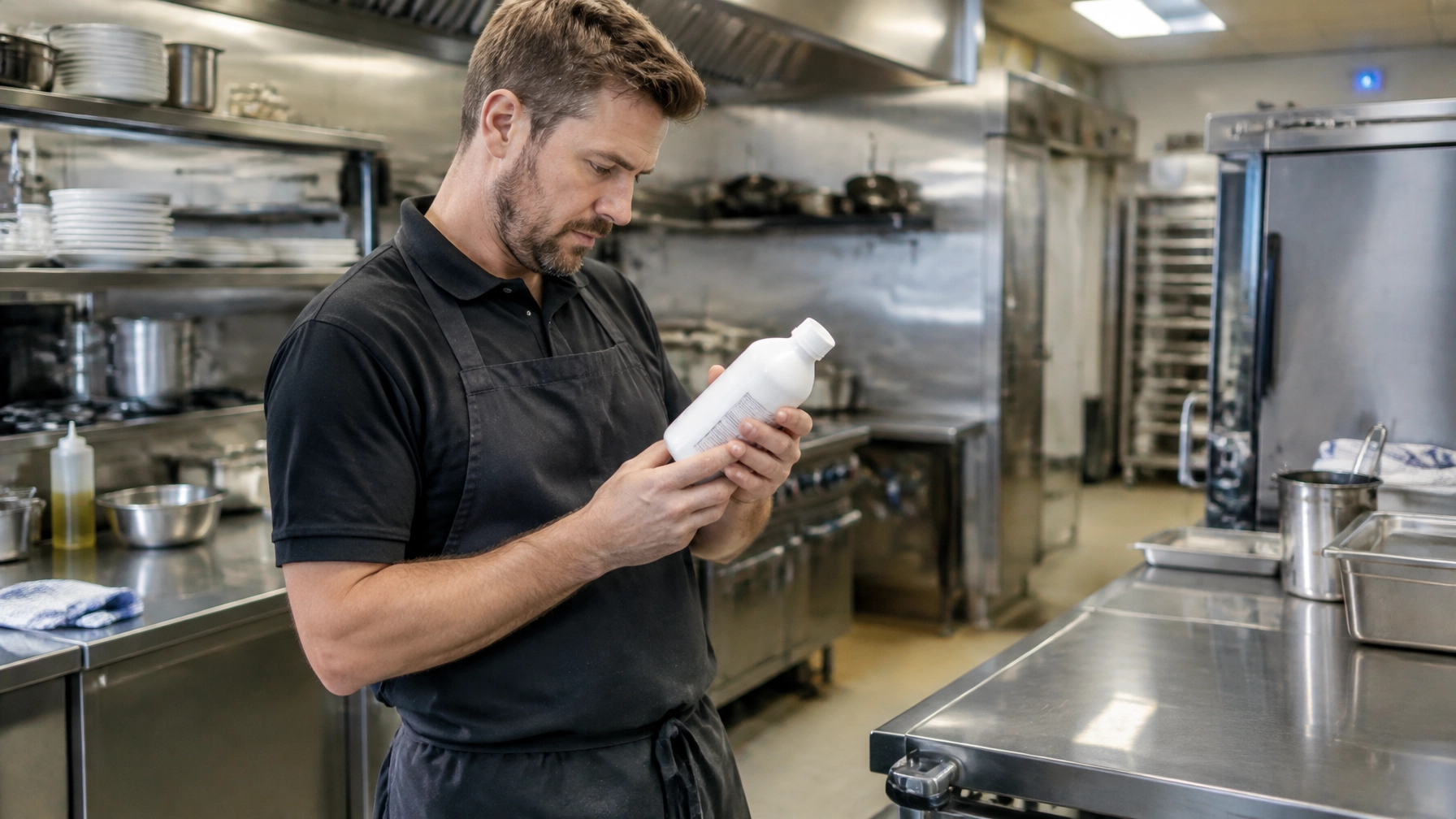
The closing shift is nearly over. A worktop looks clear, so someone sprays disinfectant across it and wipes it straight away. It seems like a sensible shortcut. But if grease and food residue were still on the surface, and the disinfectant was wiped off before its stated contact time, the important part of the job may not have happened.
In food hygiene, the most common cleaning weakness is not necessarily the choice of chemical. It is the order of the work. Disinfecting before cleaning, or treating one quick wipe as both stages, can leave dirt in place and give the disinfectant too little time to act.
The Food Standards Agency (FSA) explains a two stage process in its cleaning guidance. The law requires food premises and equipment to be kept clean, and requires food contact equipment to be effectively cleaned and, where necessary, disinfected. The guidance makes clear how to carry out those distinct tasks when disinfection is needed.
Many businesses believe their teams follow that sequence. The more useful question is whether the procedure is clear, workable during a busy shift and supported by records showing what was done. The gap between an ideal procedure and the late night reality is where cleaning controls can break down.
Regulation (EC) No 852/2004 Annex II is part of the assimilated law applying in Great Britain. In England, the Food Safety and Hygiene (England) Regulations 2013 provide for enforcement of the hygiene requirements. Wales, Scotland and Northern Ireland have their own enforcement arrangements, so businesses operating in more than one nation should check the rules and advice applicable to each location.
The Annex covers more than worktops. Chapter I requires food premises to be kept clean and in good repair. It also requires their layout and design to permit adequate maintenance, cleaning and disinfection. Cleaning agents and disinfectants must not be stored in areas where food is handled.
Chapter II deals with rooms where food is prepared, treated or processed. Floors must be sound and easy to clean and, where necessary, disinfect. The regulation describes suitable materials as impervious, non absorbent, washable and non toxic, with adequate surface drainage where appropriate. Surfaces in food handling areas, especially those in contact with food, must be sound and easy to clean and, where necessary, disinfect. They should be smooth, washable, corrosion resistant and non toxic.
Chapter V covers articles, fittings and equipment that come into contact with food. They must be effectively cleaned and, where necessary, disinfected often enough to avoid any risk of contamination. Equipment must also be installed so that it and the surrounding area can be adequately cleaned. Chapter IX requires hazardous and inedible substances to be labelled and kept in separate, secure containers.
The significant wording is “cleaned and, where necessary, disinfected”. These are distinct actions. The law does not mean every surface must be disinfected at every moment. It does mean that where the food safety risk calls for disinfection, it cannot be treated as a substitute for cleaning.
Cleaning removes dirt, grease, food particles and other matter. Disinfection reduces microorganisms on a surface. The FSA’s Safer Food Better Business guide to cleaning effectively and its E. coli O157 cross contamination guidance describe the practical sequence.
Stage one is general cleaning. Use detergent to loosen and physically remove visible grease, dirt and food particles. Rinse the surface thoroughly so that cleaning residues and loosened soil are removed.
Stage two is disinfection. Apply a suitable disinfectant or sanitiser across the surface, following the manufacturer’s instructions for dilution, contact time and temperature. Rinse afterwards if the instructions require it, and take account of any direction about drying before food is put back in contact with the surface.
The sequence matters because disinfectants are not designed to work reliably through layers of grease, food residue or visible dirt. The FSA guidance warns that disinfection may fail if a surface is dirty, if the product is diluted incorrectly, if it is left for too little time or if it is used at the wrong temperature.
A sanitiser does not remove the need for two stages simply because it combines cleaning and disinfecting properties. Use it first as a detergent to remove soil, rinse, then apply it again for the disinfection stage. Follow the product instructions each time, including whether a final rinse is needed to avoid residues contaminating food.

A disinfectant needs to remain on the surface for the stated contact time. Wetting a worktop and wiping it straight away is not the same as completing the disinfection stage. If the surface is wiped before the product has had the required time to work, the method on the label has not been followed.
This is where cleaning systems often meet the reality of service. A chef may not have time to stand beside a worktop while a product remains wet. That practical constraint does not make contact time disappear. It means the product and the workflow need to be chosen together. The product must have a contact time that staff can achieve in the real working pattern, or the task needs to be arranged so the surface can remain wet for the required period.
The cleaning stage also needs time and physical action. A quick spray over a greasy surface is not a shortcut to disinfection. It is an attempt to disinfect through soil, which the FSA guidance identifies as a reason chemical disinfection will not be effective. A suitable heavy duty degreaser can be useful where grease is the main soil, but it still belongs to the cleaning stage. It does not remove the requirement to rinse and then disinfect where necessary.
A clear procedure can help staff understand the sequence as well as the reason behind it. For a related discussion of how activity levels and defined standards differ, see why frequency alone is not a cleaning standard.
For chemical disinfectants or sanitisers used to control cross contamination, FSA guidance says the product should meet the requirements of BS EN 1276 or BS EN 13697, or an equivalent standard, at the recommended use, dilution and contact time. These standards provide evidence that a product can reduce a range of harmful bacteria when it is used in the conditions claimed.
If the relevant standard is not printed on the label, the guidance points to the supplier or manufacturer for confirmation. Products are introduced, withdrawn and reformulated, so an old certificate or a remembered product name would not establish that the current product in a particular bottle has the required performance.
The practical purchasing test is therefore straightforward. Ask for current documentation that confirms the standard and explains the tested dilution and contact time. Keep the label information and technical data sheet on file. The safety data sheet has a different but important purpose: it supports safe handling and workplace chemical controls. It is not, by itself, proof of disinfectant efficacy.
This is a modest step for a catering buyer, facilities manager or contract cleaner. A product name on an invoice is not enough to tell a member of staff how to dilute it, how long to leave it on a surface, or whether rinsing is needed. A documented product choice can make the process easier to teach and verify.
A worktop may be on the closing schedule while the touch points around it are forgotten. Door handles, fridge handles, light switches, taps, telephones and other hand contact points can transfer contamination between people, equipment and food areas. FSA cross contamination guidance specifically recommends including these points in cleaning checklists and schedules. If staff reach for a handle immediately after handling raw food, the clean surface nearby may not be the only concern.
Complex equipment needs its own clear method. Vacuum packers, slicers and mincers can contain parts that are difficult to access. The FSA guidance says these should not normally be used for both raw and ready to eat food during an ordinary business day. If a business changes the use of complex equipment, the equipment needs to be dismantled and all relevant surfaces cleaned and disinfected. Follow the equipment maker’s instructions, and ensure that the person dismantling it is competent to do so. A quick surface wipe is not a replacement for access to parts that could harbour residue.
Temperature probes also need a defined sequence. Clean and disinfect the probe before and after insertion into food. Remove food residue first, then use a new wipe for disinfection, applying firm movement along the probe and observing the product’s contact time. Probe wipes can reduce risk, but the FSA guidance does not treat them as an adequate control for a probe shared between raw and ready to eat food. A more effective method is needed in that situation, such as wiping away food residue and then immersing the probe in water above 80 degrees Celsius, where that method is suitable for the probe and business procedure.

A glass cleaner may be appropriate for display fridge doors, glass cabinets and sneeze screens, but the use of a glass cleaner on those areas does not make it a disinfectant. The purpose and method need to match the surface and the food safety task.
Staff and customer toilets are part of the premises. A professional bathroom cleaner may be appropriate for routine soil and limescale, but bathroom cleaning should not be allowed to contaminate food areas. Keep tools, chemicals and cloths designated for toilets apart from kitchen materials, and store cleaning chemicals away from areas where food is handled.
Floor cleaning is often treated as a routine mopping task, but the FSA guidance is more careful. Floors can never be regarded as clean. Food or food equipment that touches a floor must be treated as potentially contaminated. Discard affected food, and clean and disinfect containers that have made contact.
Tools used on floors must be kept separate from those used on worktops and other surfaces. Floor cleaning must also be carried out in a way that avoids contaminating clean surfaces, including through splashing. A mop bucket parked beside food preparation equipment, or a floor cloth brought back to a worktop, can undo an otherwise careful two stage clean.
Greasy kitchen floors may need a stronger cleaning method than routine maintenance. A light detergent can simply spread a heavy soil load if the floor is not properly cleaned. A heavy duty cleaner or heavy duty cleaning products may suit a demanding floor task, while an all purpose floor cleaner should be selected according to the soil and surface rather than used automatically out of habit. Always follow directions for the chosen product and ensure that floor cleaning does not compromise food handling areas.
Drains are another part of the premises that deserve planned maintenance. Grease and food residues in floor drains can create difficult cleaning conditions, so include suitable drain maintenance in the site procedure. A drain cleaner unblocker should be used according to its instructions and managed as a chemical task, not as a substitute for removing grease from the floor or controlling splashes. Cleaning chemicals must be stored in accordance with the law and workplace safety procedures. Further practical guidance is available on storing and handling professional cleaning chemicals.
A cloth used to remove grease and residue can also spread it to the next surface. This is especially likely when one cloth moves between raw food areas, ready to eat food areas and general cleaning tasks without being changed or properly laundered.
The FSA recommends disposable single use cloths or blue paper roll where practicable. If reusable cloths are used, they should be thoroughly washed, disinfected and dried between tasks, not only when they look dirty. The guidance notes that a suitably high temperature can be obtained through a 90 degrees Celsius washing machine cycle. A quick rinse is not an equivalent process.
If a dirty cloth is found in an area where unwrapped food is handled, remove it immediately for washing or dispose of it. Any surface or equipment it has contaminated should be cleaned and disinfected before further use. Colour coded materials help staff identify which tools belong in each area, but colour coding only works if equipment is stored separately and staff know what each colour means.

For more on how cleaning tools can carry contamination from one area to another, read how cloths, mops and vacuums can spread what they remove.
A written procedure describes what should happen. Records help demonstrate whether it happened. Under section 21 of the Food Safety Act 1990, due diligence can provide a defence in applicable proceedings where the person charged proves that they took all reasonable precautions and exercised all due diligence to avoid the offence. This is not a guarantee of a particular outcome. In practice, a clear documentary trail can help show what controls were in place and how they were managed.
FSA cross contamination guidance says documented procedures should cover potential sources of contamination and the method used to separate raw and ready to eat food. It also expects the cleaning procedures for surfaces, equipment and utensils, the type of disinfection required for each area, and staff training to be written down. Records may also cover monitoring and verification, corrective action when something goes wrong, cleaning, maintenance and pest control. Food safety procedures should be reviewed when there are significant changes and the system reviewed at least once a year.
Records should be suitable for the scale and complexity of the business, and organised so they can be found when needed. The guidance offers a useful retention example: where a product has a two year shelf life, records relating to that batch should be kept for at least three years. Different records may need different retention periods, so consider product shelf life, traceability needs and staff training history.
An honest record also makes the system more useful. If a task was missed, note it, take corrective action and review why it happened. A signed sheet that does not match the work is less helpful than a record that identifies a problem and shows how it was put right. A closer look at the practical evidence trail is available in how to verify cleaning standards through audits and inspections.
A cleaning schedule should tell a team exactly what the task involves. For each item or surface, it should name the frequency, product, dilution, method, required contact time and responsible person. It should also provide a clear place for initials or another record that the task has been completed. Where the method requires a rinse, say so.
A schedule that says “clean worktops” leaves room for different interpretations. Does the task mean removing visible soil only, or cleaning and disinfecting? Which product is used? How long does it need to remain wet? Does a food contact surface need rinsing before use? The more precise instructions answer these questions before the shift becomes busy.
Training should cover product names, correct dilutions, contact times and the standard expected. Staff need to know how to apply the sequence, not simply which bottle to reach for. The method should also be checked during quieter and busier periods, since a procedure that works only when the kitchen is empty may not be reliable.
Stock availability is part of the control. FSA guidance notes that staff are less likely to clean properly if suitable chemicals, materials and equipment are unavailable. Stock control is therefore more than a housekeeping matter. A site should have a reliable way to replace key products, cloths and protective materials before they run out. This is relevant whether a team buys janitorial supplies through a regular trade account or compares trade cleaning supplies from different sources. Teams researching professional cleaning products, professional cleaning supplies uk, a cleaning supplies shop or a cleaner supply should check the documentation and instructions alongside the price.
An all purpose cleaner and an all purpose cleaner spray can support small frequent wipe downs and clean as you go routines, but they do not automatically meet the requirement for disinfection. Match every product to the task it is intended to perform. A dedicated glass cleaner, bathroom cleaner or heavy duty degreaser may address a particular soil or surface, while a disinfectant has a defined role and conditions of use. Good selection makes the work easier; correct sequence makes it effective.
The Food Hygiene Rating Scheme rates food businesses from 0 to 5. Environmental health officers assess how food is handled, the cleanliness and condition of the premises, and how food safety is managed. A rating is a view of standards at the time of inspection, not a guarantee of what happens at every service.
Display rules vary across the UK. In Wales and Northern Ireland, rated businesses are legally required to display their rating sticker in a visible place near the entrance. In England, display is voluntary. The FSA’s guidance on displaying a food hygiene rating explains the requirements and recommendations.
In Northern Ireland, mandatory display began on 7 October 2016. In an FSA article published on 18 November 2026 to mark ten years of mandatory display, its chief environmental health officer reported that the share of businesses with a top rating of 5 rose from 54 per cent in 2013 to 70 per cent in 2016. It reached 84 per cent in 2026. The same article reports that 93 per cent of people in Northern Ireland had heard of the scheme and 95 per cent recognised the sticker. It adds that 49 per cent of those who eat out had checked a rating in the previous 12 months. These figures relate to Northern Ireland and should not be taken as a measure of every UK customer. They do, however, show how visible ratings can form part of customer choice.
The FSA’s Cost of Illness model, published in October 2026, estimates that foodborne illness costs UK society approximately £11.8 billion annually at 2025 prices, using 2018 case data. This is a society wide estimate, not a forecast of an individual business’s losses. It helps explain why practical controls and prevention matter beyond the inspection itself.
A dependable two stage clean, supported by records, is one manageable input into consistent hygiene. It is not the only factor in a rating or in preventing illness, but it is a controllable part of daily practice.
Disinfection reduces microorganisms. It does not remove allergen proteins in the way physical cleaning can. Detergent, rinsing and suitable cleaning materials help remove food residues that may contain allergens, which is another reason not to skip or shorten the cleaning stage. Do not assume a surface is safe for an allergen controlled task simply because it has been disinfected. The cleaning method should be validated for the foods, equipment and procedures in use.
Before the week gets busy, check whether the current disinfectant label and supporting documentation are on file, including its standard and contact time. Look at whether the cleaning schedule records contact time as well as product and dilution. Check that floor tools are stored separately from worktop tools, that reusable cloths receive an appropriate hot wash rather than only a rinse, and that door handles and light switches appear on the schedule.
Check how probes and probe wipes are handled before and after use, including the stronger method required when a probe is shared between raw and ready to eat food. Finally, see whether you can find a month of signed cleaning records without having to search through unrelated paperwork. These checks can reveal whether the written sequence is practical and whether staff can demonstrate it.
The two stage clean is a sequence, and a sequence can be audited, taught and planned for. It begins with removing soil, continues with rinsing, and only then moves to disinfection where the risk and procedure require it. KleanPro Supplies is one supplier of professional cleaning products for kitchens, washrooms and shared buildings.
The legal and guidance references in this article include Regulation (EC) No 852/2004 Annex II, the Food Safety and Hygiene (England) Regulations 2013, section 21 of the Food Safety Act 1990, the FSA’s E. coli O157 cross contamination guidance, and its Safer Food Better Business cleaning guide.
For ratings and wider context, see the FSA’s rating display guidance, its ten years of transparency article and its research on the cost of foodborne illness.