Newsletter Subscribe
Subscribe for news, offers and a welcome 5% discount on us.
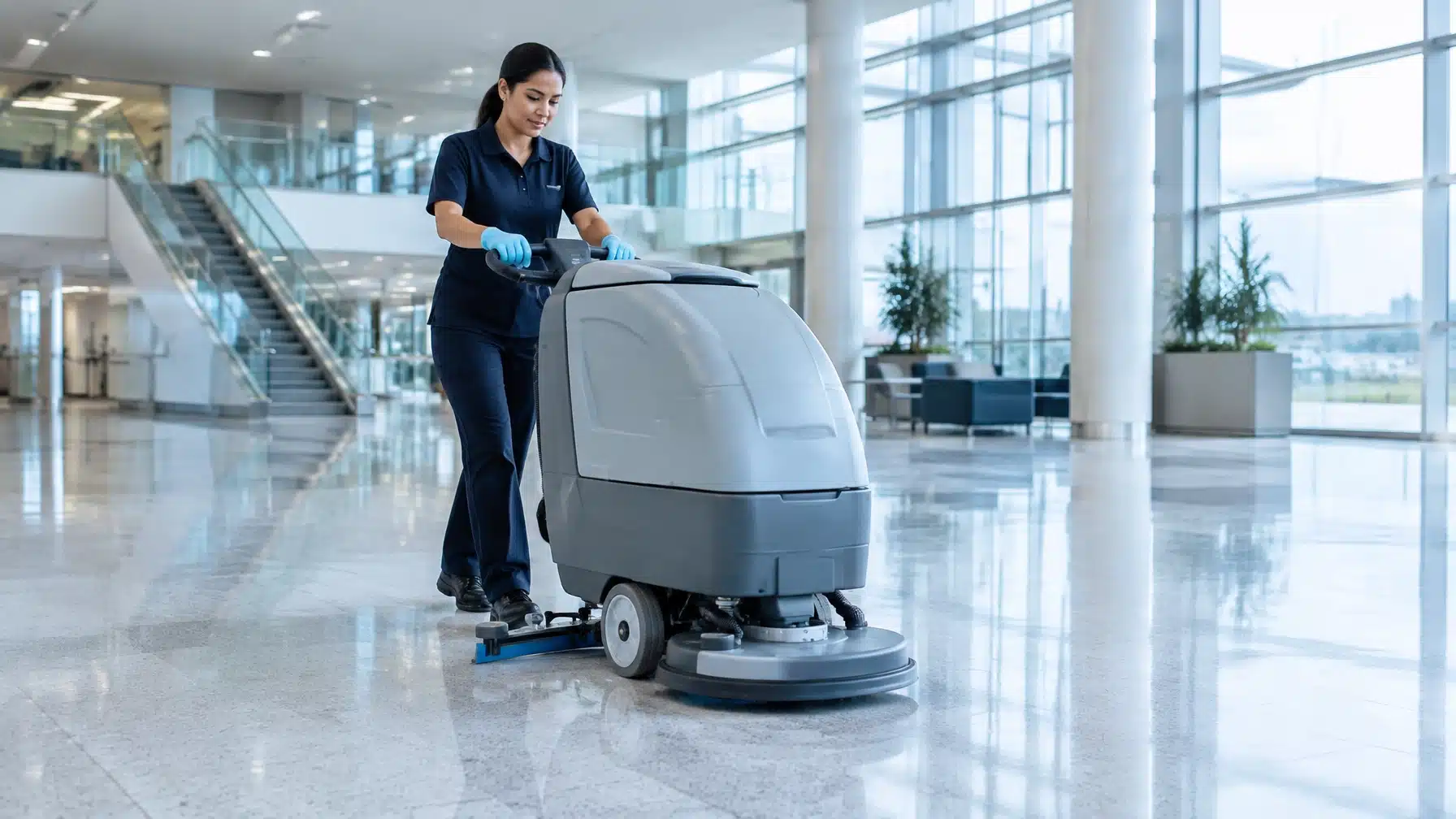
A floor machine chosen by drum size rather than by surface can become a maintenance cost that arrives slowly. The purchase decision is really about how much abrasive energy reaches the floor’s wear layer, and in what direction. Get that relationship wrong and the surface may look clean while being worn a fraction of a millimetre at a time.
Rotary, cylindrical and orbital machines are not simply three versions of one tool at different prices. Their drives make contact with the floor differently. That affects where pressure lands, how soil is moved and whether the cleaning action reaches the surface profile.
A sound buying decision starts with the floor, then considers the contaminant, the area and layout, the power source and the people who will use the machine. For most buildings, the practical answer is one machine and a suitable set of pads for the dominant floor, not a fleet of machines.
A rotary machine uses a single disc that turns a pad or brush beneath the motor. The pad moves across the floor in one continuous rotation. Contact pressure is concentrated towards the rim of the disc, and the motor’s torque creates a reaction that the operator feels through the handle, particularly in the wrists and shoulders. A rotary can be used for several jobs by changing the pad or brush, but those attachments do not make every floor suitable for every task.
A cylindrical machine uses two counter rotating rollers. Their action moves debris forwards into a collection tray and brings the brush surface into contact with areas that a flat disc may pass over. That can make the design worth considering for textured floors, grout lines and other recessed features.
An orbital machine moves its pad through small circles rather than driving it in one continuous rotation. The small moving footprint can deliver high pad pressure per unit area, while creating minimal torque reaction for the operator. Many orbital machines track straight with one hand and can be manoeuvred close to edges and around obstacles.
Those descriptions explain how each drive acts; they do not establish a universal performance ranking. The Health and Safety Executive says that different scrubber drier designs suit different situations. It does not offer comparative figures proving that one drive is consistently faster or more effective. Select for the building and task, then test the result on the actual floor.

Four variables determine whether a pass cleans, polishes or strips: pressure, speed, dwell and chemistry. The pad is a consumable abrasive. The machine is the delivery system that moves it across the floor, controls the pressure and, where applicable, puts down and recovers solution.
Pressure affects how firmly the pad meets the surface. Speed affects how often the abrasive passes over a point in a given time. Dwell is the time the cleaning solution has to act before it is removed or dries. Chemistry affects how effectively soil is loosened and held in solution. These variables interact. A more aggressive pad or greater pressure is not automatically a better way to remove dirt.
Detergent concentration matters as much as the pad. HSE advises following the manufacturer’s instructions: a solution that is too strong can be as ineffective as one that is too weak. Its food factory case study describes a scrubber drier that was not removing greasy contamination because staff had adopted a habit of adding just one capful of detergent, far below the recommended amount. The machine’s squeegee was also in poor condition. Once the machine was maintained, staff trained and the recommended detergent concentration used, the improvement was rapid.
For grease, the aim is to loosen and hold contamination in the cleaning solution, then recover it. A suitable heavy duty degreaser can have a role on a greasy kitchen floor when used for the task and according to its instructions. That does not make it a routine floor treatment for every surface.
The same logic holds elsewhere on site. A professional bathroom cleaner is formulated for sanitary ware and the deposits found there, a glass cleaner is formulated for glazing and mirrors, and an all purpose cleaner spray is formulated for light soil on desks, doors and shared surfaces. None of them is a substitute for a floor detergent, and a floor detergent is not a substitute for any of them. Matching the product to the surface is what makes a dilution ratio meaningful rather than arbitrary.
Manufacturers commonly describe pads by colour and relative abrasiveness. The colours below reflect one manufacturer’s selector chart, not a universal standard. Always check the pad maker’s chart and the machine instructions. A black pad from one brand should never be assumed to match a black pad from another.
The manufacturer’s floor pad selector chart describes these uses and also includes microfibre pads for gentle removal of grey haze. It notes that many pads contain at least 50 per cent post consumer recycled material and are washable and reusable. Its care advice is simple: remove the pad after use, rinse it and do not let a dirty pad dry before washing.
Vinyl with polyurethane reinforcement needs a method that protects the wear layer. Start with the flooring supplier’s maintenance guidance and use a neutral detergent at the specified dilution. Polyflor states that its residential collections have polyurethane reinforcement and recommends clean equipment, neutral cleaning solutions diluted to the manufacturer’s directions, even application, removal of excess liquid and a clean water rinse.
Polyflor also warns against abrasive liquids and metal scouring pads, solvents, caustic detergents, washing up liquid, soap powders, bleach, furniture polishes, petroleum based products, pine gels, stain removers and highly coloured products. These can make the floor slippery or cause permanent damage. The full Polyflor cleaning and care guidance is relevant to its floors; other floor coverings may have different restrictions.
That distinction matters in kitchens. A heavy duty cleaner formulated to cut grease may attack a vinyl wear layer if it is used as a routine cleaner rather than for the job it was designed to do. Product strength is not a substitute for surface compatibility. The same caution applies across a trolley of heavy duty cleaning products: each one should have a named surface and a named task rather than being treated as a general purpose standby.
Profiled and safety floors have raised points and low areas, sometimes alongside grout lines or exposed aggregate. A flat disc can bridge across the profile, leaving the low spots less directly contacted. A cylindrical deck can reach into recesses with its rollers. That is one practical reason to specify a machine by the floor rather than by its purchase price. Recovery must still be assessed: the squeegee may not follow a rough or profiled surface well enough to collect all the water.
Stone and unsealed floors need particular care. A black pad on a vulnerable, unsealed stone surface can be an act of vandalism: the abrasive may scratch, dull or change the finish. Identify the stone and its finish, then follow the supplier’s approved pad and chemical guidance. Diamond pads are specialist tools, not a general permission to abrade stone.
Concrete and industrial floors may tolerate more aggressive pads than a protected vinyl floor, but condition and finish still matter. The black pad is described for heavy duty cleaning on concrete and industrial floors; the specific machine, pad and cleaning method should be trialled together.
Wood and laminate often make water volume more critical than pad colour. Too much water, or water left in joints, can damage the floor. Confirm whether the flooring supplier permits machine cleaning at all, then consider how much solution the machine applies and whether it can be recovered promptly. Do not let a suitable looking pad override a restriction on moisture.
A scrubber drier does not make a floor safe simply because it has a water recovery system. The squeegee must be wide enough to recover all the water the machine puts down. HSE notes that single disc machines tend to throw water out to one side and may need an asymmetric squeegee to collect it.
Condition matters as much as width. A poorly maintained squeegee can leak and leave a smooth floor dangerously wet. On very rough or profiled surfaces, the blade may not be flexible enough to recover water adequately. HSE also says the operator must be trained to use the appropriate water level for the surface, helping reduce leaks and water trails.

The HSE guidance on the importance of floor cleaning gives a clear hierarchy for keeping pedestrians away from a floor while it dries. In order of effectiveness:
Cones are a weak control on their own. They do not stop people entering, often fail to mark the full extent of a wet area and are frequently left on floors that are already dry. When people learn to ignore them, their value falls further. HSE describes slips and trips as the most common cause of major injuries at work, with around 90 per cent of those injuries being broken bones, and puts the cost to industry at more than £500 million a year.
In a survey of interior cleaners, 74 per cent reported muscular aches, pains and discomfort in the previous year. Of those affected, 52 per cent had sought medical advice. Reported areas included the low back at 46 per cent, neck at 33 per cent, knees at 24 per cent, right shoulder at 23 per cent and right wrist or hand at 22 per cent. More than 20 per cent of cleaners reported lifting, pulling, pushing or carrying loads above 25 kg.
The European Agency for Safety and Health at Work lists faults found in buffing machines: excessive height, weight and vibration; poor grip and trigger or lever design; and awkwardly placed controls that require high activation pressure. It also offers practical checks for buyers. Aim for a hand span of 45 to 55 mm, forces below 10 N to operate triggers and controls, and controls that are reachable and comfortable for left and right handed users. Check that the machine is safe to move on stairs, in lifts and on ramps, and consult the workforce before purchase. See E facts 39 on cleaners and musculoskeletal disorders.
A machine that looks manageable in a showroom may be difficult to turn in a narrow corridor, push up a ramp or lift into storage. Test it in the actual building with the people expected to use it. HSE’s guidance on musculoskeletal disorders in cleaning identifies cleaning machines and heavy manual work among the demands that can contribute to these disorders, and says employers should select equipment that lets cleaners work safely and maintain it appropriately.

Under the Control of Noise at Work Regulations 2005, employers must assess risks and provide information and training from daily or weekly average exposure of 80 dB(A). At 85 dB(A), hearing protection must be provided and hearing protection zones established. The exposure limit value is 87 dB(A), allowing for hearing protection, and must not be exceeded. See HSE noise regulations guidance.
The Control of Vibration at Work Regulations 2005 set hand arm exposure action and limit values of 2.5 and 5.0 m/s² A(8). For whole body vibration, the corresponding values are 0.5 and 1.15 m/s² A(8). The HSE hand arm and whole body vibration guidance explain these thresholds.
A well maintained machine is quieter and smoother than a worn one. Rectify vibration characteristics caused by poor maintenance. A rider machine transmits vibration through the seat and into the operator’s body, which is why whole body values are considered separately.
Noise and vibration are rarely the reason a machine is bought, but they are often the reason it is disliked. If operators avoid a machine, the floor is cleaned less thoroughly than the specification assumes, and the fault is attributed to the cleaner rather than to the equipment.
Regulation 5 of the Provision and Use of Work Equipment Regulations 1998 requires equipment to be maintained in an efficient state, in efficient working order and in good repair. If machinery has a maintenance log, it must be kept up to date. Regulation 9 requires adequate health and safety training for everyone who uses work equipment, covering methods, risks and precautions. The same applies to people who supervise or manage its use, as set out in regulation 9.
HSE’s portable electrical equipment guidance gives suggested initial intervals for inspections, selected according to risk. For floor cleaners, it lists user checks and a formal visual inspection every 6 months to 1 year for both Class I earthed equipment and hand held Class II double insulated equipment. For Class I equipment it also suggests a combined inspection and test every 1 to 2 years; no combined test is listed for hand held Class II equipment. User checks apply in both cases.
These are guidance intervals, not statutory frequencies. The dutyholder should base a maintenance plan on the equipment, how it is used and the environment. Cables, leads, plugs and battery charging equipment have separate suggested intervals, from 6 months to 4 years for formal visual inspection and 1 to 5 years for combined inspection and test depending on what they are connected to. See HSE guidance HSG107.
Compare the full operating cost rather than the machine price alone. Pads and brushes are consumables and can become the real running cost. A cheap machine with expensive pads is not necessarily a cheap choice. The battery may be the largest midlife cost for cordless equipment or a battery scrubber drier. Add servicing, downtime and the operator’s time to move, fill and empty the machine. Buying professional cleaning products that suit the pads you have already committed to is part of the same calculation, because a pad specified for a neutral detergent will not perform as intended in a stripping solution.
Then test the layout. A machine that takes fifteen minutes to move from the store to the third floor, and needs a lift, may be left unused. A scrubber drier earns its place only where the open area cleaned per shift justifies its time and handling demands. Take a walk round with a stopwatch before committing: time the journey, note door widths, check storage and charging points, and observe how the machine would pass through busy areas. This links equipment choice to the real operating cost, not just the invoice, a point also explored in our guide to labour and cleaning budgets.
Judge the trial by the surface result, water recovery, access, handling and time required. Frequency alone is not a cleaning standard; the floor condition and task outcome matter, as discussed in our guide to cleaning frequency and standards.
One more test is worth running during the trial. Ask the operator to clean the machine at the end of the shift and see how long it takes. Pads, brushes, squeegee blades and solution tanks all need attention, and a machine that is awkward to strip down will be put away dirty. A dirty brush or pad carries soil back onto the next floor, a problem examined in the hidden life of cloths, mops and vacuums.
The useful question to put to any supplier is whether it publishes the pad chart and the dilution ratio. Ask, too, whether it will confirm which of its heavy duty cleaning products suits the floor and the machine process you are running. A cleaning supplies shop that answers that plainly is easier to buy professional cleaning products from than one that only lists a pack size. KleanPro Supplies does not sell floor machines. Our range covers the chemistry side, including an all purpose floor cleaner for machine work and an all purpose cleaner for the wider building, and the directions on each product should be checked against the floor before use. That applies whether you are comparing professional cleaning supplies uk ranges, trade cleaning supplies or a modest cleaner supply order, and it applies before you commit to janitorial supplies in volume.
The machine is a decision about the surface, not simply a decision about the budget line. The right drive, pad and dilution remove soil while preserving the wear layer. The wrong combination can leave a floor looking acceptable until the finish is gone.
A correctly matched pad is a replaceable consumable. A worn floor may need replacing. That is the difference a considered selection can make.