Newsletter Subscribe
Subscribe for news, offers and a welcome 5% discount on us.
The first fortnight of November has brought three stories that may seem separate but share an important theme: expectations for hygiene continue to rise, while the supply of people and trustworthy product information needed to meet them is under strain.
A proposed wet wipes Bill could change how products are labelled and which claims manufacturers can make. A new school pilot will explore whether concentrating hygiene measures on particular moments and surfaces can reduce winter illness absence. At the same time, new figures underline the challenge of recruiting and training enough people to deliver cleaning services.
For facilities managers and trade buyers, these developments could influence product choices, cleaning plans and the resilience of contracts. For homeowners, they raise useful questions about where wipes should go and what product labels really mean. Here is what to watch, followed by one date for the diary.
The Wet Wipes (Labelling, Sale and Marketing) Bill is a Private Member’s Bill introduced by David Burton-Sampson, Labour MP for Southend West and Leigh. Its aim is to establish rules for how wet wipes are marketed, advertised and sold, including what information appears on packaging.
The Bill’s Second Reading was listed for Friday 13 November 2026 but did not take place. It is now scheduled for 19 March 2027, the next Friday sitting allocated to Private Members’ Bills. Bills of this kind are taken in the order they appear on the list, so earlier items ahead of it need to be dealt with first. A Second Reading can slip in this way, and it does not indicate that the Bill has been dropped.
The issue is not simply what a wipe is made from. Wet wipes are a major contributor to sewer blockages and fatbergs, alongside fats, oils and grease. Figures from Anglian Water cited by the Bill’s sponsor suggest around 500,000 wet wipes are flushed each day across its network. In the MP’s constituency, 610 blockages in the previous year were attributed to unflushable items.
The Bill proposes clearer and more consistent disposal information on packaging, encouraging people to put wipes in the bin rather than flush them. Non flushable products would carry a prominent symbol on the front of the pack. Products could still be marketed as flushable if they pass rigorous testing, but manufacturers would need to demonstrate that they break down without damaging sewerage systems or household plumbing. Packaging would also need to explain any restrictions, such as flushing only one wipe at a time.
A key point for consumers is that a product described as plastic free or biodegradable is not necessarily flushable. Its fibres may remain intact in water and cause problems downstream. The Bill’s sponsor also pointed to the International Organization for Standardization publishing a technical specification on flushability in August.
The Bill has not yet passed its Second Reading. If MPs agree that it should proceed in March, it moves to Committee Stage for detailed examination, followed by Report Stage and Third Reading in the Commons. It would then go to the House of Lords. For cleaning teams and facilities buyers, this is a reason to keep an eye on the parliamentary process and review the wipes stocked for washrooms or cleaning tasks. Clear disposal instructions matter in shared buildings, where one unclear label can lead to repeated mistakes.
For homeowners, clearer packaging could help resolve a familiar conflict: some product claims suggest a wipe can be flushed, while water companies advise against flushing wipes. Until rules or evidence make the advice unambiguous, putting used wipes in a bin is the more cautious choice. KleanPro’s guide to waste sorting and the cleaning team also looks at why clear disposal routines need to work in practice.
The cost of a blockage can quickly become a facilities problem, particularly when a washroom or drainage system is out of use. A drain cleaner unblocker may help clear a blockage once it occurs, but it addresses the symptom rather than the cause. Better disposal habits and clearer labelling aim to prevent wipes entering the system in the first place.

The British Cleaning Council is working with multi academy trust Ark and SC Johnson Professional on a pilot to explore whether targeted hygiene can reduce pupil absences from winter illness. The project is due to launch in six Ark schools during November.
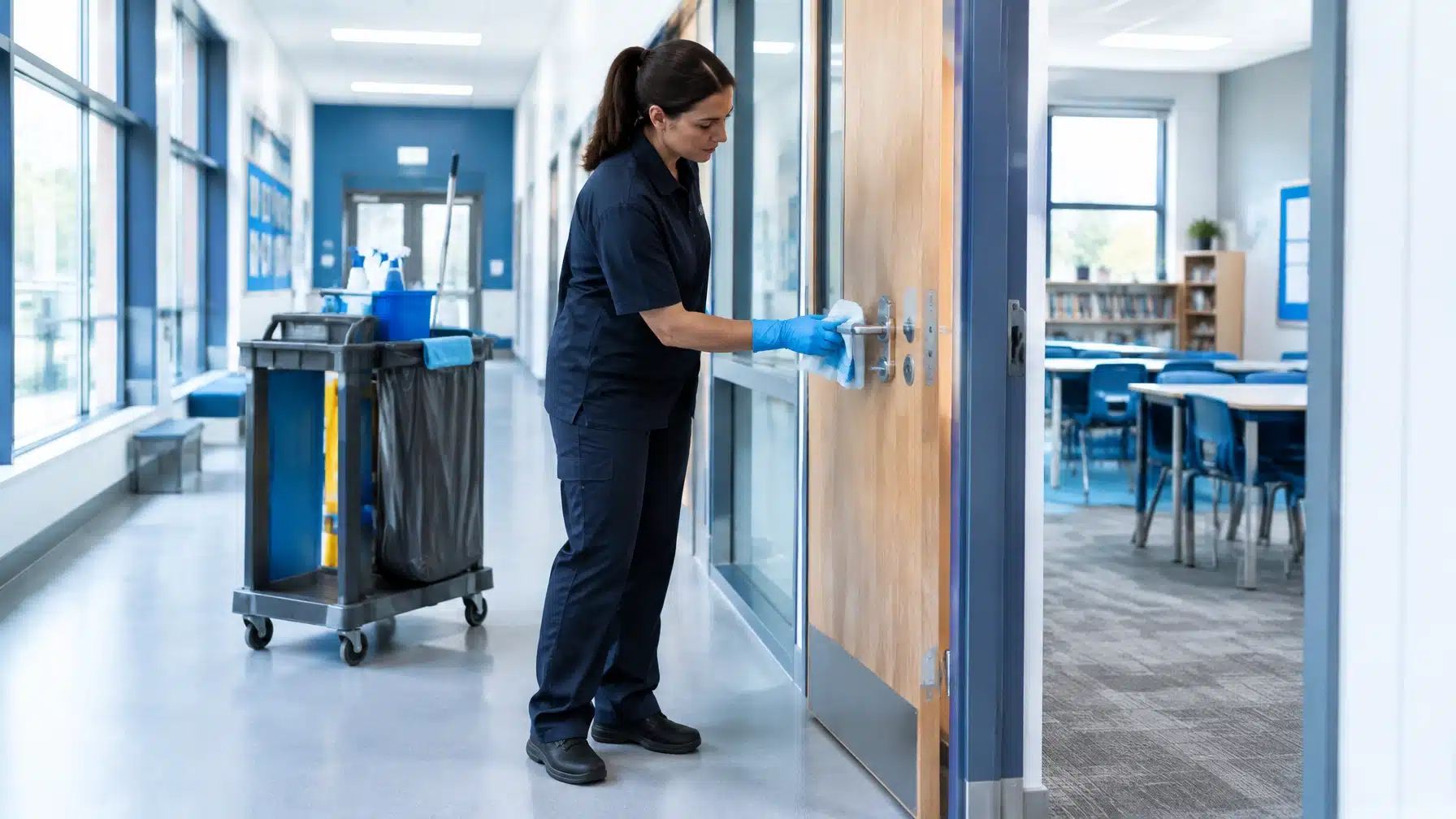
Targeted hygiene focuses attention on the places and moments where infection is more likely to spread. That includes arrival and departure, before mealtimes, after toilet visits, and frequently touched shared surfaces such as door knobs and desks. Rather than trying to clean every surface more often, the approach uses school specific hygiene mapping to identify where practical action is most useful.
Measures in the pilot include support for hand hygiene infrastructure, targeted cleaning protocols for high touch surfaces and behavioural prompts for pupils and staff. The approach is endorsed by the Scientific Forum on Home Hygiene and the Royal Society for Public Health. It was developed with SC Johnson Professional in line with World Health Organization guidelines.
The project will use routine attendance and absence data that schools already collect. It will not involve medical testing or individual pupil monitoring. That design is important: the pilot is intended to test a practical approach within existing school routines, rather than introduce intrusive monitoring.
The scale of winter absence gives the work a clear context. Department for Education figures for 2024/25 show approximately 42.2 million pupil days were lost due to illness. Ministers Dan Jarvis, Dame Diana Johnson and Georgia Gould have asked to be briefed and kept informed of the results.
The pilot will not, by itself, establish that targeted hygiene reduces absence. Its value will depend on the evidence collected and how carefully the results are interpreted. If the findings support the approach, it could influence how schools and other organisations plan cleaning. Offices, retail settings and hospitality venues may also consider mapping the times and places where hygiene measures are most useful.
That would shift some procurement discussions from “How much cleaning is being done?” to “Where and when is it most needed?” A clear site plan can help teams focus time, supplies and checks on high use areas. Our article on turning building needs into a cleaning specification discusses how a written plan can make those expectations clear for the people delivering the work.
A 4 November commentary in Cleaning Matters by Katherine Ring of ProFM Group brings together figures that make recruitment and training pressures concrete.
British Cleaning Council research puts the UK cleaning, hygiene and waste sector at an estimated £72 billion, comprising 78,915 businesses. It is a large and varied industry, but the age profile raises questions about who will be available to do the work in the years ahead. The share of cleaning workers aged over 55 has risen from 27 per cent in 2024 research to 29 per cent in the latest research. Across all sectors, the comparable figure is 24 per cent.
At the other end of the age range, only 9 per cent of the cleaning workforce is under 25, compared with 11 per cent across the economy. The National Foundation for Educational Research estimates that elementary administration and service roles, including cleaners, will need around 1.36 million replacement workers between 2020 and 2035.
Training is another concern. Only one in ten cleaning and hygiene operatives report receiving job related training in the previous three months, compared with one in four workers across all occupations. The Level 2 Cleaning Hygiene Operative apprenticeship was launched in January 2024 as the sector’s first apprenticeship for new entrants. From September 2026, however, new starts no longer receive government funding. British Cleaning Council Chair David Garcia called the decision an alarming step backwards.
There is also a gap in the wider skills conversation. Skills England’s 2026 annual skills report does not mention the cleaning sector. Taken together, these figures point to a difficult combination: a workforce with an increasing share of older workers, relatively few younger entrants and limited recent training.
For buyers, labour is likely to remain a significant influence on contract costs and service capacity. A shortage of available staff can make reliable scheduling and consistent delivery harder, especially when teams are already stretched. This does not mean chemistry or product choice is unimportant. It means that the time, training and people needed to use products and complete tasks should be considered alongside purchase prices. For more on this distinction, see our article on why labour, not chemistry, drives cleaning costs.
For cleaning managers, straightforward procedures and dependable supplies can help teams use their time effectively. For trade buyers, service reliability is therefore about more than the product itself: availability, clear instructions and suitable pricing can all matter when a site has little spare capacity.

Registration is now open for The Cleaning Show 2027, taking place at Excel London from 16 to 18 March 2027. The event is co produced by the British Cleaning Council and is free to attend for trade visitors. Organisers have also announced an expanded free conference programme.
Exhibitors include Tennant UK, Nilfisk, Numatic, SEBO, Essity, Kimberly Clark Professional, SC Johnson, Bunzl, WEPA Professional and Freudenberg Home and Cleaning Solutions. The show offers trade buyers an opportunity to compare equipment and products, speak with suppliers and hear about operational issues affecting the sector.
For people reviewing trade cleaning supplies or professional cleaning products, an event can be a useful place to understand what is available and ask direct questions. The programme and exhibitors may be particularly relevant to organisations looking at productivity, sustainability and workforce support.

These three main stories point in the same direction. Demand side pressure is increasing, with stronger expectations around hygiene and closer attention to product claims. At the same time, the supply side is under strain, with fewer young workers entering cleaning and limited access to recent job related training.
For facility managers, one practical response is to plan hygiene by risk rather than by habit. Identify where people gather, which surfaces are touched frequently and when those areas are busiest. Make routines clear enough for staff to follow and managers to review. For households, the same principle applies in simpler form: follow product directions, keep shared surfaces clean and dispose of wipes in a bin unless reliable evidence and clear instructions say otherwise.
Buyers should also consider the reliability of the products and replenishment arrangements behind their cleaning routines. A cleaning supplies shop that maintains dependable stock and trade pricing can help organisations plan routine purchasing when teams are already working under pressure.
The Wet Wipes Bill will not return to the Commons until March 2027. Its eventual progress may still affect which wipes organisations choose to stock and how disposal advice is communicated. Whatever happens next, the practical message is already clear: hygiene plans work best when the right tasks, products and instructions are in place.