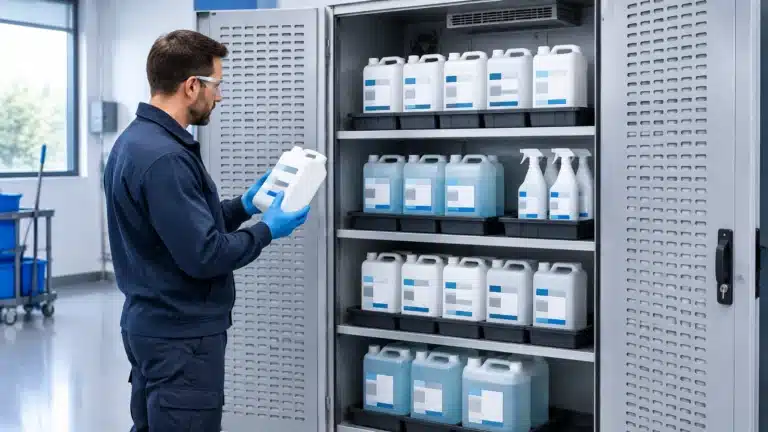



Concentrated cleaning products can help businesses reduce the amount of packaging and water they buy, store and transport. For facilities teams, hotels, restaurants and other high use workplaces, those changes may also make supply routines easier to manage and lower the cost of each litre of usable cleaner.
The benefits depend on the product and how it is used. A concentrate needs to be diluted correctly, its packaging still needs to be considered, and savings should be calculated against products that deliver the same cleaning result. This guide explains how to make a fair comparison, what UK packaging rules mean for businesses, and where professional cleaning supplies can support more efficient purchasing.
What makes a cleaning product concentrated?
A ready to use cleaner arrives at the site in the form in which it will be applied. A concentrated cleaner contains less water in the supplied product and is diluted before use, following the manufacturer’s instructions.
The difference matters because water is heavy and takes up space. If a workplace adds dilution water on site, it does not need to receive the same quantity of prepared cleaning solution from a supplier. Concentrates may therefore need less packaging and transport capacity for an equivalent volume of usable solution.
The comparison is not simply between the size of two containers. It should be between the amount of product purchased and the amount of correctly diluted cleaner it can make. It should also consider whether both options perform the same task at the required standard.

Less packaging for the same amount of usable cleaner
A business buying ready to use products receives a container for every volume of cleaner it purchases. Where a concentrate makes several litres of solution, it can reduce the number or size of containers needed for the same volume of prepared cleaner. This may also reduce the amount of cardboard, outer packaging and storage space involved, depending on the product’s pack design.
That can simplify day to day operations. A hotel may need fewer bulky cases in its housekeeping store. A facilities team working across several buildings may find it easier to transport compact containers between sites. A restaurant may be able to keep a smaller reserve of a frequently used surface cleaner.
However, the actual packaging reduction depends on product details. Check the weight and material of the concentrate container against the number of ready to use bottles it replaces. Include closures, labels, cartons and any protective packaging. A concentrate in a complex or difficult to recycle pack may not offer the same packaging benefit as one in a straightforward, recyclable container.

UK packaging rules add context to purchasing decisions
Two UK policies are relevant when businesses assess packaging: Plastic Packaging Tax and extended producer responsibility for packaging, commonly called EPR.
HM Revenue and Customs states that Plastic Packaging Tax applies to finished plastic packaging components containing less than 30% recycled plastic, subject to the rules and exceptions. From 1 April 2026, the rate is £228.82 per tonne. A business generally needs to register if it manufactures or imports 10 tonnes or more of finished plastic packaging in the relevant period.
This is not a tax on cleaning liquid. Nor does it apply in the same way to every company buying cleaning products. The rules concern businesses that manufacture or import packaging components, and obligations depend on the activity and circumstances. A buyer should not assume that every reduction in plastic packaging will directly remove a tax charge from its own invoice. It can, however, be useful to ask suppliers about packaging materials, recycled content and their approach to packaging compliance.
EPR has separate thresholds and responsibilities. GOV.UK says that an obligated producer must be established in the UK, carry out a relevant packaging activity, supply or import more than 25 tonnes of packaging in the previous year, and have annual worldwide turnover of at least £1 million. Relevant activities can include importing packaged goods, filling packaging or selling filled packaging to an end user. Large producers have additional obligations, including reporting packaging data and paying applicable household packaging waste disposal fees.
PackUK’s published Year 2 EPR fees are illustrative, not final confirmed rates. The December 2025 estimates list plastic at £415 per tonne for green rated packaging, £455 for amber and £545 for red. For paper and board, the estimates are £190, £210 and £250 respectively. PackUK notes that the estimates may change as further data is submitted and reviewed. The classification depends on the applicable Recyclability Assessment Methodology, so it cannot be inferred from material alone.
The practical takeaway is that packaging weight, material and recyclability can matter in a business’s wider supply chain. Concentration is one possible way to reduce the amount of packaging associated with cleaning operations, but it is not a substitute for checking who is legally responsible or what fees apply.
Fewer tonnes to move can mean lower transport impact
When a ready to use cleaner is delivered, much of its mass may be water. A concentrated product can mean that less liquid is transported for the same volume of prepared solution, with water added at the point of use. Less mass can mean fewer tonne kilometres for the delivery stage, although the result depends on factors such as distance, vehicle type, load capacity and packaging.
The Department for Energy Security and Net Zero publishes annual greenhouse gas conversion factors to help UK organisations calculate emissions from activity data, including distance travelled. Its 2026 factors can support a more informed estimate when a business has shipment weights and transport distances. A reliable comparison should use those figures with actual logistics information, rather than claiming one universal emissions saving for every concentrate.
The wider evidence supports careful comparison. A comparative life cycle assessment of institutional cleaning products reported that conventional ready to use products had the highest impacts across the product types and most impact categories it assessed. The study also found that packaging and distribution could be important contributors for conventional products. That is useful context, but it does not establish a single percentage reduction for every concentrated cleaner, supply chain or cleaning task.
For a local calculation, compare the delivered mass and packaging for both options over the same period. Include the delivery distance where known. If the concentrate requires additional equipment or more frequent deliveries, include those factors too.
Compare cost per litre at the correct dilution
The price printed on a container does not show the cost of the usable cleaning solution. A fair comparison is:
Cost per litre of usable solution = delivered product cost divided by the litres of solution made at the label dose.
For example, imagine a one litre concentrate costing £12 that makes 20 litres of solution when diluted as directed. The concentrate costs 60 pence per litre of prepared solution. A separate ready to use product costing £10 for five litres costs £2 per litre. On those hypothetical figures, the concentrate has a lower product cost per litre.
This is an illustration, not a price comparison for a particular KleanPro Supplies product. It assumes that the two products are suitable for the same purpose and deliver comparable results. It also excludes labour, dosing equipment, storage and waste costs. Check the product label and supplier information before comparing dilution rates or suitability.
For a broader purchasing review, include:
- Product cost at the delivered price
- Correct dilution and expected volume of solution
- Packaging weight and material
- Freight and delivery frequency
- Storage and waste handling requirements
- Any equipment, training or time needed to prepare the product
A concentrate that is dosed incorrectly can lose its financial advantage. Using too much product increases consumption and may leave residues or create avoidable risks. Using too little may not deliver the cleaning result required. Clear instructions and consistent dosing are therefore part of the cost calculation, not an optional extra.

Make concentrated products practical for your team
A concentrated product works best when the process is simple and consistent. Keep the original product labelled and stored as instructed. Use suitable measuring or dosing equipment, and make sure staff can follow the dilution directions. Prepared bottles should be identified clearly in line with the product and workplace procedures.
Do not mix cleaning products unless the manufacturer’s instructions explicitly permit it. Teams should follow relevant safety information, including product labels and safety data sheets. A straightforward, standard process can help reduce accidental overuse and support consistent results across shifts and sites.
Facilities managers can begin with one frequently used product, such as a general surface cleaner, and record how much is ordered and used. Hospitality teams may prefer to review housekeeping and washroom products separately, as each has a different purpose and consumption pattern. A small, measured trial can show whether the concentrate fits the operation before a wider change is made.
Choosing supplies with confidence
Concentrated formulas can offer a practical route to less packaging, reduced transport of water and a lower product cost per litre of usable cleaner. Their value is strongest when the dilution instructions are followed, the packaging is considered in full and the comparison is based on equivalent cleaning performance.
For UK businesses, Plastic Packaging Tax and EPR provide useful context for understanding packaging responsibilities and costs. They do not mean that every business buying cleaning products has the same obligations. The rules depend on packaging activity, thresholds and the producer’s role in the supply chain.
KleanPro Supplies offers professional cleaning products for commercial and everyday use. You can browse the KleanPro Supplies shop to review available products, or contact the team to discuss your requirements. A clear comparison of cost, dose, packaging and delivery can help your team choose a dependable cleaner supply while making purchasing decisions with waste and operating costs in mind.
References and further reading
- HMRC, Plastic Packaging Tax: steps to take
- HMRC, Environmental taxes, reliefs and schemes for businesses: Plastic Packaging Tax
- Defra and the Environment Agency, Check if you must comply with EPR for packaging
- PackUK, Year 2 illustrative waste disposal fees: Extended producer responsibility for packaging
- Department for Energy Security and Net Zero, Greenhouse gas reporting: conversion factors 2026
- Comparative life cycle assessment, Conventional and Green Seal compliant industrial and institutional cleaning products