

A care home is both someone’s home and a place where care is delivered. That combination makes cleaning different from both hospital cleaning and ordinary household routines. Residents share lounges, dining rooms, bathrooms and equipment, while staff provide close personal care to people who may be particularly vulnerable to infection. Cleaning has to support safety without making daily life feel clinical or impersonal.
This balance shapes the work. Cleaning plans need to be clear enough for staff and contractors to follow, but flexible enough to respond to residents’ needs, changes in infection risk and the pressures of winter. The aim is not to disinfect every surface continually. It is to keep the environment visibly clean, remove soil effectively and use suitable disinfection where the risk calls for it.
The guidance discussed here applies principally to care homes in England. Providers in Scotland, Wales and Northern Ireland should follow the relevant national and local guidance for their setting.

Care homes need a distinct approach
In a hospital, cleaning routines take place in a clinical environment organised around treatment. At home, people generally decide how and when to clean their own spaces. Care homes sit between these models. Residents live in the building, bring personal belongings and furniture, and use shared facilities, while the provider remains responsible for a safe and appropriately clean environment.
That means a schedule must account for more than floors and washrooms. It should cover resident bedrooms, lounges, dining spaces, bathrooms, toilets, equipment and frequently touched surfaces. It should also respect people’s privacy, routines and independence. Cleaning around personal possessions requires consideration, particularly where residents have dementia or may find changes to their surroundings distressing.
The scale of the sector also matters. The December 2025 adult social care statistics report an average of around 47 beds per care home in England. In a home of that size, clear responsibilities and dependable supplies help teams maintain consistent standards across shared and private spaces. A schedule that depends on memory or informal handovers can leave gaps, especially when staffing or routines change.
The regulatory framework is about systems as well as appearance
The Health and Social Care Act 2008 code of practice sets out infection prevention and control expectations for registered providers in England. It includes the provision and maintenance of a clean environment, staff awareness of their responsibilities, and suitable policies for preventing and managing infection. The code is guidance for demonstrating compliance with relevant regulations. Providers should apply it proportionately to the nature of their service.
The Care Quality Commission considers infection prevention and control within its Safe key question. Its care home guidance and single assessment framework prompts direct attention to practical evidence, not just written policies. Inspectors may look for a named lead for cleaning and decontamination, staff training, audits, action plans, cleaning schedules and evidence that scheduled work is completed.
They also look at what the environment shows. Are high touch surfaces and shared equipment visibly clean? Can staff explain who is responsible for cleaning a particular area or item? Are premises maintained and uncluttered enough to make cleaning possible? Are arrangements in place for additional cleaning when it is needed?
These questions make documentation useful only when it reflects daily practice. A schedule should identify the task, location, frequency, method and responsible role. Records and checks can then help managers identify missed tasks, recurring problems and training needs.
Daily cleaning: detergent first, disinfection where needed
For routine environmental cleaning, UKHSA’s infection prevention and control resource for adult social care describes a measured approach. Routine cleaning typically uses a neutral detergent to remove dirt and organic matter. Disinfection is reserved for sanitary fittings or specific risk areas, in line with local procedures and the product instructions.
This distinction matters. Cleaning physically removes contamination; disinfection reduces the number of viable microorganisms. A disinfectant cannot do its job well if soil has not first been removed. Nor is stronger chemistry automatically a better choice for every surface or everyday task. Using products for the purpose and surface specified by their manufacturer helps protect finishes and supports a consistent method.
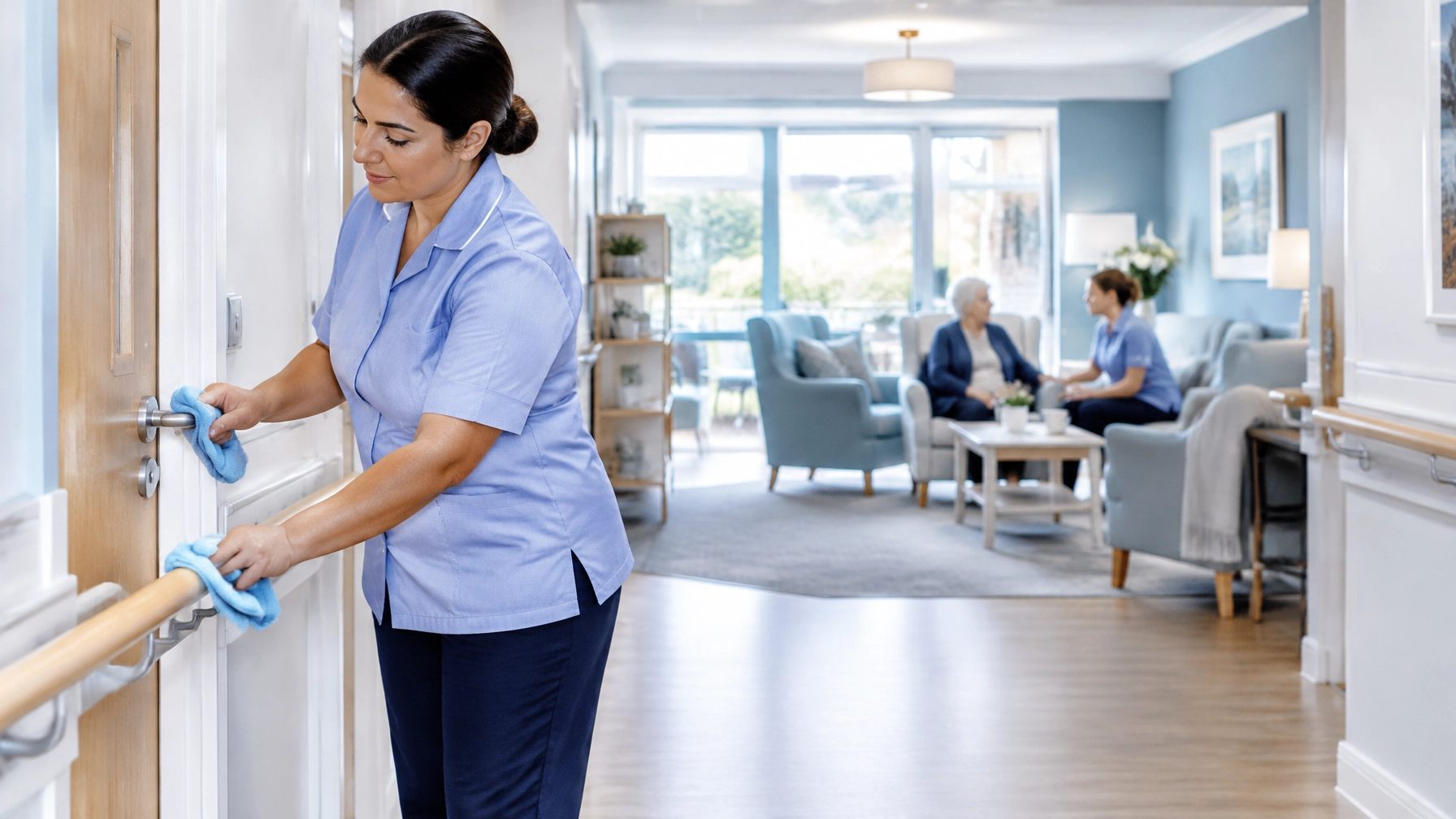
High touch points need particular attention because they are handled repeatedly throughout the day. Examples include door handles, light switches, bed rails, call bells, taps and handrails. The schedule should reflect how often each is used and the level of risk in the area. Shared equipment should also be cleaned after use, or according to the manufacturer’s instructions and the home’s procedure.
Colour coding helps separate cleaning equipment between areas and reduce the risk of transferring contamination. The system only works if staff know what each colour means, where equipment is stored and how cloths and mops are handled after use. Responsibilities should be clear, especially where care staff and housekeeping teams both carry out cleaning.
Outbreak mode requires a planned change
An outbreak calls for a defined change from the routine schedule. It is not enough to tell staff to clean more often without clarifying what needs attention, which product to use, how it should be applied and who is responsible. The home’s outbreak plan should set out how cleaning, equipment use, laundry, waste, staff communication and access to advice will be managed.
For norovirus, the UKHSA and PHE outbreak management guidance describes increased cleaning frequency, with care areas, shared equipment and frequently touched surfaces cleaned at least twice daily during an outbreak, as well as after contamination. Local instructions may require more frequent cleaning in particular areas.
The sequence is important. First remove visible vomit or faecal material safely, using the required PPE and disposable materials. Then clean the surface with warm water and detergent to remove organic soil. Only after that should the appropriate disinfectant be applied. The cited guidance specifies 0.1 percent sodium hypochlorite, equal to 1000 parts per million available chlorine, for disinfection in this context. Staff must follow the product manufacturer’s instructions for preparation, contact time, use and disposal.
Chlorine based products can damage some materials and may create respiratory risks if used in poorly ventilated areas. Staff should be trained, use the PPE identified by the risk assessment and ventilate as directed. Products must never be mixed. Always check surface compatibility and the label before use.
UKHSA guidance defines a norovirus outbreak as two or more people with vomiting or diarrhoea within 48 hours. Care homes should follow their local outbreak procedure and contact their local Health Protection Team for advice when an outbreak is suspected. The acute respiratory infection guidance for care homes also sets out how homes should respond to respiratory outbreaks. Those responses involve more than cleaning, so staff should follow current public health and clinical advice as well as the home’s plan.
Linen needs its own clean and dirty workflow
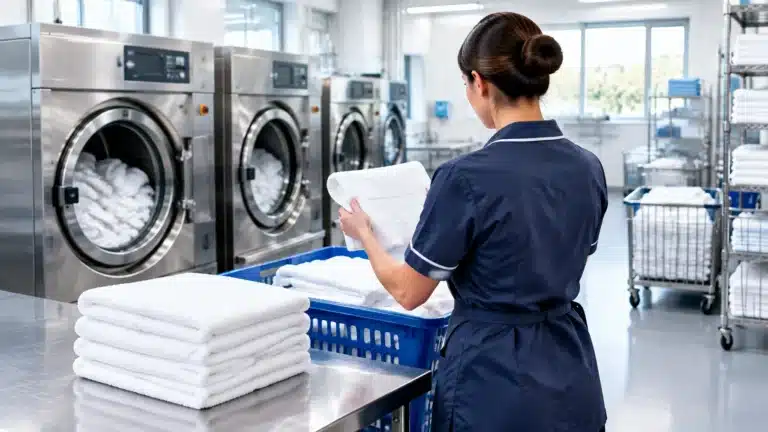
Linen can carry contamination from one room or person to another if it is handled carelessly. UKHSA’s linen processing information sheet categorises linen as clean, used or infectious. Keeping those categories separate is a practical control, not simply a laundry room preference.
Staff should wear disposable gloves and an apron when handling used or infectious linen, according to the task and risk assessment. Used linen should be placed directly into a laundry bag at the point of use. It should not be shaken, sorted in the room, placed on the floor or carried against clothing. Once bagged, it should not be handled again unnecessarily.
Infectious linen should be sealed in a suitable water soluble bag and then placed inside an impermeable outer bag. The inner bag should go directly into the washing machine without being opened. Clean and dirty processes should remain physically separated, including storage and movement through the laundry room. Clean linen should be stored in a clean, dry place above floor level, away from used linen and the area where it is processed.
The Scottish National Infection Prevention and Control Manual chapter on care homes and linen is an additional resource for providers seeking linen guidance within the Scottish system.

Why late October is a useful time to prepare
Late October is a practical point in the calendar to review winter readiness. UKHSA guidance notes that respiratory infections such as influenza and RSV commonly circulate between autumn and spring, while norovirus outbreaks also place demands on care homes during winter. Increased cleaning and laundry activity can use supplies more quickly, and staff may need to switch from routine procedures to outbreak arrangements at short notice.
Preparation is not about predicting exactly when an outbreak will happen. It is about checking that the home can respond without delay. Managers can review cleaning schedules, confirm who leads on cleaning and decontamination, check training records and make sure staff know how to access the local Health Protection Team. They can also check that the home has suitable detergent, appropriate disinfectant, cloths, PPE, hand hygiene products and the bags required for linen handling.
A stock check should consider storage and use by dates as well as quantities. Cleaning chemicals should be stored safely and remain identifiable. Staff need access to the relevant product instructions and safety information. A prepared home can then put its documented plan into practice without relying on last minute substitutions or unclear instructions.
What buyers should check before choosing products
Care home buyers need a practical range of products for routine cleaning and a separate plan for outbreak disinfection. When comparing professional cleaning products, check the intended use, surface compatibility, dilution or application instructions and required contact time. Do not assume that a product described as a cleaner is also a disinfectant, or that a general purpose disinfectant is effective against a particular virus.
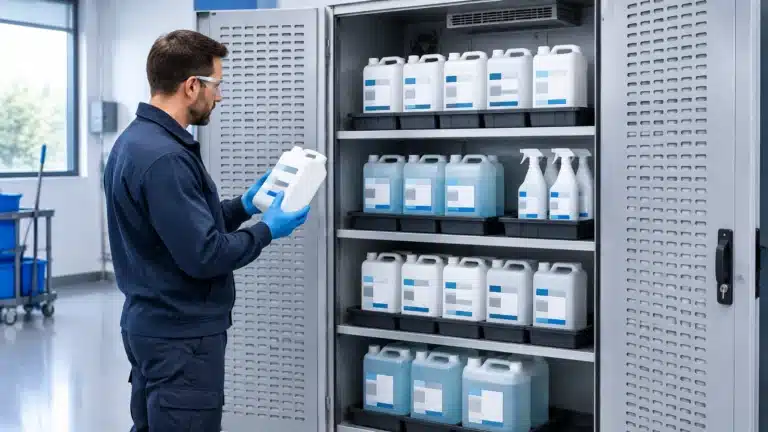
COSHH responsibilities should be considered when selecting and using cleaning chemicals. Keep current safety data sheets accessible, assess risks for the tasks involved and make sure staff understand safe handling, storage, PPE and what to do in the event of a spill. Product labels and training should support one another.
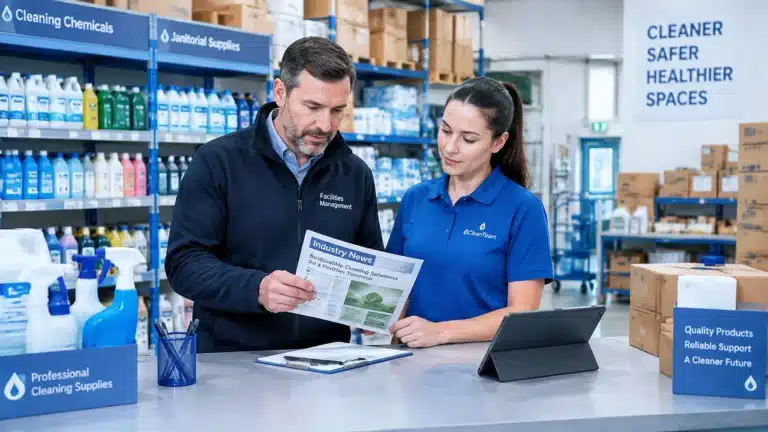
A cleaning supplies shop can help buyers compare available formats, but suitability should be determined by the product instructions, safety information and the home’s written procedures. When sourcing trade cleaning supplies and janitorial supplies, it is also sensible to consider storage space, staff familiarity and the ability to maintain a consistent product range. This is relevant whether a provider is ordering for one home or coordinating purchasing across several locations.
For buyers searching for professional cleaning supplies UK, the key is to match products to the cleaning plan rather than selecting by strength alone. A routine neutral detergent, an appropriate washroom cleaner and a disinfectant intended for the relevant outbreak risk serve different purposes. Keep those roles clear in purchasing records and staff instructions.
Applying the same principles at home
Homeowners supporting an older relative can use the same basic logic on a smaller scale: clean regularly, pay attention to frequently touched surfaces, keep cleaning equipment suitable for the area and follow product instructions. Routine detergent cleaning is appropriate for many everyday tasks. Disinfection should be used when the situation or current health advice calls for it, not as a substitute for removing visible soil.
Where an older person is unwell, has vomiting or diarrhoea, or has a specific care need, seek advice from the relevant health professional and follow current public health guidance. Avoid using strong chemicals without checking their suitability for the surface and the person’s environment. A safe, familiar home remains important to wellbeing.
Care home cleaning succeeds when it is reliable, well understood and respectful of the people who live there. A clear routine, trained staff, suitable products and an outbreak plan give teams a practical framework for maintaining both cleanliness and a homely environment.
References
UKHSA, Infection prevention and control resource for adult social care
https://www.gov.uk/government/publications/infection-prevention-and-control-in-adult-social-care-settings/infection-prevention-and-control-resource-for-adult-social-careCare Quality Commission, Infection prevention and control in care homes
https://www.cqc.org.uk/guidance-regulation/adult-social-care/infection-prevention-control-care-homesCare Quality Commission, Single assessment framework, Safe, infection prevention and control
https://www.cqc.org.uk/guidance-regulation/providers/assessment/single-assessment-framework/safe/infection-prevention-controlDepartment of Health and Social Care, Health and Social Care Act 2008 code of practice on the prevention and control of infections
https://www.gov.uk/government/publications/the-health-and-social-care-act-2008-code-of-practice-on-the-prevention-and-control-of-infections-and-related-guidance/health-and-social-care-act-2008-code-of-practice-on-the-prevention-and-control-of-infections-and-related-guidanceUKHSA and PHE, Guidelines for the management of norovirus outbreaks in acute and community health and social care settings
https://assets.publishing.service.gov.uk/government/uploads/system/uploads/attachment_data/file/322943/Guidance_for_managing_norovirus_outbreaks_in_healthcare_settings.pdfUKHSA, Linen processing within adult social care information sheet
https://www.gov.uk/government/publications/linen-processing-within-adult-social-care-information-sheet/linen-processing-within-adult-social-care-information-sheetUKHSA, Management of acute respiratory infection outbreaks in care homes
https://www.gov.uk/government/publications/acute-respiratory-disease-managing-outbreaks-in-care-homes/management-of-acute-respiratory-infection-outbreaks-in-care-homes-guidanceDepartment of Health and Social Care, Adult social care in England monthly statistics, December 2025
https://www.gov.uk/government/statistics/adult-social-care-in-england-monthly-statistics-december-2025/adult-social-care-in-england-monthly-statistics-december-2025NHS Scotland, National Infection Prevention and Control Manual, care home chapter on linen
https://nipcm.scot.nhs.uk/care-home-infection-prevention-and-control-manual-ch-ipcm/print?section=2907