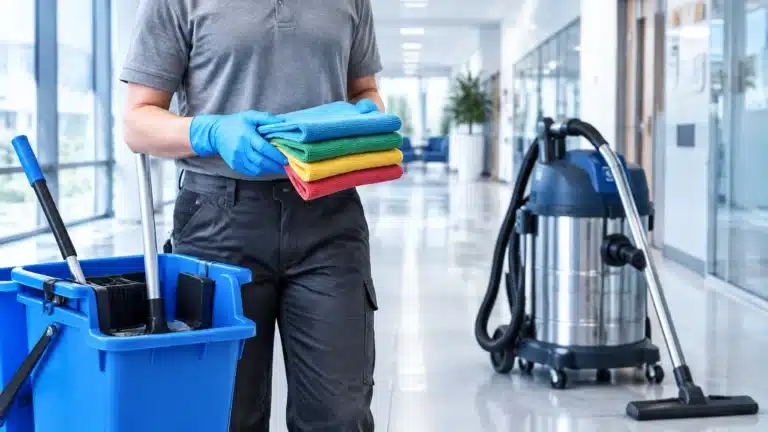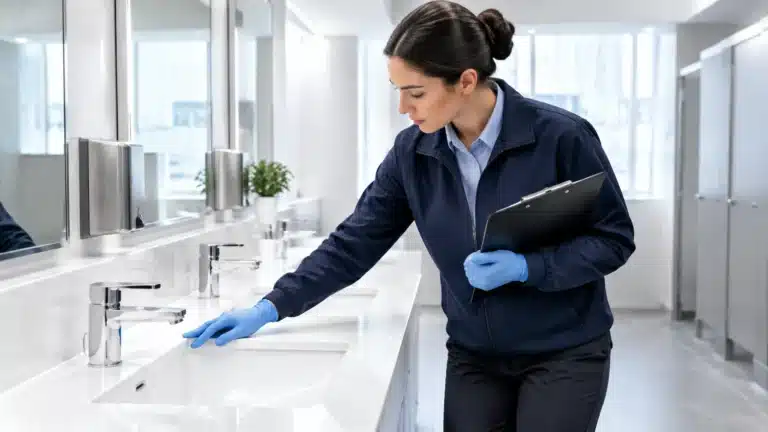



Cleaning work rarely happens in just one place. A contractor’s team may move between offices, kitchens, washrooms and shared corridors, often working on premises controlled by a client. When an incident occurs, this can leave supervisors unsure who should notify the regulator, who should keep the record and who should lead the investigation.
That uncertainty matters. The Reporting of Injuries, Diseases and Dangerous Occurrences Regulations, usually known as RIDDOR, set out when certain work related events must be reported to the enforcing authority. They also require records to be kept for some injuries that do not need a RIDDOR report.
This guide explains the practical distinctions for cleaning contractors, facilities teams and supervisors. The aim is not to report every mishap. It is to recognise the events that meet the legal tests, assign responsibility before a shift begins, and make sure that important information leads to safer working arrangements.
Why reporting can be missed in cleaning
A reportable event may happen during a short shift, on a client site, while a supervisor is elsewhere. A worker may tell a client’s reception team rather than their own manager. Agency staff may not know whether to contact the host business or the agency. Symptoms of a work related condition may also develop gradually and be raised only after several weeks.
These are operational challenges, not necessarily signs of carelessness. They do, however, make clear reporting arrangements essential. A near miss or injury may be known to one party while the responsible person has not been told.
HSE statistics show why the difference between incidents and reports deserves attention. In 2024/25, 680,000 workers reported a non fatal injury through the Labour Force Survey, while employers reported 59,219 employee non fatal injuries under RIDDOR. These figures cover different forms of reporting and should not be read as a direct comparison of like for like cases. HSE also estimates that employers report around half of RIDDOR defined non fatal injuries overall. Slips, trips and falls on the same level made up 30 percent of reported employee injuries, and handling, lifting or carrying accounted for 17 percent.
Cleaning teams encounter both kinds of risk. Wet floors, moving waste, repositioning furniture and repeated wiping can all feature in the work. The figures are a reminder to make the reporting route clear, rather than a reason to presume that every accident is reportable.
Who is responsible on a client site?
RIDDOR reports should be made by the legally responsible person. In ordinary cleaning operations, that will often be the employer in relation to its workers. The employer’s duty follows its employees wherever they are working. A cleaning contractor does not hand this duty to the client merely because the work takes place at the client’s premises.
The person controlling the premises has separate duties. These include reporting work related deaths, certain injuries to members of the public and self employed people on the premises, and dangerous occurrences there. The same incident may therefore need to be considered by more than one organisation, depending on who was involved and the legal circumstances.
Agency arrangements need particular care. In many cases, the agency is the legal employer and has the employer’s reporting duties. In other cases, such as when the worker is self employed, the host business may have duties as the person controlling the premises. Employment status is not always obvious to a worker or the organisations involved. The agency, host business and relevant employer should agree who makes the decision and ensure the worker knows who to contact.
Put the arrangement in the contract and the site file. The file should state who receives an initial incident notification, who decides whether RIDDOR applies, who submits any required report, and who retains the supporting records. These arrangements support cooperation between contractor and client. They do not change which organisation has the legal duty in a particular case.
An injured worker or member of the public does not make the RIDDOR report. They should tell the relevant employer or site contact promptly, so the responsible person can assess the event.
What must be reported, and when?
RIDDOR covers specified types of work related event, not every accident or injury. The responsible person must assess the facts against the relevant criteria. If a worker needs first aid or attends hospital, that alone does not automatically mean a RIDDOR report is required.
A specified injury to a worker includes a fracture, except to a finger, thumb or toe, when it is diagnosed or confirmed by a doctor. A doctor’s fit note may confirm it. A worker’s own suspicion of a fracture is not enough. Other specified injuries include an amputation; an injury likely to cause permanent loss or reduction of sight; and a crush injury to the head or torso that injures the brain or internal organs.
The category also includes a burn covering more than 10 percent of the body surface, or one that causes significant damage to the eyes, respiratory system or other vital organs. This includes qualifying chemical burns and scalds. Loss of consciousness caused by a head injury or asphyxia is reportable, as is any degree of scalping that requires hospital treatment. An injury from working in an enclosed space is reportable where it causes hypothermia or heat induced illness, requires resuscitation, or leads to hospital admission for more than 24 hours.
If the extent of an injury is not clear, a precautionary report is not required simply because it might later prove to be specified. The enforcing authority should be notified or updated once a specified injury is confirmed.
A separate test applies when a worker is incapacitated for more than seven consecutive days, not counting the day of the accident. The period relates to being unable to do normal work, rather than simply being absent from the site where the accident occurred. This report must be received within 15 days of the incident.
For deaths, specified injuries to workers, non fatal accidents to non workers that require hospital treatment, and dangerous occurrences, the responsible person must notify the enforcing authority without delay. The report must be received within 10 days of the incident. A diagnosed reportable occupational disease should be reported as soon as the responsible person receives the diagnosis.
There is also a record keeping threshold that is easy to miss. An injury to a person at work that incapacitates them from routine work for more than three consecutive days, excluding the accident day, must be recorded under Regulation 12. This is not, on its own, a RIDDOR reporting threshold. The distinction is important: a record may be required even when the injury does not meet the test for a report.
Cleaning related occupational diseases
Some reportable conditions develop over time rather than at the moment of an accident. The diagnosis must be made by a doctor, and the work must involve the hazard specified for that disease. A condition is not reportable under these rules simply because a worker has symptoms.
Occupational dermatitis is especially relevant in cleaning. HSE identifies soaps, cleaners and wet work among the possible causes, and lists cleaning among the types of work with a greater risk. For RIDDOR, the work must involve significant or regular exposure to a chemical or biological skin irritant or sensitiser. A diagnosed condition linked only to exposure outside work does not meet that work exposure test.

For supervisors, early reports of dry, itchy, red or cracked skin should be taken seriously, even if they do not yet amount to a confirmed reportable diagnosis. They can prompt a check of tasks, exposure, protective measures and how solutions are prepared and used. HSE advises avoiding contact where possible, using suitable gloves where needed, moisturising, checking hands regularly and reporting early symptoms to a supervisor.
The way products are dispensed affects that exposure. A professional bathroom cleaner or an All Purpose Cleaner Spray measured out at the supplier’s stated dilution, rather than poured neat from the bottle, reduces both the concentration on the skin and the amount of mist in the air. The same principle applies to a glass cleaner used across a large glazed frontage and to an all purpose floor cleaner mixed for a mop bucket. Training that covers dilution, glove choice and hand care is often more useful than a general instruction to be careful.
Cramp of the hand or forearm is reportable when it is chronic and the work involves prolonged repetitive movement of the fingers, hand or arm. A one off episode of acute cramp is not reportable under this category. Tendonitis or tenosynovitis is reportable when it affects the hand or forearm and results from frequent, repetitive and physically demanding work.
Carpal tunnel syndrome has a narrower work test. It is reportable where the worker regularly uses hand held percussive or vibrating power tools. It is not reportable on the basis of typing or similar repetitive movements. A powered cleaning machine should not automatically be assumed to meet this test. Where a scrubber dryer or polisher is involved, assess the actual equipment, task and exposure against the HSE criteria rather than relying on its name.
Occupational asthma is reportable only where the work involves significant or regular exposure to a known respiratory sensitiser. A diagnosis of asthma by itself does not meet the test if the condition was not caused or made worse by work exposure.

Dangerous occurrences involving cleaning equipment
Some dangerous occurrences must be reported even when no one is injured. They are specific events listed in RIDDOR, with high potential to cause death or serious injury. The assessment calls for reasonable judgement about whether there was a real risk of harm, not an elaborate technical exercise.
A failure of a pressure system may be reportable if it had the potential to cause death. This can include scalding or burns from steam, hot water or other hot liquids, making failures involving hot water pressure cleaning equipment relevant to consider. A routine fault or leak is not automatically reportable: the circumstances and potential consequences matter.
An electrical short circuit or overload is reportable in the relevant circumstances when it causes a fire or explosion, puts the equipment out of action and unusable for more than 24 hours, and had the potential to cause death. The assessment concerns the time needed to repair the damaged equipment, not incidental delays such as waiting for parts.
A hazardous escape of a substance may include a spillage from a container or equipment, or a failure of plant or pipes. Consider the nature and amount of the substance, how it dispersed, and whether anyone was or could reasonably have been exposed to significant risk. A small, controlled spill is not automatically a dangerous occurrence. A release that creates a real and significant risk may be.
The judgement matters most with the strongest products in the cupboard. A split container of a drain cleaner unblocker, or a decanted volume of a heavy duty degreaser that reaches a floor drain or a walkway, deserves a proper assessment rather than a quick mop and a note. Record what escaped, roughly how much, where it went and who could have been affected. Those details are what make a reasonable judgement defensible afterwards, and they also tell the buyer whether the container size or storage arrangement is wrong for the site.
A fire or explosion at work premises may also be reportable if it suspends normal work for more than 24 hours. The responsible person should check the specific RIDDOR test rather than assuming that every fire, spill or equipment failure falls within the dangerous occurrence categories.
Records that should stand up to review
Regulation 12 requires records of reportable incidents, reportable diagnoses, and injuries to people at work that incapacitate them from routine work for more than three consecutive days, excluding the day of the accident. Entries must be kept for at least three years from the date they were made. They must be held at the place where the related work is carried out or at the responsible person’s usual place of business.
Keep a copy of the submitted online form and its reference details. If a copy of the form is not retained, the record must include the date and method of reporting, the date, time and place of the event, personal details of those involved, and a brief description of the event or disease. A suitable accident record may cover the injury details, provided it contains the required information. Disease records may need a separate method.
Store records so that the people responsible can retrieve them when needed, while protecting personal and health information from unnecessary access. The client and contractor should know where the record is held and how each party will provide information for an investigation.
A RIDDOR report is not a notification to an insurer. HSE says information supplied through RIDDOR is not passed to insurance companies. If the insurer needs to be told about an accident, injury or ill health case, contact it separately.
Investigate to improve the work
Submitting a report does not finish the task. A useful investigation establishes what happened, what conditions contributed and what practical change could reduce the likelihood of a repeat. It should be proportionate to the incident and focused on learning, rather than blame.
Cleaning work is physically demanding. HSE identifies musculoskeletal disorders as the most common work related ill health or injury reported by cleaners, linked to activities such as mopping, wiping, polishing, moving rubbish bags and furniture, and working in awkward postures. Buildings designed for other occupants can add problems, including poor access, badly placed taps and unsuitable floor materials. An injury or pain report can therefore signal a problem with the task design, equipment, storage or access arrangements.
Review the relevant risk assessment and speak with the worker who did the job. Check whether the equipment was appropriate, maintained and used as intended. Consider whether better equipment selection could reduce manual handling, repeated force or awkward reaching. Where cleaning solutions are involved, check that staff understand the correct preparation and use instructions. Correct dilution and suitable task methods can help avoid unnecessary skin contact. A heavy duty cleaner should be selected for the task it is meant to address, not treated as a reason to use stronger chemicals more often.
For floor work, consider whether the method left surfaces wetter than necessary, how the area was isolated from building users, and whether signage and access arrangements were effective. A slip event may relate to timing, drainage, equipment or the cleaning method itself. The investigation should identify the cause that can be changed, not just restate that the floor was wet. Where an all purpose floor cleaner is used at a rate above the manufacturer’s guidance, or a bucket is filled and carried rather than dispensed at the point of use, both the slip exposure and the manual handling load rise for reasons the site can control.
The same review applies to the products kept on site. A cleaner supply arrangement that puts the right heavy duty cleaning products in the right container size, with clear dilution labels and safety data sheets filed where supervisors can reach them, removes a recurring cause of both skin problems and spillages. Teams buying through a trade cleaning supplies account and households buying commercial grade janitorial supplies at a cleaning supplies shop face the same questions about concentration, decanting and storage. A professional cleaning supplies uk range is only easier to manage when the person holding the bottle knows which product is for which surface and how much to use.
Contractors and clients should share relevant findings. HSE advises contractors to agree liaison arrangements, ensure employees know the client’s procedures and provide clients with information needed to meet their own duties. A near miss entry can be useful evidence in that conversation, even when the event does not require a RIDDOR report.

A supervisor’s practical check
When an incident or diagnosis is raised, a supervisor can use this short sequence to make sure it reaches the right person:
- Make the area safe and arrange assistance for anyone injured or unwell.
- Record when, where and how the event happened, including the people involved and any witnesses.
- Tell the designated responsible person promptly, using the agreed contractor and client reporting route.
- Check whether the event meets a specified injury, over seven day, occupational disease or dangerous occurrence test.
- Confirm who will submit any required report and the applicable deadline.
- Enter the incident in the required record, even if it does not need a RIDDOR report.
- Investigate what should change, assign an action and check that it has been completed.
Reporting as a feedback loop
RIDDOR is both a reporting duty and a record keeping duty. Cleaning operations can make both more dependable by deciding responsibility before work begins, giving workers a clear way to raise incidents and symptoms, and separating events that require a report from those that still require a record.
A well kept record and a proportionate investigation help a business recognise recurring problems and improve work methods. The aim is not paperwork for its own sake. It is a reliable account of what happened and a practical response that helps prevent the same harm from happening again.
For general reference to product categories used in cleaning operations, see the KleanPro Supplies shop.
References
- HSE, Who should report under RIDDOR
- HSE, When do I need to report an incident
- HSE, Specified, reportable injuries to workers
- HSE, Reportable occupational diseases
- HSE, Dangerous occurrences
- HSE, What records do I need to keep
- Legislation.gov.uk, RIDDOR 2013 regulation 12
- HSE, Non fatal injuries at work in Great Britain
- HSE, Musculoskeletal disorders in cleaning
- HSE, Work related contact dermatitis in cleaning