

A written cleaning schedule is a promise about what should happen. It is not evidence that the work was completed, or that the result met the required standard. That distinction matters in every setting, from a busy restaurant kitchen or office to a healthcare facility or a home where dependable results are important.
Verification provides the evidence. A reliable system does not depend on one perfect test. Visual inspections, checks on how cleaning is carried out, records and, where appropriate, objective monitoring each reveal different things. Used together, they offer a more credible view of performance than any single score or device reading.
Define what you are checking
Before inspecting a room or surface, make the standard clear. A useful specification sets out what must be cleaned, how often, who is responsible, and what acceptable means for each item. It should also describe the method where that affects the outcome, such as the equipment to use or the required contact time for a disinfectant.
Without agreed criteria, two people can inspect the same surface and reach different conclusions. One may consider a faint mark acceptable; another may fail it. Clear criteria help auditors make consistent decisions and help cleaners understand what success looks like.
This is one reason a schedule on its own is insufficient. A tick beside a task confirms that somebody recorded it as complete. It does not establish whether the right surfaces were covered, whether the method was suitable, or whether the final result met the agreed standard.
Visual inspection is the foundation
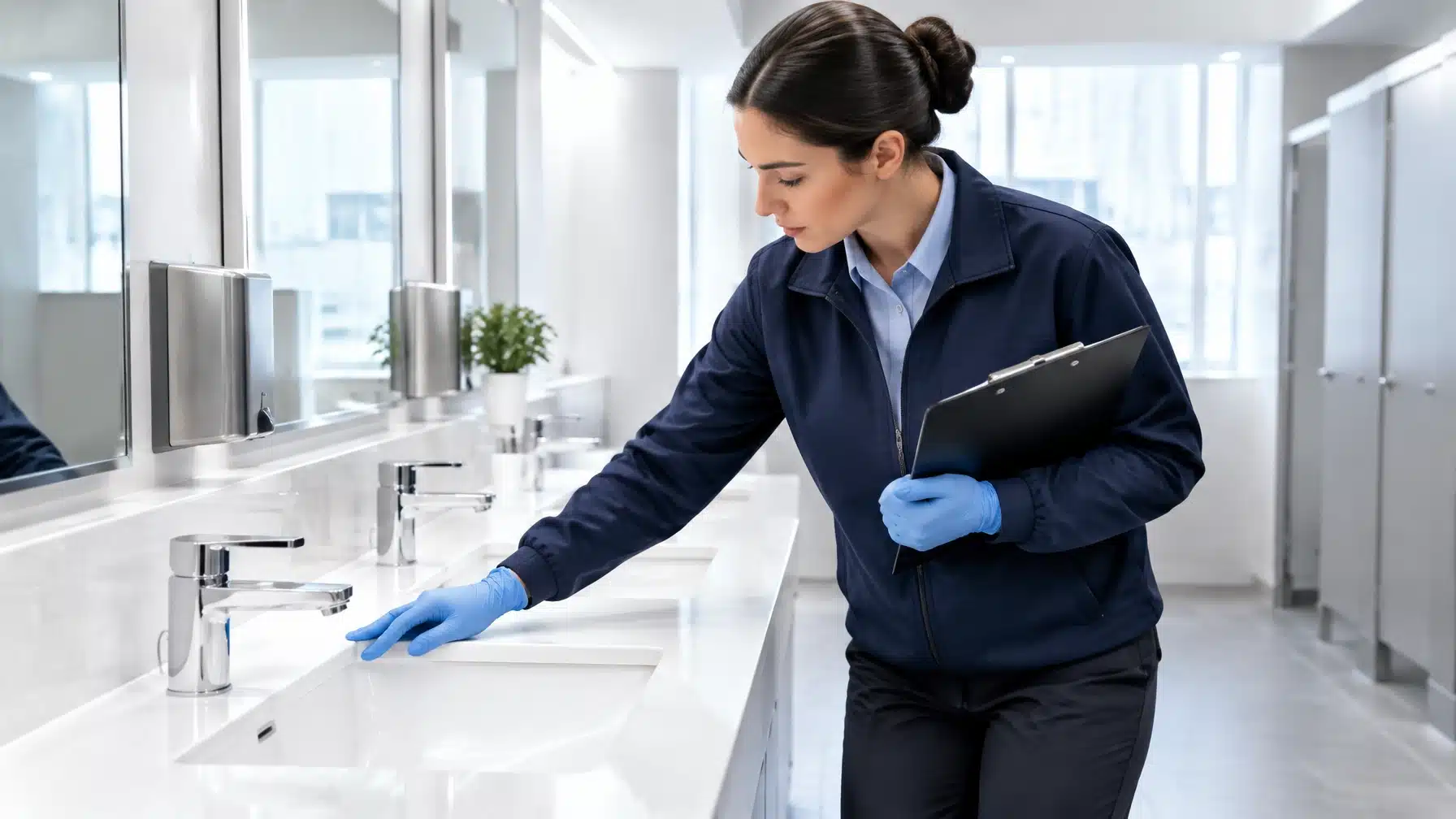
A trained visual inspection is usually the most direct way to assess whether an area meets a visible cleanliness specification, whether the site uses professional cleaning products from a dedicated cleaning supplies shop or everyday household products. Inspectors can look for dust, grease, residue, debris, fingerprints, limescale and missed areas. In a commercial kitchen, that might include work surfaces, splashbacks and the area around equipment. In a washroom, it could include basins, taps, dispensers and frequently touched points, where residue from a professional bathroom cleaner can leave a visible film if rinsing is rushed.
The timing and consistency of the inspection matter. A surface checked immediately after cleaning may look different from one inspected after normal use. The auditor should know when the area was last cleaned and judge the result in that context. Training and shared criteria also reduce the risk that different inspectors apply different standards.
The British Standard BS EN 13549:2001, Cleaning services: Basic requirements and recommendations for quality measuring systems provides a framework for planning quality measurement. It calls for the inspection items, criteria, measurement procedure and sampling approach to be defined. It allows for inspection of all items or a random sample, and recognises rooms or areas as clusters of items. The standard does not set one universal sample size or cleanliness target for every contract. The sampling plan needs to fit the service being assessed.
For a smaller site, checking every relevant room may be practical. Across a larger estate, a representative sample can make routine auditing manageable, provided the selection method is fair and documented. Avoid checking only familiar rooms or areas that happen to be convenient. That can create a reassuring score without giving a dependable picture of the service.

What the NHS model demonstrates
The NHS England National Standards of Healthcare Cleanliness 2025 offer a detailed example of verification in practice. Published on 5 February 2025, the standards replaced the 2021 version, expanded to include ambulance services and patient transport vehicles, and introduced six functional risk categories. The system recognises that different areas carry different levels of risk and need different levels of monitoring.
The NHS audit targets and recommended frequencies are linked to those categories:
| Functional risk category | Audit target | Audit frequency |
|---|---|---|
| FR1 | 98 percent | Weekly |
| FR2 | 95 percent | Monthly |
| FR3 | 90 percent | Every two months |
| FR4 | 85 percent | Every three months |
| FR5 | 80 percent | Every six months |
| FR6 | 75 percent | Every twelve months |
These figures are part of a healthcare framework, not universal targets for every business or household. Their wider lesson is that verification frequency should reflect risk. An area with more demanding use or greater consequences if cleaning falls short will usually need closer attention than a low use storage area.
The NHS standards also distinguish between a technical audit and an efficacy audit. A technical audit scores the cleanliness outcome against defined criteria. An efficacy audit observes the cleaning process: for example, whether staff use the appropriate equipment and materials, follow the agreed method, and handle chemicals and protective equipment correctly. An area can appear clean at the moment of inspection while the process used to reach that result is inconsistent or unsuitable. Checking both aspects gives a fuller picture.
The NHS star rating is calculated from the average percentage scores across the staff groups responsible for the area, such as cleaning, nursing and estates. It represents the whole area rather than the performance of one group alone. Ratings are displayed in areas accessible to patients, and areas scoring three stars or fewer require an improvement plan. This approach makes failures visible and connects the audit result to responsibility and follow up.
Use objective measures for the right question
Tools can add useful information, but they do not all measure the same thing as a visual inspection. Fluorescent marking, for example, can show whether a marked target surface was physically wiped: a mark is applied before cleaning and checked afterwards under an appropriate light. It can help identify missed areas and support staff training. It does not measure the amount of dirt or establish that a surface is microbiologically safe.
ATP monitoring also needs careful interpretation. The test measures adenosine triphosphate, or ATP, from organic sources and reports a reading in relative light units, or RLU. Sources can include microorganisms, food residue and skin cells. A reading is therefore an indication of ATP detected on the sampled area, not a direct count of harmful organisms.
Research has found no, poor or inconsistent correlation between ATP readings and microbiological colony counts in studies of healthcare cleaning. The Healthcare Improvement Scotland literature review concludes that there is insufficient evidence to use ATP or fluorescent marking to infer the microbiological cleanliness of a surface. The review describes these methods as possible adjuncts to visual assessment and training, provided local methods and benchmarks are established. The peer reviewed 2018 study of ATP testing in operating theatres likewise discusses its value and limitations.

ATP can be useful for showing a team that a surface was missed, supporting training, or tracking patterns when the same device and method are used consistently. But a low RLU reading does not prove that a surface is free of pathogens. A high result does not identify a pathogen, either. Results can also be influenced by sampling technique, the surface and chemical residues. Thresholds vary, so a number from one meter or setting should not automatically be treated as meaningful in another.
The practical point is simple: choose a test because it answers a defined question. If the question is whether a particular area looks visibly clean, inspect it against clear criteria. If the question is whether a target was wiped, a fluorescent marker may help. If the question is whether viable microorganisms are present, ATP is not a substitute for appropriate microbiological sampling and expert interpretation.
Audit the method as well as the result
A strong verification system looks at how work is done, not only at how a room looks afterwards. Observe staff carrying out routine tasks and check whether the method matches the agreed procedure. Depending on the setting, this might include the order of work, equipment condition, cloth or mop management, correct product dilution, chemical handling, surface compatibility and whether a required contact time is observed.
This is not a reason to turn routine checks into a search for blame. It is a way to identify why a result is or is not consistent. For example, recurring residue may point to an unclear method, unsuitable equipment, rushed work or a product being used incorrectly. Repeated failures on high touch surfaces may call for a review of task expectations or supervision.
Using professional cleaning products or trade cleaning supplies does not, by itself, prove that standards are met, and the same applies to well specified janitorial supplies. Products and equipment need to suit the task and be used according to their instructions. The same is true whether cleaning is carried out by an in house team, a contractor or an individual at home.
Keep an audit trail that can be trusted
An inspection result is more useful when another person can understand how it was reached. Record the date, location, items checked, criteria used, person carrying out the audit, result and any failures. For each failure, note its location and cause if known, who is responsible for action, the expected completion time and whether the correction was checked afterwards.
Keep the original result separate from the corrective action. If a failed surface is cleaned after an audit, record the remedial work and any recheck, but do not change the original score to make it appear that the surface passed on inspection. This preserves a truthful record of what was found and makes performance trends more useful.
Some other workplace checks provide a clear example of documented verification. The Health and Safety Executive’s HSG274 Part 2 concerns Legionella control in hot and cold water systems, not general room cleaning. It recommends that infrequently used outlets are flushed at least weekly and that the regime is logged. Its guidance also calls for monthly monitoring of sentinel temperatures in hot and cold water systems. The guidance specifies hot water reaching at least 50°C within one minute at outlets, or 55°C in healthcare premises, and cold water below 20°C where possible. Monitoring and inspection records should be kept for at least five years.
The example is valuable because it shows how a defined control can require a specified check, frequency and record. Those water system requirements should not be confused with cleaning audit scores. They are a separate form of verification for a separate risk.
For smaller operators, a simple logbook can be enough to bring structure to routine checks. Use a consistent form, identify who is responsible, and make sure overdue actions are visible. Paper or digital records can both work; the important thing is that entries are timely, complete and easy to retrieve.

Set a proportionate frequency and respond to trends
The appropriate inspection frequency depends on the area’s use, risk, cleaning frequency and previous results. A risk based approach can combine regular checks of higher priority areas with less frequent checks elsewhere. It should also allow for additional inspections after a complaint, a change in use, a failed audit or an incident.
Look beyond one score. Repeated problems on the same surface, a decline over several audits, or a pattern across similar rooms may reveal a cause that an isolated result would miss. Consider whether work has enough time and resources, whether staff understand the standard, whether access is practical, and whether the equipment and materials are suitable. Then check that the corrective action has worked.
A good verification system uses methods that can be challenged. Randomly varying inspection times and locations makes it less likely that the audit captures only prepared areas. Periodically involving someone outside the team that delivers the service can provide a useful independent view. In healthcare settings, NHS England recommends external assurance to check the quality and method of internal technical and efficacy audits.
Questions to ask a cleaning contractor
If you buy a cleaning service, ask how the provider verifies that the agreed standard is being met. Useful questions include:
- What criteria are used to pass or fail each item?
- How are locations and samples selected?
- How often are inspections carried out, and how does risk affect that frequency?
- Can you see recent audit results and trends, including failures?
- How are corrective actions assigned, completed and checked?
- Are audits of the cleaning process carried out as well as checks of the visible result?
- Who conducts the audits, and how is consistency between auditors maintained?
A clear report should show more than a headline percentage. It should explain what was checked, how the result was scored, what failed and what happened next. That is more useful than a perfect looking score without supporting detail.
For healthcare providers in England, the Health and Social Care Act 2008 code of practice on infection prevention and control includes cleanliness within its guidance for providers. It says providers should have regard to the code when deciding how to meet the regulations. The code is guidance rather than a mandatory checklist, and providers may demonstrate compliance in another equivalent or better way.
Verification turns a promise into evidence
A cleaning schedule is an essential starting point, but it cannot demonstrate its own success. Reliable assurance comes from clear criteria, consistent visual inspection, checks on the cleaning process, honest records and objective tools used within their limits. Each method has weaknesses; together, they can give a more balanced account of whether standards are being achieved and sustained.
For general information about available cleaning supplies, visit the KleanPro Supplies shop.