


Good cleaning standards depend on more than a spotless surface. Staff need to know what to clean, when to clean it, which method and product to use, and how a supervisor will check the result. A clear routine protects food safety, supports consistent workplace hygiene and helps teams spot missed tasks before they become recurring problems.
For UK food businesses, cleaning is part of the food safety management system. The Food Standards Agency (FSA) advises food businesses to maintain and follow a system for managing food safety, and provides practical advice on cleaning through its cleaning guidance and Safer Food, Better Business resources.
The same principles can be adapted for offices, hospitality venues, washrooms, smaller trade premises and homes. The detail will vary, but a good cleaning schedule always connects the task with its risk and makes completion easy to verify.
Start with the spaces and risks
Walk through the premises and divide it into practical zones. In a commercial kitchen, these could include food preparation, cooking, pot wash, cold storage, dry storage, waste handling and staff facilities. In a wider facility, include washrooms, reception, offices, shared kitchens, corridors and cleaning stores.
For each area, consider how it is used and what could make it dirty or unsafe. A preparation bench used for raw ingredients needs controls to prevent cross contamination. A door handle used by many people needs regular attention. A seldom used store cupboard may need less frequent cleaning, but should still be checked for dust, spills, pests or signs of damage.
Do not assume every room needs the same frequency. The right interval depends on use, risk, soil, the surface and the work carried out. The FSA does not give one universal timetable for every kitchen. The business needs a routine appropriate to its own processes and must follow it.
A simple way to prioritise is to ask:
- Could this surface come into contact with food, clean equipment or hands?
- How often is it touched or used?
- Does the task create grease, spills, dust or other residue?
- Could a missed clean create a hygiene, slip or pest risk?
- Does the cleaning method need a specific product, contact time or protective equipment?
Build a schedule people can follow
A schedule should be specific enough for a new team member to understand without guessing. For each task, record the item or area, the method, the frequency, the responsible role and how completion is recorded. Where relevant, add the product, dilution, contact time, rinsing requirement and any surface restrictions.
Use clear task names. “Clean kitchen” is difficult to check. “Clean and disinfect the preparation bench after raw food handling and at the end of service” gives staff a usable instruction. Separate work that must happen during service from closing duties and less frequent deep cleaning.
A practical schedule might include:
- During service: remove spills promptly, clear food debris and clean equipment between tasks where required.
- At shift change or end of service: clean food contact surfaces, sinks, taps, handles, utensils and equipment used during the shift.
- At closing: clean floors, bins and relevant cooking or washing equipment, then leave the area tidy and ready for the next team.
- Weekly or at another risk appropriate interval: inspect and clean less accessible surfaces, shelving, areas behind movable equipment and other locations that are not part of routine wipe downs.
- After an incident or change: add a specific clean after a spill, maintenance task, pest issue or change in production.
Treat these as planning examples, not a substitute for an assessment of your own premises. Include equipment instructions and the site’s food safety procedures when deciding what to clean and how often.
Kitchen hygiene: clean first, disinfect when required
Cleaning removes food residue, grease and visible dirt. Disinfection is a separate step intended to reduce microorganisms on a surface when performed using the correct product and method. One does not automatically replace the other. A disinfectant applied over grease or food debris may not work as intended.
For food contact surfaces, follow the product label and the business cleaning procedure. Where the method requires it, first wash away soil with detergent, rinse if instructed, then apply a suitable disinfectant. Keep the surface wet for the stated contact time. Rinse afterwards if the instructions require it, and protect food and clean utensils from chemical contamination.
The FSA advises food businesses to use appropriate products and to follow their instructions. Where a disinfectant is used in a food business, check the label for relevant efficacy information and suitability for the intended use. Do not assume a product is suitable for a food preparation surface simply because it is described as a professional cleaner.
A heavy duty degreaser may be appropriate for grease on suitable equipment or surrounding surfaces, but that does not automatically make it suitable for food contact areas. Check the product directions and material compatibility, and use the separate cleaning and disinfection steps required by your procedure.

“Clean as you go” helps keep soil from building up during service. It should not be used as a vague substitute for planned cleaning. Specify which spills must be dealt with immediately, which surfaces need cleaning between tasks, and what remains for the end of the shift. Make sure staff have the time and equipment to complete these tasks safely.
Washrooms and shared facilities
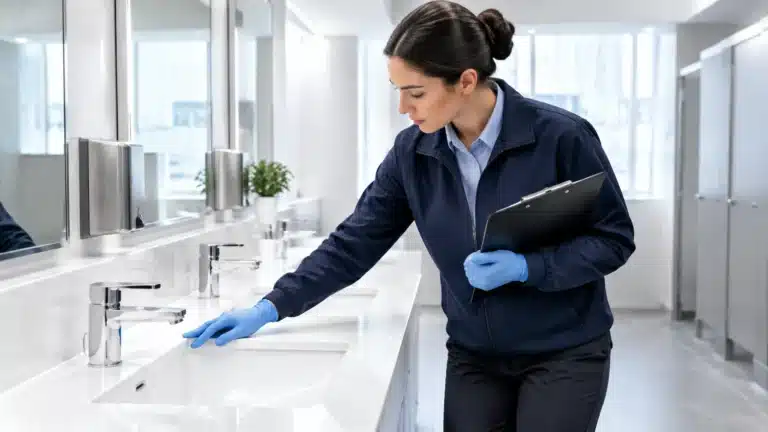
Washroom cleaning should cover more than visible basins and floors. Include taps, flush controls, door handles, dispensers, cubicle locks, light switches and other frequently touched points. Check mirrors and glass, empty bins, replenish soap and drying supplies, and report leaks or damage.
A professional bathroom cleaner may help with routine soil or limescale on suitable surfaces, but product choice and use should follow the label. Do not combine products or apply chemicals to a surface for which they are not intended. Where disinfection is part of the routine, clean the area first and follow the disinfectant’s contact time and rinsing directions.
Set a frequency that reflects use. A busy public washroom may require checks and cleaning throughout the day, while a small staff facility may need a different pattern. Keep a record of checks and replenishment as well as scheduled cleaning. A washroom can look tidy but still have empty dispensers, an overflowing bin or a missed touch point.

Use colour coding to keep equipment separate
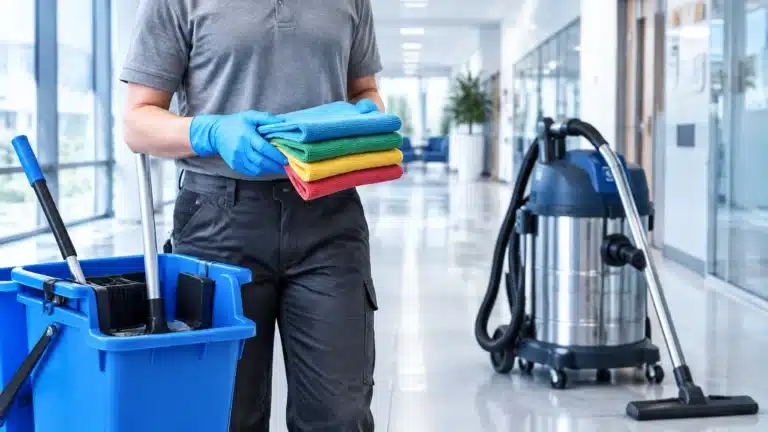
Colour coding can make it easier for staff to keep cleaning cloths, mops and other tools in their intended areas. Agree a simple scheme, label it clearly and train everyone to use it consistently. For example, a site may reserve one colour for food preparation areas and a different colour for washrooms.
There is no single colour system that automatically applies to every commercial kitchen. A colour scheme used in healthcare settings should not be presented as a legal requirement for all catering premises. Choose a practical local arrangement, record it in the cleaning instructions and prevent equipment used for sanitary areas from being used in food areas.
Colour coding only works when the tools are maintained too. Wash or dispose of cloths as specified in the procedure, allow reusable equipment to dry, and store clean items apart from used ones. Replace tools that are damaged or no longer clean properly.
Get chemical dilution and handling right
A product used at the wrong concentration may give poor results, leave unwanted residue, damage surfaces or increase the risk to staff. Follow the label, use any dispensing system as directed and train staff on the correct measure. Never assume that more product means better cleaning.
Keep chemicals in their original containers where possible, with labels intact. If a product is decanted, the new container must be suitable and clearly identified according to workplace procedures. Store chemicals away from food and follow the instructions for incompatible substances. Never mix cleaning products.
Employers must assess and control risks from hazardous substances under COSHH. The HSE guidance for the catering industry highlights risks including skin irritation from frequent wet work and exposure to substances in cleaning products. The HSE also provides guidance on safe use of cleaning substances in hospitality, including products such as dishwasher detergents, rinse aids, drain cleaning products, oven cleaners and disinfectants.
Provide the protective equipment specified by the assessment and product instructions. Staff should know how to use it, where chemicals are stored, what to do after a spill and who to tell about an exposure or damaged container. Keep the safety information accessible to the people who need it.
Verify the result, not just the signature
A tick on a checklist shows that a task was recorded. It does not prove that the method was followed or that the surface is clean. Supervisors should combine record checks with occasional observation of the work and inspection of the finished area.
Visual checks are a useful first step. Look for grease, crumbs, streaks, residue, odour, standing water and missed areas around equipment edges. Check that tools are in the correct zone and stored cleanly. Where food safety risks warrant it, a site may use ATP swabs as an additional way to assess cleaning effectiveness. Follow the equipment instructions, set suitable site criteria and use results to identify patterns or investigate failures.
ATP results are not a substitute for a sound cleaning procedure, nor should a single reading be treated as a complete food safety assessment. A result outside the site’s expected range should prompt investigation, corrective cleaning and a review of the method. Keep a record of what was found and what action followed.

For records that are useful during an inspection, keep the schedule and task instructions together with daily or shift sign offs. Record missed tasks, corrective action, periodic deep cleaning, relevant training and changes to the schedule. Keep product instructions and COSHH information available. Records should be clear, dated and honest. A repeated copied tick is less useful than a brief note explaining what was checked and what was corrected.
Train staff at induction and refresh the routine
Show new team members how to prepare the cleaning solution, choose the right cloth, work safely around food and complete the record. Demonstrate the site’s colour coding and explain how to protect food, utensils and clean surfaces while cleaning. Do not rely on a written schedule alone, especially where staff have different levels of experience or language needs.
Check understanding in practice. Ask the worker to explain the task and observe them completing it. Refresh training when products, equipment or procedures change, and when an audit identifies a repeated gap. Training records can note the task covered, the date and who delivered it.
Common gaps found during site checks
Routine audits often find the same practical weaknesses: tasks described too broadly, unclear ownership between shifts, dilution left to guesswork, missed edges or undersides, dirty cloths reused, washroom tools brought into food areas, and signatures entered without a genuine check. Another common issue is a schedule that lists daily tasks but never assigns periodic work such as cleaning behind equipment.
Correct these problems by making the task clearer, assigning responsibility and checking that equipment and time are available. Review the schedule after a menu, layout, process or product change. If the same task fails repeatedly, investigate the cause instead of adding another reminder to the checklist.
Applying the same principles at home
Homeowners can use a simpler version of the same system. List the kitchen, bathroom and shared touch points, then set a routine that suits household use. Clean up spills promptly, clean food preparation surfaces after use and keep toilet and kitchen cloths separate. Read product instructions, use the stated dilution and keep chemicals away from children, pets and food.
A commercial grade product is not automatically necessary for every household task. Match the product to the surface and soil, and avoid using a heavy duty cleaner where a milder option is suitable. An all purpose cleaner spray can support routine cleaning on compatible surfaces, while a glass cleaner is intended for glass and mirrors. Floor products should suit the flooring material.
When comparing professional cleaning products, trade cleaning supplies or janitorial supplies, consider intended use and instructions rather than relying on strength alone. Someone browsing a cleaning supplies shop or looking for professional cleaning supplies UK wide should check whether the product fits the task and home surfaces. The same applies to a professional bathroom cleaner, an all purpose floor cleaner or heavy duty cleaning products. A drain cleaner unblocker is for drains, not general surface cleaning, and must be used only as directed. For commercial kitchens, KleanPro’s kitchen degreaser guide provides further context on matching a heavy duty cleaner to the job. For household or smaller trade use, keep the cleaner supply organised and only buy what can be stored and used safely.
A consistent standard is built through clear instructions, suitable products, trained people and checks that lead to action. Start with the highest risk areas, document a routine staff can actually follow, and review it whenever the work changes.