

Cleaning has an environmental footprint beyond the products used. Heating water, running washing machines and dishwashers, and repeating a cleaning task all consume resources that can be easy to overlook when bills are recorded only at building level.
For trade buyers, facilities teams and homeowners, a useful starting point is to look at the whole cleaning operation. How often do machines run? How much water does a cycle use? Is hot water being supplied by a gas boiler or heated inside the machine? And how often does a first attempt need to be repeated?
These questions matter because the answers point to practical ways to reduce water and energy use without compromising hygiene or cleaning results. They also help businesses produce a more credible picture of their greenhouse gas emissions.
The energy behind a clean
A cleaning product is only one part of a task. The rest may involve water, a machine, heat, drying and staff time. In laundry and dishwashing, heating water can account for a meaningful share of the energy used. A machine may also consume power while waiting for the next load, even when it is not actively washing.
This is why buying a product described as sustainable does not, on its own, establish the footprint of the cleaning process. The temperature, equipment, cycle choice, load size and frequency of use all affect the result. Water matters too: a high volume of hot water takes more energy to heat than a smaller volume at the same temperature.
A simple physical estimate shows why temperature deserves attention. Heating one cubic metre of water by one degree Celsius requires about 1.16 kilowatt hours of heat before accounting for boiler or system losses. The actual energy needed will be higher where a heater is not fully efficient or where hot water loses heat on its way to the point of use. This estimate is a way to understand the relationship between water volume and temperature, not a substitute for meter readings.
The important point is that a small change in temperature or water volume can be repeated across many cycles. In a hotel laundry, care facility or busy kitchen, the cumulative effect may be more significant than a single wash suggests.
Hot water in laundry and dishwashing
Laundry and dishwashing have different performance requirements, so there is no single best temperature for every job. A wash temperature must suit the fabric, soil and hygiene protocol. A dishwasher must meet the machine manufacturer’s and site’s requirements for cleaning and sanitation. Reducing temperatures without checking those requirements can compromise results or safety.
Within those limits, temperature settings are worth reviewing. Avoid using a hotter programme than the task requires. Check whether the machine has an appropriate lower temperature or economy setting, and confirm that its cleaning performance remains acceptable for the loads being processed. For laundry, a full load that is correctly sorted can often make better use of the water and heat already required for a cycle. For dishwashing, follow the equipment guidance on loading and pre rinsing rather than running hot water over items unnecessarily.

Commercial laundry and dishwashing figures vary widely between equipment types and operating patterns. A result from one site should not be treated as a universal benchmark for another. The most useful comparison is often within your own operation: energy per kilogram of linen washed, water per laundry cycle, or electricity and water per dishwasher load.
A 2025 peer reviewed European life cycle assessment of laundry and dishwashing underlines the importance of the use phase and how appliances are used. Its findings support a practical approach: measure the cycles and resources at your site, rather than assuming that the product or machine specification alone tells the whole story.
Machines use energy between tasks
A machine’s impact is not limited to its active wash programme. Some equipment continues to use energy while holding water at temperature, remaining on standby or waiting for the next load. That background use can be difficult to spot if only the cycle time is considered.
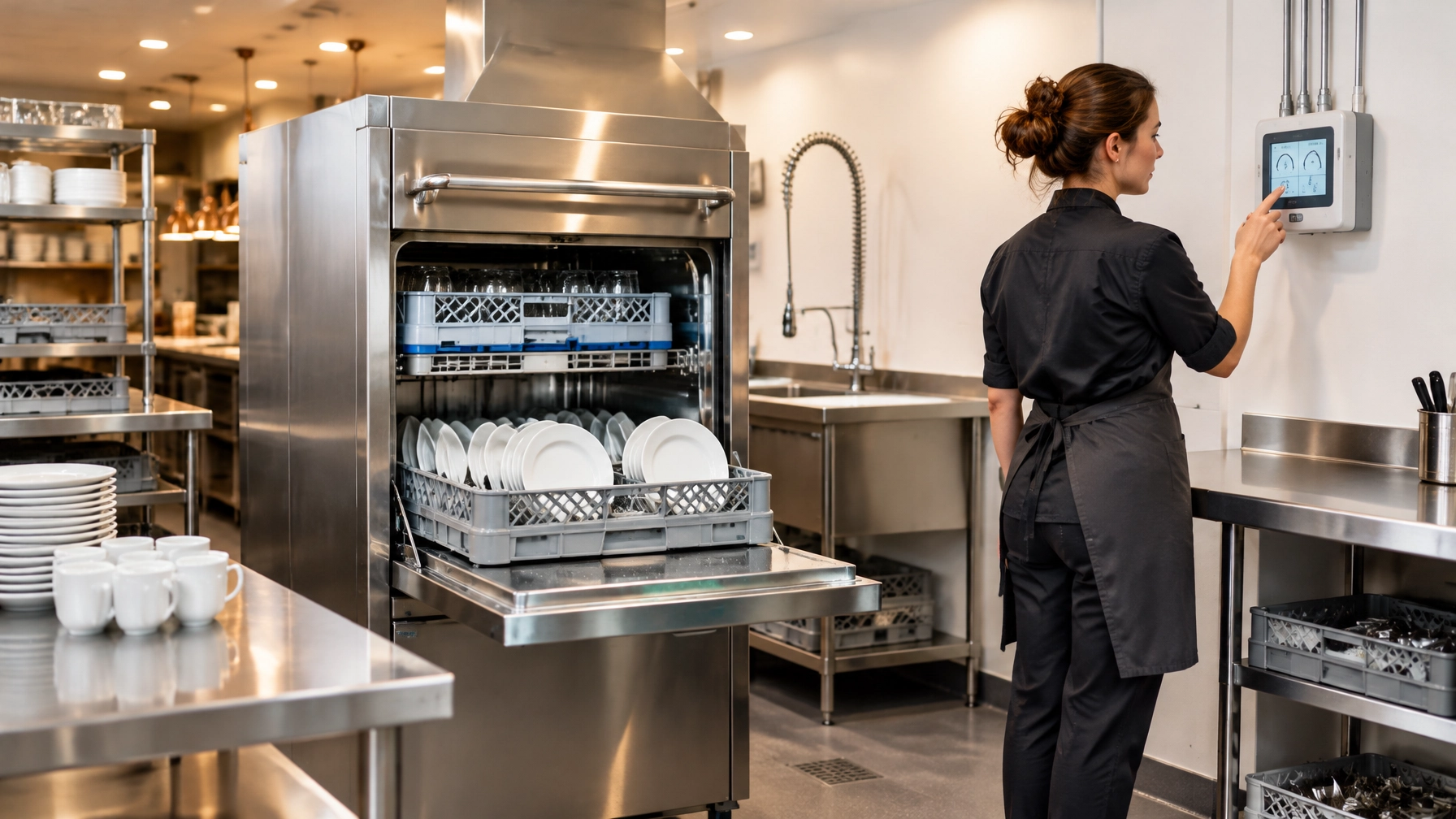
An older Department for Environment, Food and Rural Affairs and Carbon Trust assessment of contract catering sites found that usage patterns and equipment operation can influence energy demand. Its sample was small and the research is historical, so its figures are not a current benchmark for every kitchen. However, the report illustrates why measuring equipment use matters: dishwashers were sometimes left heating during long idle periods, drawing energy without processing a load, and hot water pre rinsing was identified as an avoidable use of energy. Across the sites studied, dishwashing accounted for a modest share of total kitchen energy compared with cooking, refrigeration and extraction, yet the assessment still estimated that around a quarter of dishwashing energy could be saved through changes in operating behaviour.
For trade buyers, ask for relevant performance data when reviewing replacement equipment. Useful measures include electricity per cycle, water per cycle, standby use, and, where relevant, the machine’s ability to recover heat. Compare models with similar capacity and intended use. A machine that uses fewer resources per cycle may not deliver a lower footprint if it is routinely underloaded or left switched on for long periods.
Maintenance is part of this picture. Blocked filters, scale build up, faulty thermostats, leaks or poor seals may affect performance and lead to more water, heat or repeat cycles. Follow the manufacturer’s maintenance instructions and keep a basic record of faults and servicing.

Rework can multiply the impact
A failed clean is not just an inconvenience. If a load needs to be washed again, the second cycle uses additional water and energy. It may also require more detergent, rinse aid or laundry chemicals. In some settings, it adds labour and delays as well.
The effect is especially easy to miss when each repeat is recorded as a separate task rather than as a failure of the first attempt. If two out of ten equivalent loads need a full repeat cycle, the operation has processed twelve cycles’ worth of direct machine activity to complete ten planned loads. That represents 20 per cent more cycle activity in this simplified example, assuming the repeat cycles use the same resources as the originals.
Track rework as a practical performance measure. Record how many tasks are repeated and why. Common causes may include incorrect loading, unsuitable cycle choice, equipment faults, poor water quality or a product being used outside its instructions. The aim is not to blame staff or assume that every repeat can be avoided. It is to identify recurring problems and correct them.
Avoiding unnecessary rework can reduce energy and water use while improving consistency. The UK Cleaning Products Industry Association makes a similar point in its professional cleaning guidance: when machines are incorrectly adjusted or operated, the resulting rework can double all of the impacts that should have arisen in cleaning those items in the first place. For cleaning teams, the same principle applies to a missed area or a surface that needs to be cleaned again. The extra impact depends on the task, but a second pass will generally require more resources than getting the first pass right.
How to measure your cleaning footprint
For UK businesses, the Government’s 2026 greenhouse gas conversion factors provide a consistent way to convert activity data into emissions. The Department for Energy Security and Net Zero says the factors are suitable for UK organisations of all sizes and for reporting UK activities in 2026. The published page notes a correction to the flat file in July 2026, so use the current full set or the corrected flat file.
The calculation is straightforward:
Activity data multiplied by a conversion factor equals greenhouse gas emissions.
For cleaning operations, activity data may include kilowatt hours of electricity and gas, water supplied in cubic metres, machine cycles and the amount of laundry processed. Bills provide a starting point. Sub meters, machine data and water readings can help separate cleaning activity from the rest of the site.
The GHG Protocol Corporate Standard and its Scope 2 guidance offer a useful way to organise business emissions:
Scope 1 covers direct emissions from sources the business owns or controls. Gas burned in an on site boiler to heat water is a typical example.
Scope 2 covers emissions associated with purchased electricity, heat, steam or cooling. Electricity used by a dishwasher, washing machine, dryer or electric water heater is normally included here.
Purchased water, wastewater treatment, cleaning products and outsourced laundry are generally considered in Scope 3, rather than Scope 1 or Scope 2. A small business can start by measuring its main energy use, then add other material categories as data becomes available.
Take care not to count the same energy twice. If a gas boiler heats water, record the gas as Scope 1. Do not also count the resulting hot water heat as purchased electricity. If a site buys heat from a shared system, use the appropriate purchased heat method instead. Where Scope 2 emissions are reported under the GHG Protocol, check the relevant guidance on location based and market based reporting and keep records of the electricity data and any contractual evidence used.
A practical first measurement can be completed in four stages.
Set a boundary and period. Decide which sites and operations are included. A twelve month period, aligned with the business year where possible, gives a more useful baseline than a few days of readings.
Gather activity data. Collect electricity and gas use from bills, water supply and treatment from water bills, and machine data where available. For laundry, note cycles and kilograms washed. For dishwashing, record cycles or racks processed. Include dryer use and repeat cycles where possible.
Apply the right factors. Use the current government conversion factors for the relevant reporting year and activity. Keep the source, factor and any assumptions alongside your calculation.
Compare like with like. Track emissions and resource use per kilogram of laundry, per dishwasher load or per cleaning task, as well as the annual total. A busy month may use more energy because more work was completed. A measure per unit of activity helps show whether the process itself is becoming more efficient.
The UK Government’s small business guide to greenhouse gas measurement recommends starting with practical activity data such as electricity, gas and water bills. It also advises making reasonable estimates where data is not available, while being clear about the method used. That is a sensible starting point for a small operator without sub meters.
Practical steps for trade buyers
A small number of operational changes can make the data useful and lead to action.
Review machine settings against the task, the manufacturer’s instructions and hygiene requirements. Where a lower energy programme is suitable, record its performance and use it consistently.
Avoid long idle periods where equipment guidance and operational needs allow the machine to be turned off. Set clear responsibilities for start up and shut down, particularly across shifts.
Train teams to load machines correctly and to avoid unnecessary pre rinsing. Record the number of racks or loads alongside the cycle count, so the figures reflect useful work rather than machine activity alone.
Review repeat cycles and identify their causes. Correcting one recurring equipment or process issue may reduce energy and water use across many future loads.
When comparing equipment, consider resource use over its working life, not only purchase cost. Ask suppliers for data that can be compared on a consistent basis, such as water and energy per cycle. Consider heat recovery where the equipment and site setup make it appropriate.
Keep supplier and equipment information with the data record. For example, the product information for automatic dishwasher detergent and laundry liquid detergent can help teams check the intended use and directions for the products in their process. Product instructions do not replace machine guidance or site hygiene procedures.
The CHSA sustainability outlook report for 2026 provides useful sector context. Its scope includes environmental regulation affecting cleaning and hygiene manufacturers and distributors, with discussion of chemicals, packaging, carbon reporting and wastewater. It is not a guide to the energy use of an individual cleaning operation. For buyers, though, it reinforces the value of asking suppliers for consistent information and keeping reliable records about the products and processes in use.
Steps homeowners can take
The same measurement principles work at home, even without sub meters. Use the meter or energy monitor you already have where possible, and record how often laundry or dishwasher cycles run. Note the programme, load size and whether a load needs a repeat. Water bills can help track the household total, although they may not separate cleaning from other uses.
Run machines with suitable full loads, use an appropriate lower energy programme when it meets the task, and avoid leaving equipment running or heating when it is not needed. Check the appliance instructions before changing temperature or cycle settings. Do not sacrifice hygiene or fabric care to reduce a reading.
If a cycle repeatedly fails, investigate the cause rather than simply adding another wash. Correct loading, suitable programmes, maintenance and following product instructions can all help achieve a satisfactory result first time. This is as relevant to professional cleaning products used at home as it is to a commercial laundry.
Measure first, then improve
The hidden energy footprint of cleaning is largely found in repeated activity: heating water, running machines and repeating work that did not succeed first time. Businesses do not need a complex system to begin understanding it. Start with bills, count machine cycles, record rework, and apply the current UK government conversion factors to the fuel and electricity data.
For trade buyers reviewing professional cleaning products and trade cleaning supplies, measurement can support better procurement and clearer discussions with site operators and suppliers. For homeowners, a simple record of cycles and programme choices can reveal where practical changes may help. In both cases, the objective is consistent cleaning with less avoidable resource use.
References
- Government greenhouse gas reporting conversion factors for 2026
- GHG Protocol Corporate Standard
- GHG Protocol Scope 2 Guidance
- Government small business guide to measuring greenhouse gas emissions
- UKCPI, Manage the impacts when you clean
- Department for Environment, Food and Rural Affairs and Carbon Trust assessment of energy efficiency in contract catering
- CHSA Sustainability Outlook report for 2026
- Mankad and colleagues, Lowering the environmental impact of dishwashing and laundry in Europe: a LCA perspective, Tenside Surfactants Detergents, 2025