Newsletter Subscribe
Subscribe for news, offers and a welcome 5% discount on us.
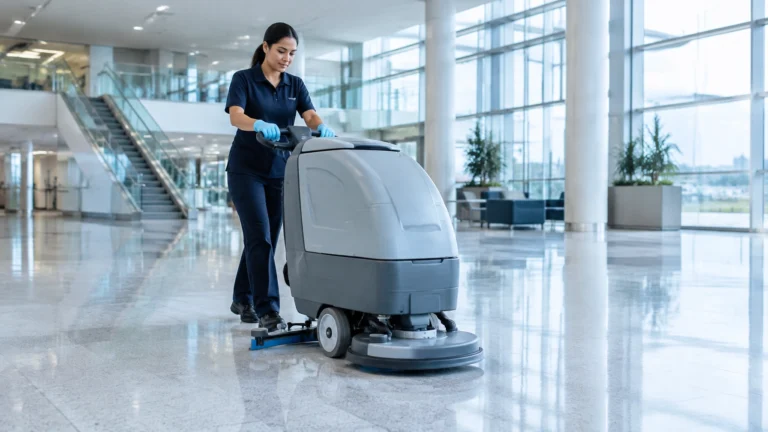
Cleaning may look straightforward from the outside, but the work involves moving and supporting loads throughout a shift. A cleaner may push a trolley, carry a vacuum between rooms, empty a bucket, move a waste bag or repeatedly reach and wipe surfaces. Each task can place physical demands on the body, particularly when it is repeated, rushed or carried out in a building that was not designed with cleaning in mind.
Musculoskeletal disorders, or MSDs, are the most common work related ill health and injury reported by cleaners, according to the Health and Safety Executive’s cleaning sector guidance. The Manual Handling Operations Regulations 1992 provide a practical legal framework for addressing these risks. In order, they ask employers to avoid hazardous handling where reasonably practicable, assess the risk from handling that remains, and reduce that risk as far as reasonably practicable.[1]
Cleaning work combines physical effort with repetition. Mopping, wiping, polishing and moving equipment or rubbish can involve sustained or awkward postures. A task that feels manageable once may become more demanding when it is repeated across several rooms or a full shift.
The wider picture supports taking these risks seriously. HSE reported an estimated 511,000 workers with work related MSDs in 2024/25, resulting in 7.1 million working days lost. The average was 14 days lost per case. Back problems accounted for 221,000 cases, while the upper limbs or neck accounted for 211,000.[2]
In HSE’s three year industry figures, administrative and support service activities had a rate of 1,700 MSD cases per 100,000 workers, compared with 1,180 across all industries. Cleaning is part of this broad industry group. Elementary occupations, which include many cleaning roles, also had a higher rate than the all occupations average.[2] These are broad categories, rather than figures for cleaners alone, but they help explain why manual handling should be built into routine supervision and planning.
The workplace itself can add difficulty. Buildings are generally planned for other activities, so access routes, tap locations, storage and floor materials may not suit cleaning tasks. A cleaner might have to carry a full bucket a long way, manoeuvre a trolley through narrow spaces, or work around furniture that restricts posture.
Equipment design and work organisation matter too. EU OSHA identifies awkward postures, repetitive movement, forceful wringing and insufficient recovery time among cleaning related risk factors. Its review also describes equipment concerns such as unsuitable mop heights, uncomfortable grips, heavy unstable buckets and high effort required to squeeze a mop.[4]

The Regulations set a clear sequence. The sequence matters: training someone to lift a load safely is not the first answer if the task can be removed or redesigned.
1. Avoid hazardous manual handling. First ask whether people need to lift, carry, push or pull the load at all. Could the task or route be changed so the load stays where it is needed? Could a mechanical aid remove some or all of the effort?
2. Assess the risk that remains. If hazardous handling cannot reasonably be avoided, make a suitable and sufficient assessment of the operation. Consider the task, load, workplace, individual capability and other relevant factors.
3. Reduce the risk. Put practical controls in place to reduce the remaining risk to the lowest level reasonably practicable. Check that those controls work in practice and keep the assessment under review.[1]
“Reasonably practicable” means weighing the level of risk against the time, money and effort needed to control it. The Regulations do not set a specific maximum weight that is safe to lift. Weight matters, but so do the shape and stability of the load, the distance it travels, how often it is moved, the working height and the person’s posture.
A simple weight check cannot replace the three step process. A comparatively light load may still be difficult to manage if it is awkward to grip, held far from the body or moved repeatedly through a restricted route.
The Regulations define manual handling as transporting or supporting a load by hand or bodily force. The definition includes lifting, putting down, pushing, pulling, carrying and moving. A load is a discrete movable object, and it can include a person or animal.[1]
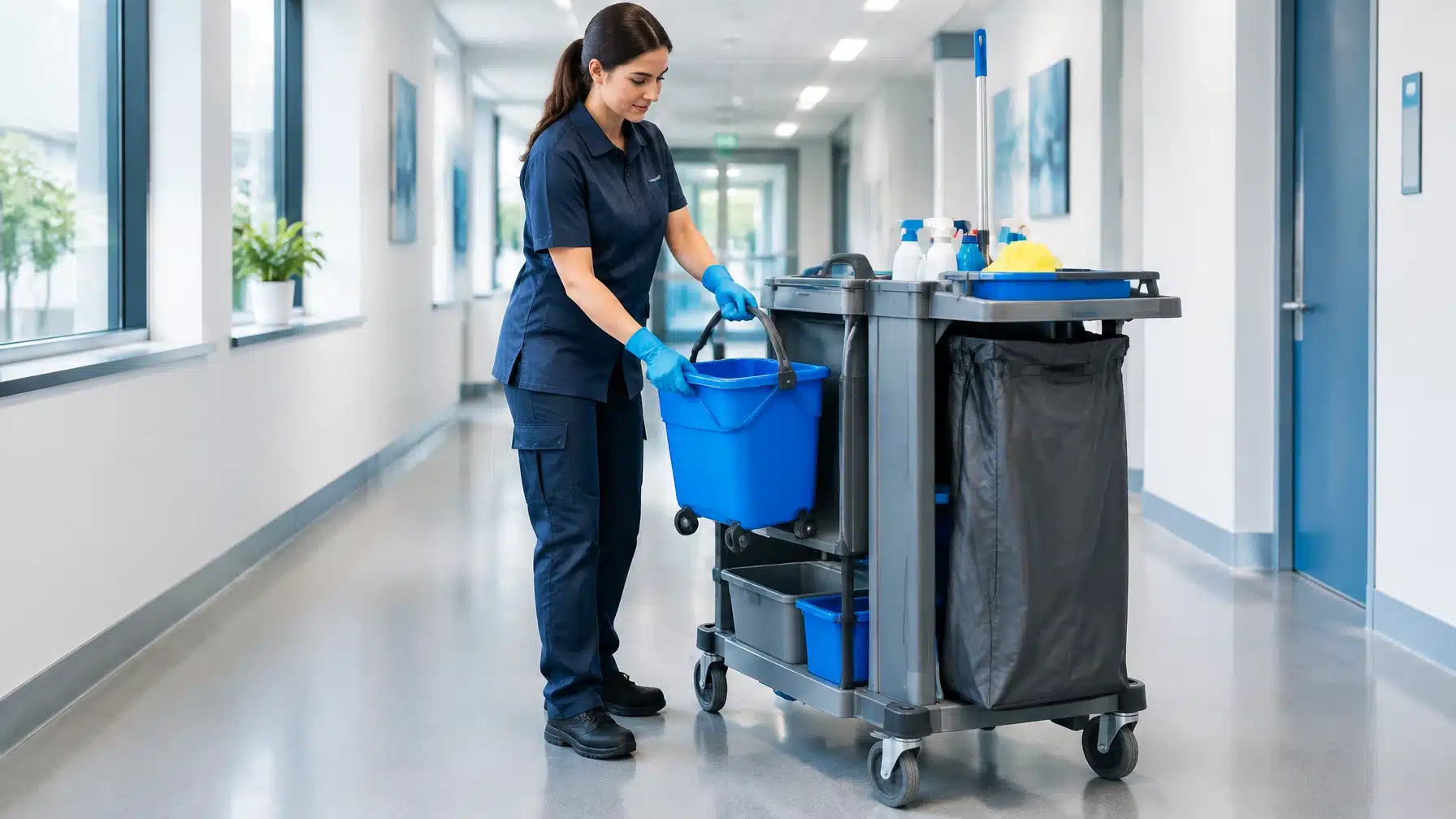
For cleaning teams, examples include carrying a bucket, moving a waste bag, loading or unloading supplies, or pushing a trolley. Pushing and pulling are manual handling operations too, even when the load has wheels. A handling aid can reduce effort, but it does not necessarily remove the manual handling: staff may still need to start, steer, stop or position it.
A cleaning machine used for its intended purpose is not treated as a load under the Regulations. However, handling the machine to move it between floors or storage locations can still create manual handling demands. The whole operation matters, not just whether the object is described as a machine or a load.
Consider changes in the load as well. A bucket becomes heavier as it is filled, and liquid can shift during movement. A wet or greasy surface may make an object harder to grip. The chemical risks of a toxic or corrosive substance are dealt with under COSHH, but a substance on the surface of a load can also matter if it makes that load slippery to handle.[1]
Avoidance often starts with asking why the load is being moved. Could supplies be delivered nearer to where they are used? Could storage be relocated to reduce repeated carrying? Could a task be changed so that a load does not need to be lifted, or so it is moved mechanically?
For cleaning operations, practical options may include:
Not every change will suit every building or task. The important point is to consider whether the handling can be designed out before settling for a control that simply asks the cleaner to be more careful.
A useful assessment describes the real job, not just a label such as “lifting” or “moving a bucket”. HSE’s Schedule 1 asks assessors to consider five areas.[1]
The task: Does it involve twisting, stooping, reaching upwards, holding a load away from the body, repeated effort, long carries or insufficient recovery? Is there a work rate imposed by a schedule or process? Holding a load at arm’s length can place about five times the stress on the body as holding the same load close to it.[1]
The load: Is it heavy, bulky, difficult to grip or unstable? Could its contents shift? Is it sharp, hot or otherwise liable to cause harm? Consider how full a bucket or waste bag is likely to be, rather than relying on its empty weight.
The working environment: Is there enough room to move and turn? Are floors uneven, slippery or unstable? Are there changes in floor level, temperature or humidity? Is lighting adequate? Check the actual route, including doorways, thresholds, slopes and access to lifts.
Individual capability: Does the task require unusual strength or height? Could it create a particular risk for someone who is pregnant or has a health problem? Is specific information or training needed? Consider the people likely to do the work, without making assumptions about capability.
Other factors: Could clothing or PPE restrict movement or reduce grip? Gloves, for example, can make it harder to hold equipment securely.
HSE offers simple risk filters and tools including the Manual Handling Assessment Charts, known as MAC, and the Risk Assessment of Pushing and Pulling tool, known as RAPP.[1] These can help identify and compare common lifting, carrying, team handling, pushing and pulling risks. Filters are a way to decide what needs closer attention. They are not legal weight limits or proof that a task is safe. Where relevant factors are not covered, add them to the assessment.
If you have five or more employees, the law requires you to record the significant findings of the assessment. A written record should explain the hazards, who might be harmed and what controls are in place. Review the assessment if there is reason to believe it is no longer valid, if the operation changes significantly, or after an accident or case of ill health.[1]
A risk assessment should lead to action. The controls need to match the task and the conditions in which it happens.
Use suitable handling aids. A trolley or wheeled bucket can reduce carrying, but check that it is suitable for the route and load. Wheels should move freely, handles should be at a usable height and the equipment should be stable. A trolley that is difficult to start, control or turn may introduce other risks.
Give useful information about loads. Regulation 4 requires employers to provide general indications of load weight and, where reasonably practicable, precise information about the weight and the heaviest side of a load when its centre of gravity is not central.[1] This is relevant where containers, equipment or deliveries vary.
Choose practical storage heights. HSE identifies around waist height as the preferred position for heavier loads. Below knuckle height or above shoulder height is better reserved for lighter items or items handled infrequently.[1] In a cleaning store, this is a reason to consider where bulk supplies are kept and how often they are moved.
Plan carrying and routes. As a rough guide, if a load is carried more than about 10 metres, demands on the heart and lungs and muscle fatigue become more limiting than lifting strength.[1] This is not a legal distance limit. It is a prompt to check whether the route, storage location or use of a trolley can be improved.
Check pushing and pulling effort. HSE’s L23 guidance gives guideline figures for push and pull force: about 200 newtons for men and 150 newtons for women to start or stop a load, and about 100 and 70 newtons respectively to keep it moving.[1] These are guidance figures for force, not maximum load weights or a substitute for assessment. The initial effort to get a load moving or change direction is usually higher than the force needed to keep it in motion. Slopes, poor wheels, uneven floors and wet surfaces can all increase the effort.
A wheeled aid is most helpful when its route is clear and the equipment is maintained. A loaded trolley pushed up a slope may require substantially more effort than the same trolley on level ground. Assess the conditions as they are, including how the equipment behaves at doorways, turns and thresholds.
Use team handling carefully. A two person lift is not automatically safer than one person lifting. The capability of the weakest person limits the team, and a team may safely handle less than the sum of individual capabilities. HSE gives about 85 per cent of the combined individual capabilities as an approximate guide.[1] One person should plan and take charge, with clear communication and roles. Teams of more than four are unlikely to work well unless carefully managed.
Make training part of a wider system. Training should help workers recognise risk factors, understand safe systems of work, use handling aids properly and practise relevant techniques. It should be specific to the actual tasks and equipment. HSE is clear that training alone will not ensure safe handling: the first aim is to design the operation to be as safe as reasonably practicable.[1] Plan training for new starters and identify when refresher training is needed. Keep records of who has been trained and when.
Allow for recovery. Repeated effort, long periods in a fixed posture and a work rate that cannot be adjusted can all add strain. Schedules should allow suitable rest and recovery. Job rotation may help when it gives one set of muscles a break, but rotating between tasks that use the same muscles in the same way may not reduce the risk.[1]
MSD symptoms can develop gradually or appear suddenly. HSE lists workplace indicators that include rising sickness absence or accident reports, reports of pain from cleaners, workers wearing splints or back supports, low motivation, and staff adapting their own equipment.[3] These signs are a reason to look again at the task and controls, not simply to treat the matter as an individual problem.
Employees must make full and proper use of the safe system of work provided for them. They should use equipment in line with instructions and training, report damaged equipment, and raise work practices that cause pain or discomfort.[1][3] Employers and supervisors need a clear, straightforward way for people to report symptoms and equipment problems early, and should take reports seriously.
For manual handling risks, early reporting and health monitoring are important ways to identify developing problems and check whether controls are working. The L23 guidance explains that statutory health surveillance is not generally the requirement for manual handling alone; it distinguishes this from health surveillance required for certain other exposures.[1]

Equipment selection is part of risk control. Before buying, consider whether the item is a suitable weight, has an appropriate handle height and can be moved by the range of people who will use it. Are controls easy to reach for left and right handed users? Is the grip comfortable? How much force is needed to operate triggers, controls or levers? Could vibration, flex management or the working environment affect safe use?[4]
Consult the cleaning workforce before making a choice. People using the equipment can identify difficulties that are not obvious from a catalogue or demonstration. In some workplaces, a range of sizes or designs may be needed to suit different users and tasks.
The equipment also needs to remain usable. HSE recommends planned maintenance for handling aids and PPE, including a way to report and correct defects. For wheeled equipment, maintenance should include the wheels. Make defective equipment easy to identify and remove from use until it is repaired or replaced.[1]
A short routine can help keep assessments connected to everyday work:
Manual handling compliance is most useful when it is part of the documented method for delivering a cleaning task, rather than a separate form that is rarely revisited. Our guide to building a documented cleaning method standard explains how method statements can connect the task, equipment, controls and evidence of delivery.
For teams reviewing the equipment and supplies used in those methods, our cleaning supplies shop stocks the wheeled buckets, trolleys and refill sized containers behind many of the controls above, with trade terms for professional and household requirements. The priority remains choosing items that suit the task, the users and the workplace.