Newsletter Subscribe
Subscribe for news, offers and a welcome 5% discount on us.
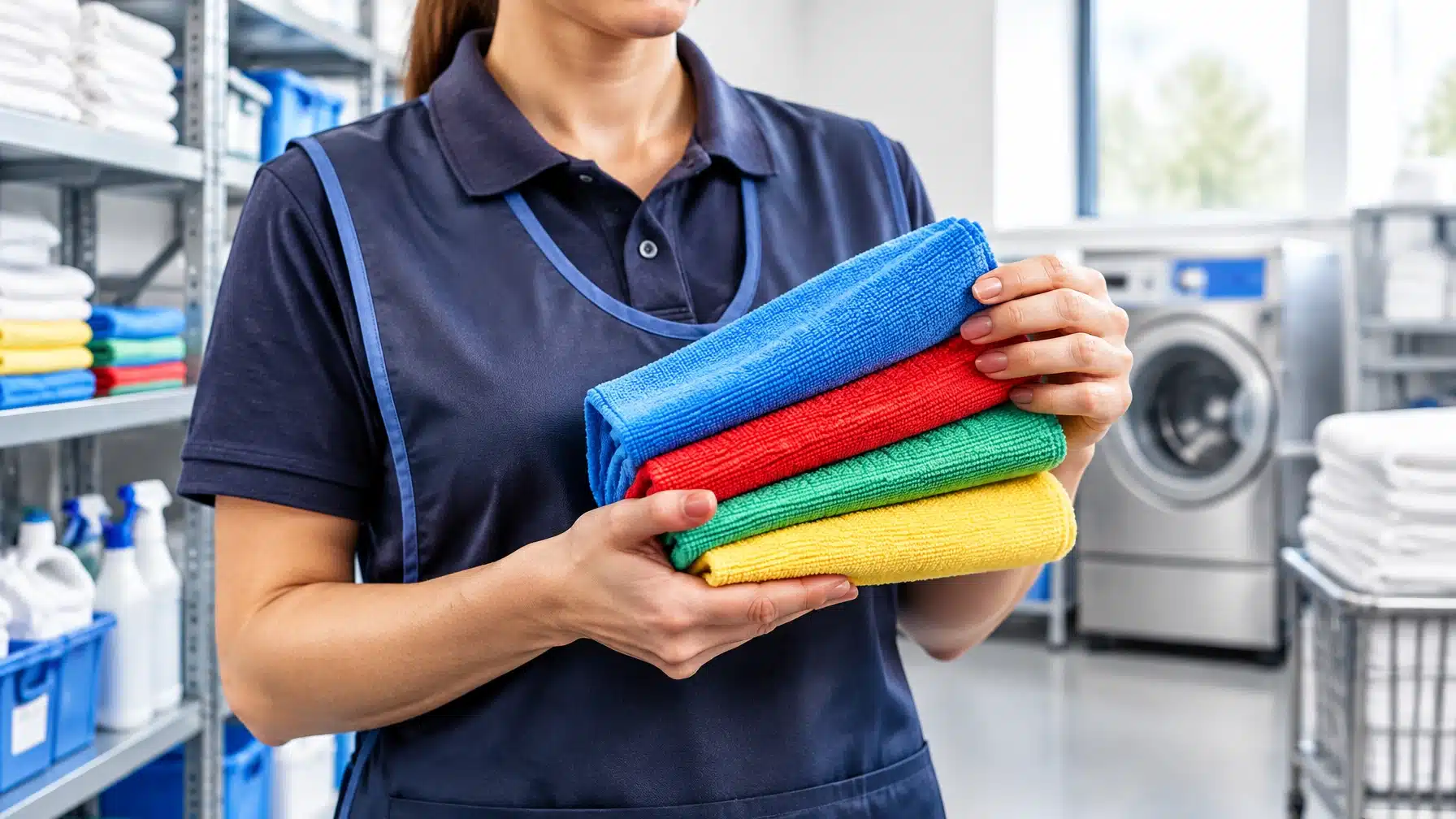
Microfibre has become standard equipment in professional cleaning because its fine synthetic fibres can trap dirt that ordinary cotton cloths may leave behind. But a cloth that cleans well when new will not necessarily perform the same way after months in use. Its results depend on how it is used, laundered and dried, and on whether it is taken out of service at the right time.
These points are easy to overlook in a busy operation. A cloth is often treated as a routine consumable, rather than as a tool with a defined service life. Yet that life is measured more usefully in wash cycles than in months. The right laundry process can help preserve performance; the wrong detergent, excess heat or an untracked cycle limit can steadily reduce it.
Microfibres are extremely fine synthetic fibres, typically made from polyester, polyamide, or a combination of both. The NHSScotland review describes them as less than one denier, roughly one hundredth the size of a human hair. A cloth made with these fibres brings far more fibre to the surface than cotton: the VSR guide to microfibre systems reports that one wipe puts ten times the number of fibres in contact with the surface compared with a traditional cotton cloth.
Many cleaning cloths use fibres that have been split into fine, angular filaments. The gaps between them create small channels. When the material is slightly damp, capillary action draws in moisture and the dirt it carries. The fine, wedge shaped filaments also help dislodge particles from surface irregularities. Together, these features give microfibre both absorbency and mechanical cleaning action.
In practical terms, damp microfibre can remove substantial amounts of dirt without leaving a surface as wet as some conventional methods. The VSR guide reports that damp mopping in cited research removed roughly two thirds of micro organisms and 90 per cent of dirt from floors. Leaving less water behind can also help reduce slip risk, although the right dampness depends on the cloth, floor and cleaning method.
The same fine structure that enables this performance is vulnerable to poor laundering. Heat can shrink or twist fibres. Detergent residues, fatty acid soap and fabric softener can coat or block the narrow channels. Chlorine and strong alkaline conditions may damage the material itself. Fabric softener is particularly unsuitable because its coating interferes with the capillary action that helps the cloth pick up soil.
There is no single wash setting that is right for every microfibre product. Suppliers generally recommend temperatures from 60 to 95 degrees Celsius, but the product label and the manufacturer’s instructions should determine the process. The wash temperature, time, detergent, machine and drying method all need to be considered together.
Where microfibre is used in healthcare, soiled items should be managed according to the site’s infection prevention procedures. JLA's commercial laundering guidance treats used microfibre as infected linen and recommends thermal disinfection as the means of decontamination. Separately, the Harrogate and District NHS Foundation Trust linen policy describes thermal disinfection for infected linen as maintaining the load at 65 degrees Celsius for at least 10 minutes, or 71 degrees Celsius for at least three minutes. Both approaches require additional mixing time so the heat reaches the whole load. For conventional domestic design machines at low load, the policy specifies four extra minutes.
The VSR guide also gives a time and temperature formula: t greater than 250 divided by T minus 55, where t is time in minutes and T is the actual temperature in degrees Celsius. On that basis, 60 degrees requires at least 50 minutes and 80 degrees requires 10 minutes. The actual load temperature matters, not simply the setting displayed by the machine. These figures are guidance, not a substitute for the product maker’s instructions or a validated process, particularly in healthcare.
A compatible laundry detergent is essential. The VSR guide advises against fatty acid soap, quaternary ammonium compounds, fabric softener, zeolite and bleach detergents. It also cautions against highly alkaline wash water. Use the detergent specified for the cloth and dose it according to the instructions. Too much detergent can leave residue on the fabric, so increasing the dose is not a reliable response to heavily soiled laundry.
Wash cloths and mops separately. Mops tend to carry heavier soil and may need a different laundry process. Avoid overloading the machine: laundry needs enough movement, water and rinsing to release the soil held in the fibres. Drying needs equal care. The VSR guide says the dryer must never exceed 95 degrees Celsius. Follow the cloth maker’s drying instructions, as excessive heat can deform synthetic fibres.

For regular commercial use, household washing machines are generally discouraged. The VSR guide notes that household machines may not maintain the required temperature throughout the cycle and that their drainage is not designed for substantial loads of heavily soiled cleaning textiles. NHSScotland recommends that reusable microfibre materials be processed in purpose built, validated machines, using heat and water in line with manufacturer guidance. A suitable machine and a correctly configured cycle are part of the cleaning system, not optional extras.
The expected number of washes varies by product and use. NHSScotland notes examples of manufacturer limits of around 100 washes for cloths used with bleach and 250 without bleach. These should be read as product specific examples, not universal service life promises. The manufacturer’s stated limit applies to the material and laundering method for which it was given.
Keeping count is harder than it sounds. A cloth in regular circulation can pass its limit without anyone noticing, especially when items are pooled, moved between teams or sent to an external laundry. NHSScotland specifically notes that tracking wash cycles can be difficult and recommends a monitored system for reuse. A reliable process therefore needs a way to identify cloths, record their cycles and remove them from service at the stated limit.
Research findings on washed performance do not point to one simple rule. In a University of Huddersfield report prepared for JLA, two brands were tested after 1, 150 and 350 washes in an Otex laundry system, with a further 250 cycles tested through conventional domestic laundering. The study found no significant performance loss across those cycle counts. It also suggested that some new cloths may need several wash cycles before reaching optimum performance.
A 2010 hospital study reached a different result. It found that microfibre cloths performed best when new, while cotton showed the best overall efficacy after 10 and 20 reprocessing cycles at 90 degrees Celsius. By contrast, a 2022 study found that reprocessed microfibre laundered to CDC laundry parameters achieved microbial removal substantially equivalent to new microfibre. The researchers compared 60 new and 60 reprocessed items and reported no statistically significant difference.
These findings are not a reason to disregard cycle limits. They show that outcomes depend on the cloth construction, laundry method and conditions tested. The practical lesson is to follow the manufacturer’s specific service life and laundering directions. Thermal over washing, chemical residues and overdrying can shorten useful life. A carefully controlled process can preserve it. Claims about how long a cloth lasts apply only when the material is used, washed and dried as directed.
The wash process is only one part of safe microfibre use. A used cloth can hold dirt and micro organisms, so staff need a clear routine for changing cloths between tasks and areas. NHSScotland recommends using new microfibre materials when moving between patient care areas and considering changes between separate areas within a patient environment.
In healthcare, a fresh cloth for each room is customary. A Danish study tested the 16 side folding method, in which successive sides of one folded cloth are used on multiple surfaces. It found that E. faecalis spread to 11 to 15 of 15 sterile surfaces. This is a reminder that folding a cloth to create more cleaning surfaces is not a substitute for a fresh cloth when the protocol requires one.
Colour coding is another basic control. The VSR guide describes a recognised colour coding system, such as the BICSc scheme, as an essential requirement for reducing the risk of using the same cloth across unsuitable areas. Staff should work from clean to dirty, use each cloth for the task and area specified, and place used materials directly into the designated laundry bag.

Do not rinse or wring cloths in a bucket during use. The system is designed for used cloths to go into a laundry bag, with a fresh one taken for the next task. Hand wringing can also place unnecessary strain on hands and wrists. Clean and dirty textiles should be kept separate in collection, processing, transport and storage.
Store clean cloths so that they cannot be contaminated by contact with used materials or dirty surfaces. In Dutch hospitals, damp storage is not permitted because micro organisms may multiply. The VSR guide also advises laundering cloths daily, including damp cloths that were not used. Follow local infection prevention requirements and the manufacturer’s advice on whether the product should be stored dry or damp.
A dependable microfibre system needs named responsibility for collection, washing, storage and distribution. When these tasks are nobody’s specific responsibility, used items can be mixed with clean stock, detergent choices can vary and cycle records can be missed. A clear owner for each stage makes problems easier to identify and resolve.
Cycle tracking can be simple if it is practical. Options include sewn in identification chips, rotating batches with dated stock, or a laundry service agreement that records cycles. The essential point is that records should be current and tied to the product’s own limit. If a cloth’s history is unknown and it may have reached its limit, staff cannot confidently confirm that it remains within the service life.
Stock levels also matter. A site needs enough cloths and mops to complete the work while allowing for laundry and scheduled replacement. If stock is too tight, staff may be tempted to use a cloth for longer than intended or delay removing worn items. Planned replacement is easier when clean spare stock is available.
Training helps the process work in practice. Staff should know what can and cannot go into the wash, how to separate cloths from mops, where used items belong and when to change cloths between areas. Managers should check the process, not only the appearance of the cleaned surface. Without instruction and monitoring, a well written procedure may not be followed consistently.
A short process checklist can support routine checks:
For a wider approach to documented cleaning methods and task controls, see KleanPro Supplies’ guide to building a documented cleaning method standard.
The cost of replacing cloths on schedule should be weighed against the cost of continuing to use exhausted ones. A worn or residue coated cloth may still look serviceable, while quietly delivering less than the cleaning specification expects. Planned replacement helps maintain consistency and makes spending easier to forecast.
Microfibre rewards operations that manage its whole service life. The cloth that cleans well is the one that has been washed correctly, kept within its cycle limit and changed between areas as the task requires. That principle applies to commercial sites and to homeowners who rely on commercial grade cleaning supplies.
For sites reviewing their equipment and stock, a cleaning supplies shop that provides professional cleaning products can be a useful source of cloths and mops with clear laundering guidance. The main priority, wherever supplies come from, is a routine that protects both the material and the cleaning standard it is meant to deliver.