

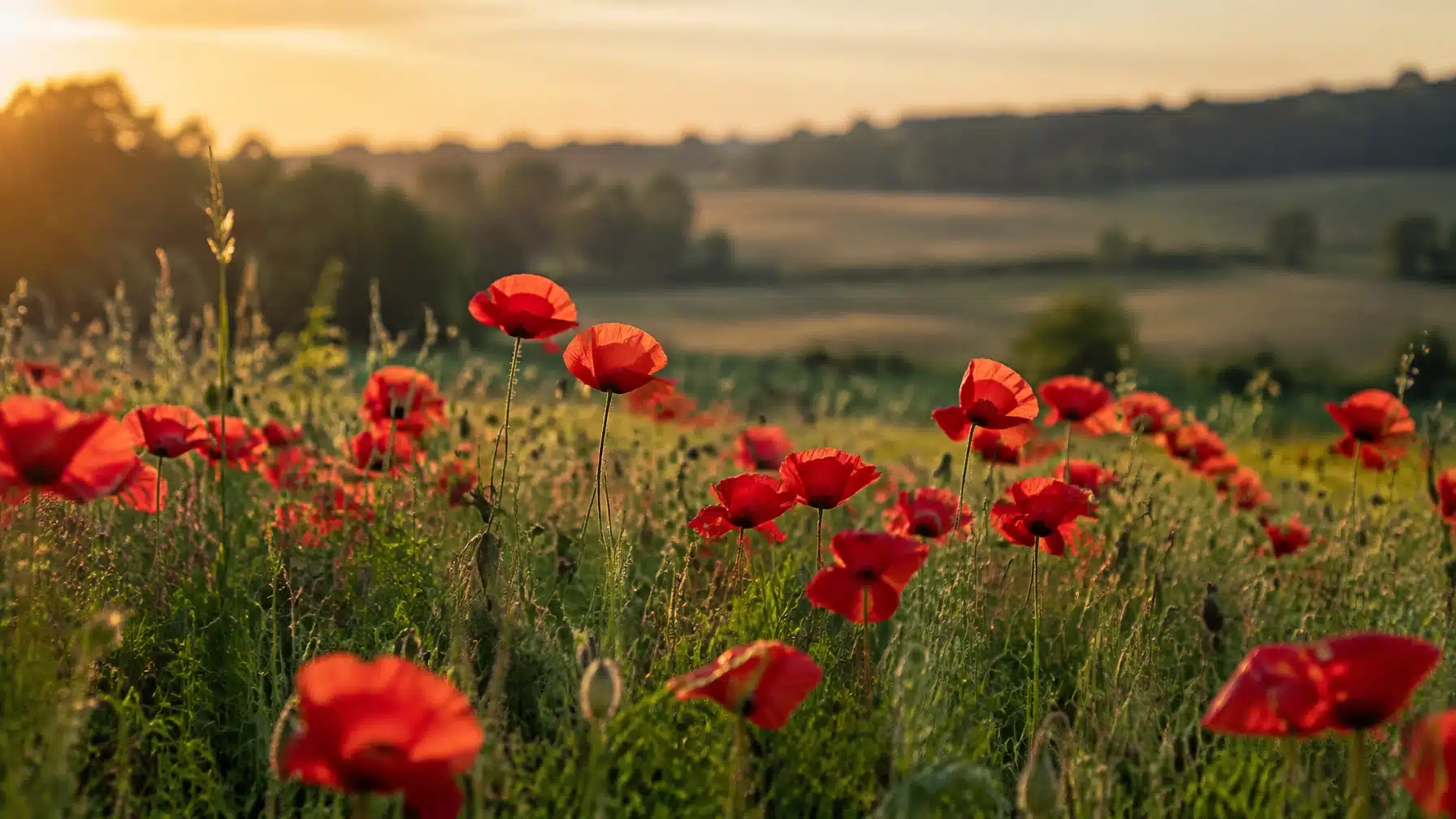

Each autumn, red poppies appear on coats, at memorials and in communities across the United Kingdom. For many people, wearing one is a quiet act of remembrance. It honours those who died in conflict and recognises the continuing service and contribution of the Armed Forces community.
The poppy is also connected to a national charitable appeal. Donations to the Royal British Legion’s Poppy Appeal help the organisation support serving personnel, veterans and their families. Its familiar red flower has a history shaped by a poem, the work of two women and the efforts of people who wanted remembrance to lead to practical help.
How a poem in Flanders inspired a symbol
The poppy became a symbol of remembrance after the First World War. Wild poppies grew across the battlefields of Flanders, where the destruction of war had disturbed the soil. Their bright flowers became associated with the landscapes in which so many people had fought and died.
In 1915, Canadian doctor and Lieutenant Colonel John McCrae wrote the poem In Flanders Fields. He had lost a friend at Ypres, and the poem reflected on loss, remembrance and the living’s responsibility to remember those who had fallen. Its words brought the image of the poppy to a wide audience and helped establish its association with those killed in war.
The poem did not, on its own, create the Poppy Appeal. Its influence was carried forward by people who saw in the poppy a way to remember the dead and to support those affected by war.
One of them was Moina Michael, an American academic. Inspired by McCrae’s poem, she campaigned for the poppy to be adopted as a symbol of remembrance by the American Legion Auxiliary. Her efforts helped give the flower a wider public meaning.
At the same time, French lecturer Anna Guerin was promoting the poppy as a remembrance symbol. By the end of 1920, she had organised Poppy Days in several American states. She also saw that the emblem could help raise funds for people affected by war.
There was no single creator of the Poppy Appeal as it is known today. McCrae’s poem gave the flower a powerful association with remembrance. Michael campaigned for its adoption in the United States, while Guerin helped bring the idea to the British Legion. Their contributions, together with the Legion’s decision to adopt the poppy, laid the foundation for the annual appeal.
The Royal British Legion’s account of the poppy and its history offers further detail on how the symbol became part of remembrance.

Anna Guerin, Earl Haig and the first appeal
In September 1921, Anna Guerin visited the newly founded British Legion. She asked whether the organisation would adopt the poppy as an emblem and use it to raise funds. The Legion agreed.
On 6 October 1921, Earl Haig, the Legion’s founder, announced that 11 November would be known as Remembrance Day and would also be a Poppy Day. The date connected the appeal with the anniversary of the Armistice that had ended the fighting of the First World War.
The first Poppy Appeal took place in 1921. Nine million silk poppies were ordered: one million from Anna Guerin in France and eight million commissioned from British manufacturers. The appeal raised more than £106,000, a substantial sum at the time. It established a lasting way for people to express remembrance while contributing to support for those affected by war.
In 1922, the Legion established its own Poppy Factory in London. Disabled war veterans were employed to make poppies, giving the appeal a practical connection to the people it aimed to support. The Poppy Factory continues today as a separate charity.
The early appeal helped establish traditions that continue, while the materials and ways of taking part have changed. The Royal British Legion remains responsible for the annual Poppy Appeal, and collectors and volunteers still help make it visible in towns, cities and neighbourhoods across the country.
What the poppy means in the UK today
For many people, the red poppy is first and foremost a sign of remembrance. It brings to mind those who lost their lives in the First World War and in later conflicts. It can also prompt reflection on the experiences of people who served, their families and the communities affected by conflict.
The meaning can be personal. Someone may wear a poppy in memory of a relative, to recognise the service of a friend or simply to take part in a shared act of remembrance. The Royal British Legion says there is no correct way to wear a poppy. Whether or not someone chooses to wear one is a matter of personal choice.
The red poppy is worn in support of Armed Forces communities across the United Kingdom, Allied Forces and the Commonwealth. The Legion also addresses a persistent rumour that poppies have been banned in some communities: it says this is not true. People can observe remembrance in different ways, and respectful differences in personal choice are part of that.
Remembrance is not the same as glorifying war. Wearing a poppy is not a celebration of conflict or a political statement. It is a way to remember the human cost of war and show support for people in the Armed Forces community. The symbol links reflection on the past with recognition of the needs that continue in the present.
That support can be needed at many stages of life. The Legion is there from the first day of service and throughout life, including during deployment, financial hardship, bereavement and later life care. Its work includes advice and practical assistance, as well as services such as the Battle Back Centre for wounded, injured and sick service personnel.
At any given time, the Legion supports nearly 8,000 members of the Armed Forces community. More than two million Armed Forces veterans live in the UK. These figures help explain why the Poppy Appeal remains significant beyond the period of remembrance: it helps fund support for people with varied needs throughout the year.
The scale of public participation is also considerable. In 2025, the Poppy Appeal raised £56.6 million. The Legion distributed 32 million poppies and 135,000 wreaths. Around 60,000 Poppy Appeal collectors and volunteers give their time each year. Their contribution helps make the appeal a familiar part of local life and gives people an opportunity to take part in their own communities.
In 2026, the appeal highlights Armed Forces families, with the theme: when someone serves, their family serves too. Service can affect partners, children and other relatives through separation, changes in routine and the demands of military life. The theme recognises that families share in those experiences, even when their service is less visible.
Dame Joanna Lumley is supporting the 2026 appeal. Its aim is to raise more than £50 million to help the Royal British Legion continue its work with the Armed Forces community.
The appeal has also changed in response to environmental concerns. In 2023, the Legion introduced plastic free poppies that can be recycled in ordinary paper recycling collections. This change allows people to observe the tradition while disposing of the poppy through a familiar household recycling route.
For workplaces and community groups, remembrance tends to take a quieter form. A two minute silence at eleven o clock on Armistice Day, a collection tin on a reception desk, a poppy on a staff noticeboard or a short mention in a team briefing are all common ways of marking the period. The Legion also offers free fundraising packs for anyone who wants to organise a collection or an event, and volunteer roles for those who would like to help distribute poppies in their area. Taking part does not require a formal event. For many organisations, simply making it easy for people to give and to pause is enough.
The symbol has also been debated over the years, and some people choose not to wear a poppy for reasons of personal conviction. That choice sits alongside the freedom of others to wear one, and the Legion is clear that observation of remembrance is a matter of personal choice rather than obligation. What the appeal asks for is not uniformity but consideration: a moment to reflect on service and sacrifice, and where people are able and willing, a contribution towards the practical support that follows.

Poppy Appeal dates and ways to take part in 2026
The Royal British Legion’s 2026 Poppy Appeal launched nationally on 22 October. Poppies are available from supermarkets including Sainsbury’s, Tesco, Morrisons and Asda, as well as high street shops and train stations. They can also be found through the official Poppy Shop.
Several dates bring people together for remembrance and fundraising:
- 22 October: National launch of the Poppy Appeal.
- 29 October: London Poppy Day.
- 7 November: Festival of Remembrance at the Royal Albert Hall.
- 8 November: March Past the Cenotaph on Whitehall, on Remembrance Sunday.
- 11 November: Armistice Day and the Two Minute Silence.
People can support the appeal by wearing a poppy, making a donation, volunteering or taking part in an event. There is no set donation amount for a poppy. The public is asked to give what they can, and every contribution is welcomed.
Only donations from the sale of red poppies go directly to helping the Armed Forces community. If you would like to learn more about the campaign, visit the Legion’s official Poppy Appeal page.
Make a donation to the Poppy Appeal
Donations can be made online through the Royal British Legion’s official donation page. You can also give cash or make a contactless donation to a collector, donate through the Poppy Shop, or call 0345 845 1945, Monday to Friday from 9am to 5pm.
There is no fixed amount to give for a poppy. Please give what you can.